Trigonometry
🎯What you need to be able to do
- Use \( \sec\theta \), \( \csc\theta \) and \( \cot\theta \), and sketch their graphs.
- Use the identities \( 1 + \tan^{2}\theta = \sec^{2}\theta \) and \( 1 + \cot^{2}\theta = \csc^{2}\theta \).
- Use the compound angle formulae for sine, cosine and tangent.
- Use the double angle formulae, including all three forms of \( \cos 2\theta \).
- Express \( a\sin\theta + b\cos\theta \) in the form \( R\sin(\theta \pm \alpha) \) or \( R\cos(\theta \pm \alpha) \).
- Use that form to solve equations and to find maximum and minimum values.
- Prove identities involving any of the above.
📚The mathematics
The reciprocal functions
Note the mismatch that catches everyone: secant pairs with cosine, not sine. The third letter of each name is the giveaway — secant with cosine, cosecant with sine.
Each is undefined wherever its partner is zero, so \( \sec\theta \) has vertical asymptotes at \( 90^{\circ}, 270^{\circ}, \dots \) and never takes a value between \( -1 \) and 1.
The Pythagorean identities
The second and third are not separate facts to memorise: divide the first by \( \cos^{2}\theta \) to get the second, and by \( \sin^{2}\theta \) to get the third. Deriving them once means never mixing them up.
Compound angle formulae
These are given in the list of formulae, so the marks are for using them, not recalling them. Watch the signs: in the cosine and tangent formulae the sign on the right flips relative to the left. The sine formula keeps the same sign, which is why it feels easier and why the cosine one is misquoted more often.
Double angle formulae
Set \( B = A \) in the compound formulae and all of these fall out, including the three forms of \( \cos 2\theta \) once you substitute the Pythagorean identity.
Three versions of \( \cos 2\theta \) exist so you can pick the one that leaves only the function you already have. If an equation contains \( \cos 2\theta \) and \( \sin\theta \), use \( 1 - 2\sin^{2}\theta \) and everything becomes a quadratic in \( \sin\theta \). Choosing the right form is most of the skill.
Rearranged, the last two also give the power-reduction forms that make \( \cos^{2}\theta \) and \( \sin^{2}\theta \) integrable in P2/3 5:
The \( R \) form
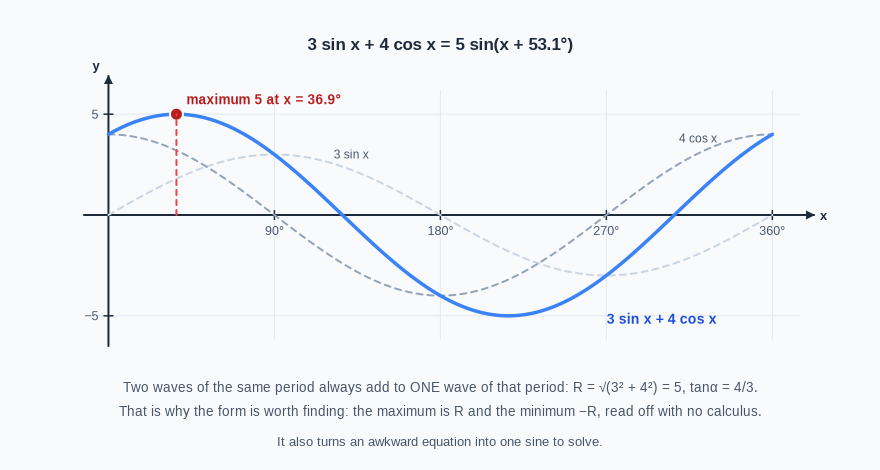
Any expression \( a\sin\theta + b\cos\theta \) can be written as a single trigonometric function:
The method is always the same: expand the target form with the compound angle formula, compare coefficients of \( \sin\theta \) and \( \cos\theta \), then get \(R\) by squaring and adding and \( \alpha \) by dividing. Take \(R\) positive and \( \alpha \) acute unless told otherwise.
Why bother? Because the single-function form makes two things immediate:
- Solving equations. \( 3\sin\theta + 4\cos\theta = 2 \) is intractable as it stands; as \( 5\sin(\theta + \alpha) = 2 \) it is routine.
- Maxima and minima. Since \( \sin \) ranges over \( [-1, 1] \), the maximum of \( R\sin(\theta+\alpha) \) is \(R\) and the minimum is \( -R \) — and you can say where they occur by setting the bracket to \( 90^{\circ} \) or \( 270^{\circ} \). No calculus required, which is the point.
✏️Worked example
(a) Expand the required form: \( R\sin(\theta - \alpha) = R\sin\theta\cos\alpha - R\cos\theta\sin\alpha \). Comparing coefficients:
Squaring and adding: \( R^{2} = 49 + 576 = 625 \), so \( R = 25 \). Dividing: \( \tan\alpha = \dfrac{24}{7} \), so \( \alpha = 73.74^{\circ} \). Hence
(b) The equation becomes \( 25\sin(\theta - 73.74^{\circ}) = 15 \), so \( \sin(\theta - 73.74^{\circ}) = 0.6 \).
Let \( u = \theta - 73.74^{\circ} \) and shift the interval: as \( \theta \) runs from \( 0^{\circ} \) to \( 360^{\circ} \), \(u\) runs from \( -73.74^{\circ} \) to \( 286.26^{\circ} \).
From \( \sin u = 0.6 \), the principal value is \( u = 36.87^{\circ} \), and the second-quadrant solution is \( 180^{\circ} - 36.87^{\circ} = 143.13^{\circ} \). Both lie in the interval. Adding \( 360^{\circ} \) to either takes us outside it.
Converting back, \( \theta = u + 73.74^{\circ} \):
(c) The maximum of \( 25\sin(\theta - 73.74^{\circ}) \) is 25, so the greatest value of the whole expression is \( 25 + 30 = 55 \). It occurs when the bracket equals \( 90^{\circ} \), that is \( \theta - 73.74^{\circ} = 90^{\circ} \), giving \( \theta = 163.7^{\circ} \).
📝Practise
Work through these, then reveal the answer. Each question targets a different objective from the list above.
1. Solve \( 3\sec^{2}\theta - 5\tan\theta - 4 = 0 \) for \( 0^{\circ} \le \theta \le 180^{\circ} \).
2. Prove that \( \dfrac{\sin 2\theta}{1 + \cos 2\theta} \equiv \tan\theta \).
3. Solve \( \cos 2\theta + 3\sin\theta = 2 \) for \( 0^{\circ} \le \theta \le 360^{\circ} \).
4. Express \( 5\cos\theta + 12\sin\theta \) in the form \( R\cos(\theta - \alpha) \) with \( R > 0 \) and \( \alpha \) acute.
5. Given \( \sin A = \tfrac{3}{5} \) with \(A\) acute, and \( \cos B = \tfrac{5}{13} \) with \(B\) acute, find \( \sin(A + B) \) exactly.
6. Find the maximum and minimum values of \( \dfrac{10}{4 + 3\sin\theta + 4\cos\theta} \).
🗺️Concept map: the topic on one page
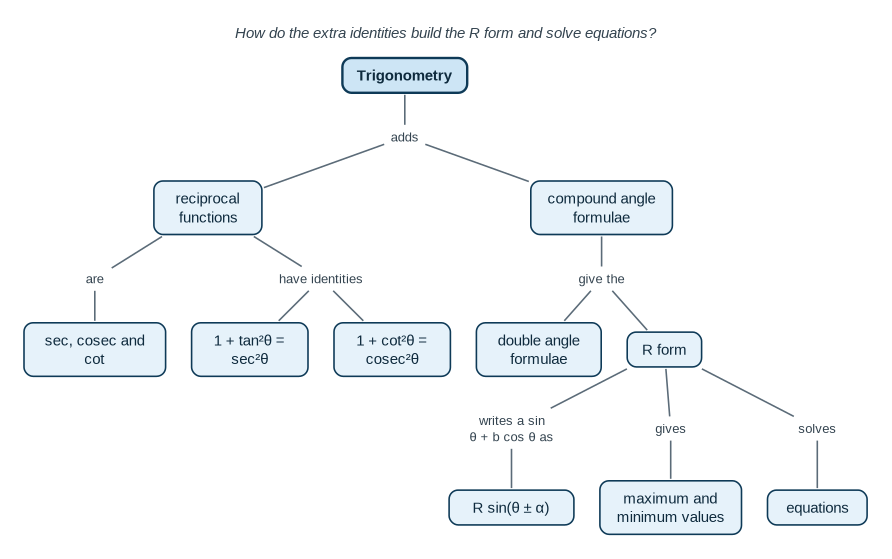
Read every link as a sentence, from the top down: compound angle formulae — give the — double angle formulae. To revise, cover the map, redraw it from memory and then check it against this one.
🔗Go deeper — other people’s work
These are external resources, not mine. If one stops working, tell me and everything above it on this page still stands.
- Desmos — plot \( a\sin\theta + b\cos\theta \) and \( R\sin(\theta+\alpha) \) together and watch them coincide
- GeoGebra — the unit circle, for the compound angle geometry
- Khan Academy — trigonometric identities and the double angle formulae
📝Exam-style questions
5 questions on this topic in the style of Paper 2 and Paper 3, each written by our teaching team to test the same skill as a question on the May/June 2026 papers, with a full mark scheme.
They are for members — sign in or join.
🃏Flash cards
9 flash cards on this topic (1 definition, 5 equations, 1 explanation, 1 exam trap and 1 method card), written from these notes. Spaced repetition brings back the cards you find hard until you know them.
They are for members — become a member or sign in.