States of matter and kinetic theory
🎯What you need to be able to do
- Describe solids, liquids and gases in terms of particle arrangement, movement and energy.
- Name and explain all the changes of state, and interpret heating and cooling curves.
- Use melting and boiling points to predict the state of a substance at a given temperature.
- Explain diffusion and how the mass of particles affects its rate.
- Describe how temperature and pressure affect the volume of a gas.
⚫The kinetic particle theory
All matter is made of tiny particles — atoms, molecules or ions — that are always moving. The state of a substance depends on how strongly its particles attract each other compared with how much kinetic energy they have.
| Solid | Liquid | Gas | |
|---|---|---|---|
| Arrangement | regular lattice, touching | irregular, touching | random, far apart |
| Movement | vibrate about fixed positions | slide past each other | move fast in straight lines until they collide |
| Energy of particles | lowest | higher | highest |
| Attractions between particles | strong | weaker | very weak |
| Properties | fixed shape and volume | fixed volume, flows | fills its container, compressible |
🔄Changes of state
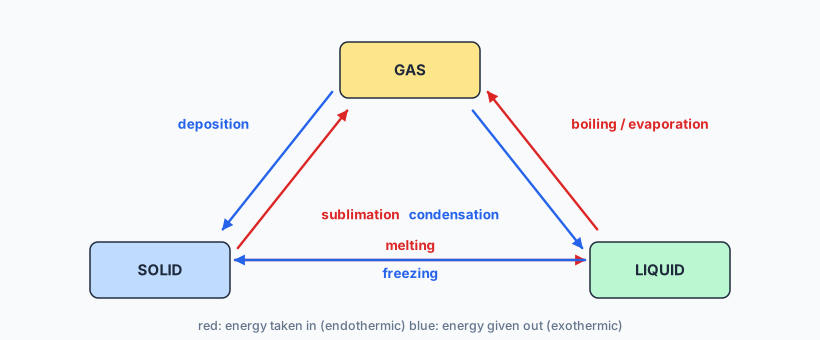
These are physical changes: no new substance forms, and they can be reversed. When a solid is heated its particles vibrate more until, at the melting point, they have enough energy to overcome some of the attractions and slide past each other. At the boiling point they have enough energy to escape the liquid completely. Evaporation is different: it happens below the boiling point, only at the surface, when the most energetic particles escape.
Heating and cooling curves
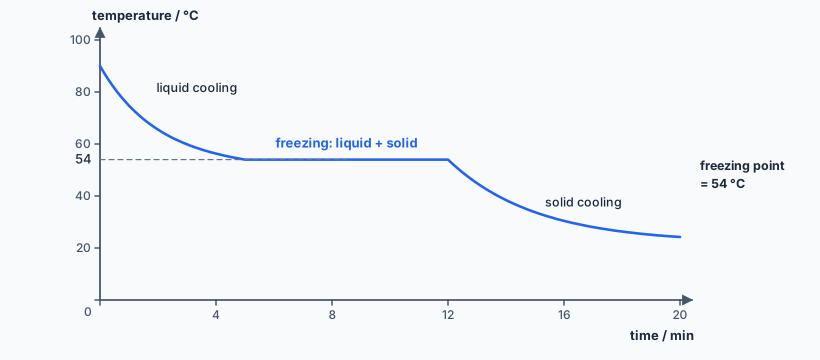
If a solid is heated steadily and its temperature recorded, the graph has flat sections at the melting and boiling points. While the substance changes state, the energy supplied goes into overcoming attractions between particles, not into increasing their kinetic energy, so the temperature does not rise. A cooling curve is the mirror image, with flat sections at the boiling (condensation) and melting (freezing) points.
✏️Worked example: predicting states
| Substance | Melting point / °C | Boiling point / °C |
|---|---|---|
| ethanol | −114 | 78 |
| bromine | −7 | 59 |
| phenol | 41 | 182 |
| propane | −188 | −42 |
Rule: below the melting point it is a solid; between the melting and boiling points a liquid; above the boiling point a gas.
- ethanol: −114 < 25 < 78, so liquid;
- bromine: −7 < 25 < 59, so liquid;
- phenol: 25 is below its melting point (41), so solid;
- propane: 25 is above its boiling point (−42), so gas.
Widest liquid range: ethanol, 78 − (−114) = 192 °C (phenol: 141, bromine: 66, propane: 146).
💨Diffusion
Diffusion is the net movement of particles from a region of higher concentration to a region of lower concentration, caused by their random motion. It is how the smell of cooking fills a house and how purple potassium manganate(VII) spreads through still water. Diffusion is fastest in gases, slower in liquids, and extremely slow in solids.
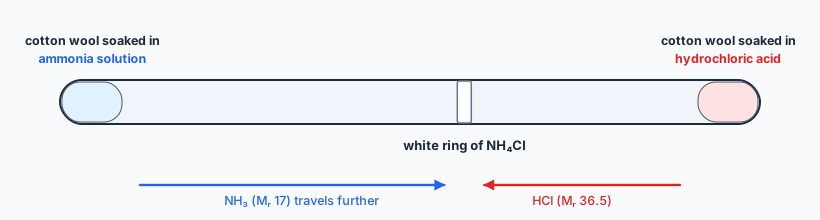
Lighter particles move faster at the same temperature, so they diffuse faster. In a classic demonstration, cotton wool soaked in ammonia solution is placed at one end of a glass tube and cotton wool soaked in hydrochloric acid at the other. A white ring of ammonium chloride forms where the gases meet — nearer the acid end, because ammonia molecules (\( M_r = 17 \)) are lighter and travel faster than hydrogen chloride molecules (\( M_r = 36.5 \)). Higher temperatures also speed up diffusion.
🎈Gases, temperature and pressure
Gas particles exert pressure by colliding with the walls of their container. For a fixed mass of gas:
- raising the temperature at constant pressure makes the gas expand: the particles move faster and push the walls outwards — a balloon in the sun gets bigger;
- raising the temperature in a fixed volume raises the pressure: more frequent, harder collisions — why aerosol cans warn you not to heat them;
- increasing the pressure at constant temperature reduces the volume: the particles are pushed closer together.
🌎Science in context: LPG in the kitchen
Many Indonesian households cook with LPG (liquefied petroleum gas, mostly propane and butane) from the familiar green 3 kg cylinders. Compressing the gas turns it into a liquid, so far more fuel fits in a small cylinder. The same particle ideas explain the safety rules: keep cylinders out of the sun (heat raises the pressure), and check for leaks, because LPG is denser than air and collects near the floor.
🧠Quick check
1. Name the change of state when a gas turns directly into a solid.
Deposition (the reverse of sublimation). Frost forming on a very cold surface is an example.
2. Why does the temperature stay constant while a solid melts?
The energy supplied is used to overcome attractions between particles, not to increase their kinetic energy.
3. A substance melts at −39 °C and boils at 357 °C. What is its state at 100 °C?
Liquid, because 100 °C is between its melting and boiling points. (This is mercury.)
4. Why is diffusion faster in gases than in liquids?
Gas particles move much faster and have large spaces between them, so they travel further before colliding.
5. Which diffuses faster at the same temperature: CO2 (Mr = 44) or CH4 (Mr = 16)? Why?
Methane, because its molecules are lighter and so move faster at the same temperature.
6. Explain, using particles, why a sealed plastic bottle of air collapses when it is put in a freezer.
The air particles slow down, so they hit the walls less often and with less force; the pressure inside falls below the pressure outside, which pushes the walls in.
📝Worksheet
Test yourself on the whole topic with a printable worksheet: questions for all four criteria, from recall to a design task, a data-analysis question and a short reflection, with a full mark scheme.