Reactivity, redox and metals
🎯What you need to be able to do
- Place metals in the reactivity series using their reactions with water, acid and oxygen.
- Predict and write equations for displacement reactions.
- Define oxidation and reduction in terms of oxygen and of electrons, and identify redox reactions.
- Explain how the method of extracting a metal depends on its reactivity.
- Explain rusting and how it is prevented, including sacrificial protection.
- Describe simple electrochemical cells and electrolysis.
📊The reactivity series
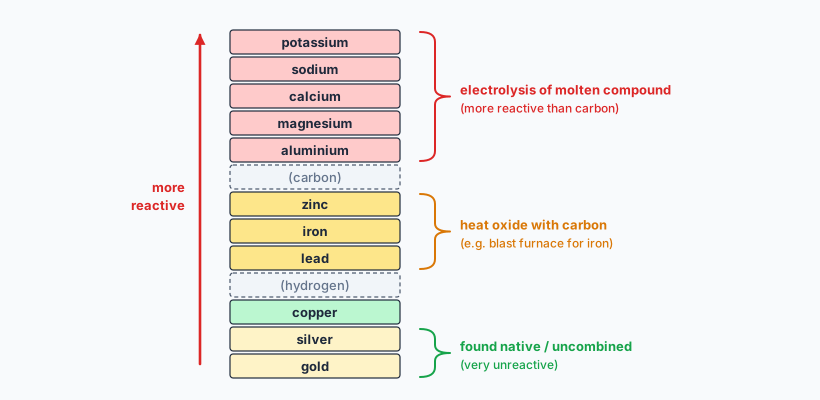
Metals are ranked by how easily they lose electrons to form positive ions. Potassium, sodium and calcium react with cold water; magnesium reacts slowly with water but quickly with steam; zinc and iron react with dilute acids; copper, silver and gold do not react with dilute acids at all. Carbon and hydrogen are included as reference points, even though they are non-metals.
🔄Displacement
A more reactive metal displaces a less reactive metal from a solution of its compound. Put an iron nail in blue copper(II) sulfate solution and it becomes coated in pink-brown copper while the solution fades to pale green:
Copper in iron(II) sulfate solution does nothing, because copper is less reactive. The thermite reaction, used to weld railway lines, is aluminium displacing iron from iron(III) oxide so violently that the iron is produced molten.
⚡Oxidation and reduction
- Oxidation is gain of oxygen, or loss of electrons.
- Reduction is loss of oxygen, or gain of electrons.
Memory aid: OIL RIG — Oxidation Is Loss, Reduction Is Gain (of electrons). The two always happen together, so these are redox reactions. In the displacement above, iron atoms lose electrons (Fe → Fe2+ + 2e−, oxidized) and copper ions gain them (Cu2+ + 2e− → Cu, reduced). The substance that causes reduction (iron) is the reducing agent; the one that causes oxidation (Cu2+) is the oxidizing agent.
⛏️Extracting metals
Most metals are found in ores as oxides, sulfides or carbonates. Extracting them is a reduction.
- Below carbon (zinc, iron, tin, lead): heat the oxide with carbon (coke), which takes the oxygen. In the blast furnace, carbon monoxide reduces iron ore: Fe2O3 + 3CO → 2Fe + 3CO2. Limestone removes sandy impurities as slag.
- Above carbon (aluminium, magnesium, sodium): carbon cannot remove the oxygen, so electrolysis of the molten compound is used. It needs huge amounts of electricity, which is why aluminium was once so expensive and is so worth recycling.
- Very unreactive metals (gold, platinum) occur native, as the element.
✏️Worked example: predicting and explaining a displacement
Mg in ZnSO4: magnesium is above zinc, so it displaces it. Grey zinc forms on the ribbon. \( \text{Mg} + \text{ZnSO}_4 \rightarrow \text{MgSO}_4 + \text{Zn} \).
Zn in MgSO4: zinc is below magnesium, so no reaction.
Oxidized: magnesium, Mg → Mg2+ + 2e− (loses electrons). Zn2+ is reduced.
🧱Corrosion and rusting
Rusting is the oxidation of iron; it needs both water and oxygen, and salt speeds it up (a big problem for cars and ships near the sea). Rust (hydrated iron(III) oxide) is flaky, so it falls off and exposes fresh iron.
- Barrier methods keep out water and air: paint, oil or grease, plastic coating, electroplating with tin or chromium.
- Sacrificial protection: attach a more reactive metal such as zinc or magnesium. It is oxidized instead of the iron. Galvanizing (coating with zinc) protects even when scratched. Ships’ hulls carry zinc blocks.
Aluminium does not corrode badly despite being reactive, because a thin, tough layer of aluminium oxide seals its surface.
🔋Cells and electrolysis
An electrochemical (voltaic) cell turns a redox reaction into electricity. Two different metals in an electrolyte are connected by a wire: the more reactive metal gives up electrons, which flow through the wire to the less reactive metal. The bigger the difference in reactivity, the bigger the voltage. A lemon with a zinc nail and a copper coin makes a (weak) cell.
Electrolysis does the reverse: electricity drives a reaction that would not happen by itself. The compound must be molten or dissolved so its ions can move. Positive ions move to the cathode (negative electrode) and are reduced; negative ions move to the anode (positive) and are oxidized. Electrolysis extracts reactive metals, purifies copper and is used for electroplating — coating an object (the cathode) with a thin layer of metal.
🌎Science in context: nickel mining and batteries
Indonesia is now the world’s largest producer of nickel, a key ingredient in electric-vehicle batteries. Processing the ore in Sulawesi and Maluku creates jobs and export income, but also raises concerns: coal-powered smelters, deforestation, tailings and water pollution. Is a metal that helps cut emissions from cars “green” if producing it causes emissions and damage elsewhere? That is exactly the kind of question Criterion D asks you to weigh.
🧠Quick check
1. Will copper react with silver nitrate solution? Explain.
Yes. Copper is above silver in the reactivity series, so it displaces silver: Cu + 2AgNO3 → Cu(NO3)2 + 2Ag.
2. Define oxidation in terms of electrons.
Oxidation is the loss of electrons.
3. Why can iron be extracted using carbon but aluminium cannot?
Carbon is more reactive than iron, so it can take oxygen from iron oxide. Aluminium is more reactive than carbon, so carbon cannot reduce aluminium oxide; electrolysis is needed.
4. What two substances are needed for iron to rust?
Water and oxygen.
5. How does galvanizing protect iron even when the coating is scratched?
Zinc is more reactive than iron, so it is oxidized in preference — sacrificial protection.
6. In electrolysis, which electrode do positive metal ions go to, and what happens to them?
The cathode (negative electrode), where they gain electrons and are reduced to metal atoms.
📝Worksheet
Test yourself on the whole topic with a printable worksheet: questions for all four criteria, from recall to a design task, a data-analysis question and a short reflection, with a full mark scheme.
Worksheets are for members — sign in or join. The topic 1 worksheet is a free sample.