Pure substances, mixtures and separation
🎯What you need to be able to do
- Distinguish elements, compounds and mixtures, and pure from impure substances.
- Use melting and boiling points to test purity.
- Distinguish solutions, suspensions and colloids, and use the words solute, solvent and soluble.
- Choose and describe filtration, crystallization, simple and fractional distillation, and chromatography.
- Calculate and use Rf values.
🧩Elements, compounds and mixtures
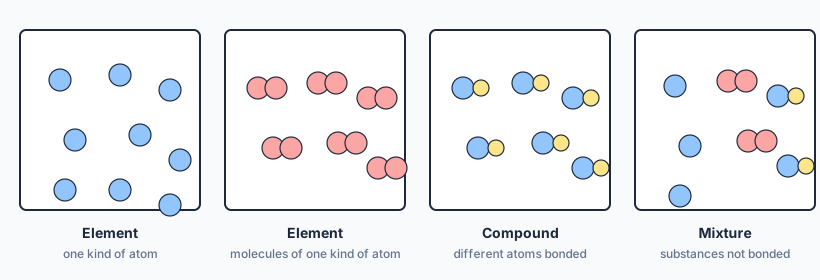
- Element — a substance made of only one type of atom (all with the same atomic number). It cannot be broken down into anything simpler by chemical means. Examples: iron, oxygen (O2), carbon.
- Compound — two or more elements chemically bonded in a fixed ratio. Its properties are different from those of its elements: sodium (a reactive metal) and chlorine (a toxic gas) form sodium chloride, table salt. A compound can only be separated into its elements by a chemical reaction.
- Mixture — two or more substances that are not chemically bonded. The proportions can vary, each component keeps its own properties, and they can be separated by physical methods.
🔍Pure or impure?
In chemistry a pure substance contains only one element or compound. (“Pure” orange juice is a mixture — natural, but not chemically pure.) A pure substance has a sharp melting point and boiling point; impurities lower the melting point, raise the boiling point, and make the substance melt or boil over a range. That is why salt is spread on icy roads: salty water freezes below 0 °C.
🥛Solutions, suspensions and colloids
A solution forms when a solute dissolves in a solvent. It is transparent (though it may be coloured), does not settle and cannot be filtered. A substance that dissolves is soluble; one that does not is insoluble. A saturated solution holds the maximum solute possible at that temperature; the amount is the solubility, often given in g per 100 g of water.
- Suspension — large, visible particles spread through a liquid that settle on standing and can be filtered (muddy water, chalk in water).
- Colloid — particles in between: too small to settle or filter, but large enough to scatter light, so it looks cloudy (milk, mayonnaise, fog, smoke). Shine a torch beam through and you see its path — the Tyndall effect.
⚗️Separation techniques
| Technique | Separates | How it works |
|---|---|---|
| Filtration | insoluble solid from a liquid (sand from water) | liquid (filtrate) passes through the paper; solid (residue) stays behind |
| Evaporation / crystallization | soluble solid from its solution (salt from sea water) | heat to evaporate some solvent until saturated, then cool slowly so crystals form; filter and dry |
| Simple distillation | solvent from a solution (pure water from salt water) | solvent boils, the vapour is cooled in a condenser and collected; the solute stays behind |
| Fractional distillation | miscible liquids with different boiling points (ethanol from water; crude oil) | a fractionating column is hottest at the bottom; each liquid condenses at a different height |
| Chromatography | dissolved substances such as dyes or food colourings | substances travel different distances up the paper depending on solubility in the solvent and attraction to the paper |
| Separating funnel / decanting | immiscible liquids (oil and water) | the denser liquid is run off from the bottom |
Paper chromatography and Rf values
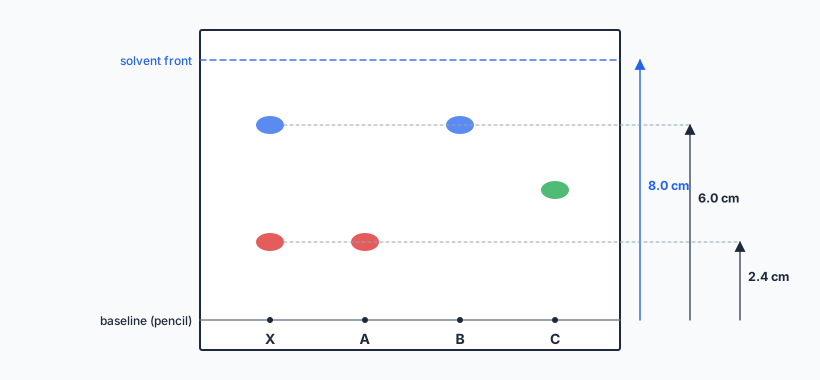
A pencil line (the baseline) is drawn near the bottom of the paper and spots of the samples are placed on it. The paper is dipped in a solvent, with the baseline above the solvent level so the spots do not simply dissolve away. The solvent (the mobile phase) rises through the paper (the stationary phase), carrying each substance a different distance. A pure substance gives one spot; a mixture gives several.
✏️Worked example: identifying food colourings
Lower spot: \( R_f = 2.4 \div 8.0 = 0.30 \). Upper spot: \( R_f = 6.0 \div 8.0 = 0.75 \).
Dye A: \( 2.4 \div 8.0 = 0.30 \); dye B: \( 6.0 \div 8.0 = 0.75 \); dye C: \( 4.0 \div 8.0 = 0.50 \).
Conclusion: X is a mixture of dyes A and B; it does not contain C.
🌎Science in context: clean drinking water
Water treatment combines several of these techniques: screens and filtration through sand beds remove suspended solids, and chlorine kills microbes. Where fresh water is scarce, desalination plants distil sea water or push it through membranes, but this uses a lot of energy. Some small islands in eastern Indonesia rely on rainwater collection or boats bringing water. A Criterion D task might ask you to compare methods on cost, energy and who can afford them.
🧠Quick check
1. Is air an element, a compound or a mixture? Explain.
A mixture: it contains nitrogen, oxygen, argon, carbon dioxide and others that are not chemically bonded to each other, and the proportions can vary.
2. A sample of water boils at 101.5 °C. What does this tell you?
It is impure: pure water boils at exactly 100 °C at normal pressure, and dissolved impurities raise the boiling point.
3. How would you obtain pure salt crystals from rock salt (salt mixed with sand)?
Dissolve in water, filter to remove the sand, evaporate the filtrate until saturated, leave to crystallize, then filter and dry the crystals.
4. How can you tell whether milk is a colloid or a solution?
Shine a beam of light through it: the beam is visible in a colloid (Tyndall effect) but not in a true solution. Milk is a colloid.
5. A spot moves 3.5 cm while the solvent front moves 7.0 cm. What is its Rf?
\( R_f = 3.5 \div 7.0 = 0.50 \).
6. Which technique separates ethanol (boiling point 78 °C) from water?
Fractional distillation: the liquids are miscible, with different boiling points.
📝Worksheet
Test yourself on the whole topic with a printable worksheet: questions for all four criteria, from recall to a design task, a data-analysis question and a short reflection, with a full mark scheme.
Worksheets are for members — sign in or join. The topic 1 worksheet is a free sample.