The atmosphere and air pollution
🎯What you need to be able to do
- State the composition of clean, dry air and describe how the atmosphere evolved.
- Describe tests for oxygen, carbon dioxide and hydrogen.
- Name the main air pollutants, their sources and their effects.
- Explain the greenhouse effect and the evidence for human-caused climate change.
- Explain how catalytic converters, flue-gas desulfurization and other methods reduce pollution.
🌬️What is air?
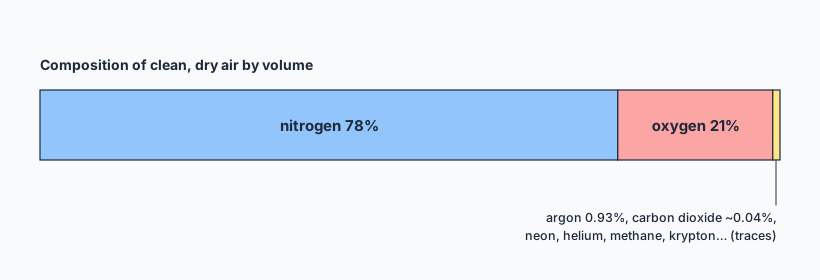
The early atmosphere, released by volcanoes, was mostly carbon dioxide and water vapour with little or no oxygen. As the Earth cooled the water vapour condensed into oceans, and much of the CO2 dissolved in them or was locked into carbonate rocks and fossil fuels. About 2.7 billion years ago, algae and later plants began photosynthesis, slowly adding oxygen. Today’s air is 78% nitrogen, 21% oxygen, about 0.9% argon and around 0.04% carbon dioxide.
| Gas | Test | Result |
|---|---|---|
| oxygen | glowing splint | relights |
| carbon dioxide | bubble through limewater | limewater turns milky |
| hydrogen | lighted splint | squeaky pop |
🏭Air pollutants
| Pollutant | Main source | Effect |
|---|---|---|
| carbon monoxide, CO | incomplete combustion of fuels | toxic: binds to haemoglobin so blood carries less oxygen |
| sulfur dioxide, SO2 | burning coal and oil containing sulfur; volcanoes | acid rain; breathing problems |
| oxides of nitrogen, NOx | high temperatures in engines make N2 and O2 react | acid rain; photochemical smog; asthma |
| particulates (PM2.5, soot) | diesel engines, burning forests and waste | lung and heart disease; haze; global dimming |
| unburned hydrocarbons | engines, fuel evaporation | smog with NOx in sunlight |
Acid rain forms when SO2 and NOx dissolve in rain to form sulfuric and nitric acids (natural rain is already slightly acidic, about pH 5.6, from dissolved CO2). It damages forests and aquatic life, and corrodes limestone buildings and metal structures.
🌡️The greenhouse effect and climate change
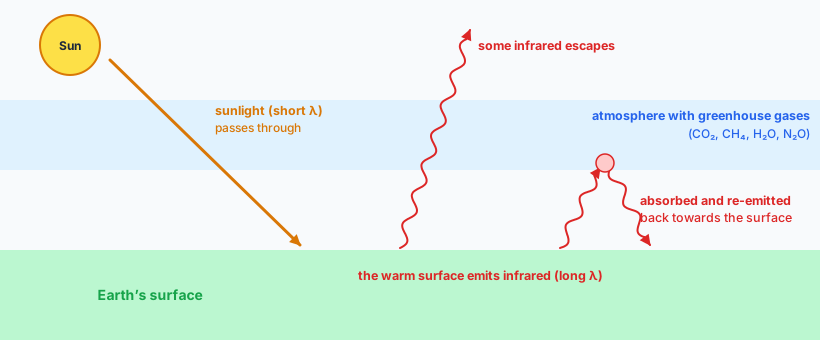
Sunlight passes through the atmosphere and warms the Earth. The warm surface emits infrared radiation. Greenhouse gases — water vapour, carbon dioxide, methane and nitrous oxide — absorb some of this infrared and re-emit it in all directions, including back down. This natural greenhouse effect keeps the average surface temperature around 15 °C instead of about −18 °C.
Burning fossil fuels, deforestation (especially burning peatland) and cement making have raised CO2 from about 280 ppm before the Industrial Revolution to over 420 ppm today; methane comes from livestock, rice paddies, landfill and gas leaks. The enhanced greenhouse effect is warming the planet: global average temperature has risen by more than 1 °C. Consequences include sea-level rise (a serious threat to low-lying coasts such as northern Jakarta), more extreme weather, coral bleaching and ocean acidification as CO2 dissolves in seawater.
✏️Worked example: reading the Keeling curve
Mean rate: \( (421 - 317) \div (2023 - 1960) = 104 \div 63 = 1.65 \) ppm per year.
Percentage increase: \( 104 \div 317 \times 100 = 33\% \).
Zigzag: in the northern-hemisphere summer, plants photosynthesize more and remove CO2; in winter, decay and reduced photosynthesis release it. Most land (and so most plants) is in the northern hemisphere.
🔧Reducing pollution
- Catalytic converters in car exhausts use platinum and rhodium catalysts to convert CO to CO2, NOx to N2, and unburned hydrocarbons to CO2 and H2O. (They do not reduce CO2.)
- Flue-gas desulfurization: power stations pass exhaust gases through powdered limestone or lime to remove SO2; low-sulfur fuels help too.
- Reducing CO2: renewable energy, efficiency, electric transport powered by clean electricity, protecting and restoring forests and peatland, carbon capture and storage.
🌎Science in context: haze
Forest and peatland fires in Sumatra and Kalimantan have produced haze that closed schools and airports across Southeast Asia and released as much CO2 in a few months as some countries emit in a year. The causes involve land clearing for plantations, drainage of peat, El Niño droughts and weak enforcement. A strong Criterion D answer considers the economic pressures on farmers alongside the health and climate costs.
🧠Quick check
1. What are the percentages of nitrogen and oxygen in dry air?
About 78% nitrogen and 21% oxygen.
2. How did oxygen come to be in the atmosphere?
Photosynthesis by algae and later plants released oxygen over billions of years.
3. Why is carbon monoxide so dangerous?
It binds to haemoglobin in red blood cells, so they carry less oxygen; it is colourless and odourless, so people do not notice it.
4. How does acid rain form?
Sulfur dioxide and nitrogen oxides from burning fuels dissolve in water droplets in clouds, forming sulfuric and nitric acids.
5. Explain how greenhouse gases keep the Earth warm.
They let incoming sunlight through but absorb some of the infrared radiated by the warm surface, re-emitting it in all directions, including back to the surface.
6. What does a catalytic converter do to nitrogen oxides and carbon monoxide?
It reduces NOx to nitrogen and oxidizes CO to carbon dioxide.
📝Worksheet
Test yourself on the whole topic with a printable worksheet: questions for all four criteria, from recall to a design task, a data-analysis question and a short reflection, with a full mark scheme.
Worksheets are for members — sign in or join. The topic 1 worksheet is a free sample.