The periodic table
🎯What you need to be able to do
- Describe how the periodic table is arranged into groups and periods, and how Mendeleev built it.
- Compare the properties of metals and non-metals and locate them in the table.
- Describe and explain trends in group 1 (alkali metals), group 7 (halogens) and group 0 (noble gases).
- Describe the typical properties of transition metals.
- Predict the properties of an unfamiliar element from its position.
🗺️Groups and periods
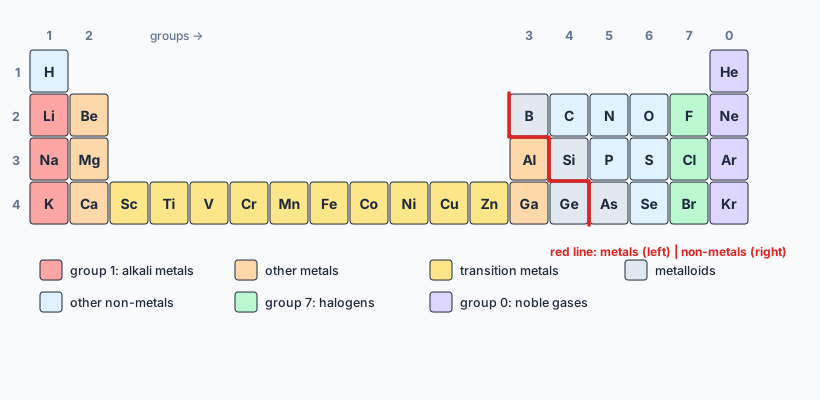
Elements are arranged in order of atomic number. Vertical columns are groups: elements in a group have the same number of outer electrons and similar chemical properties. Horizontal rows are periods: elements in a period have the same number of occupied electron shells.
In 1869 Dmitri Mendeleev arranged the known elements by atomic mass but grouped them by properties, and was bold enough to swap some elements and leave gaps. He predicted the properties of the missing elements — and when gallium and germanium were discovered, they matched. A model that makes successful predictions is powerful evidence that it is right.
🧰Metals and non-metals
| Metals | Non-metals |
|---|---|
| shiny; good conductors of heat and electricity | dull (as solids); poor conductors (except graphite) |
| malleable and ductile; mostly high melting points | brittle as solids; many are gases at room temperature |
| form positive ions by losing electrons | form negative ions by gaining electrons, or share electrons |
| oxides are basic | oxides are acidic |
🔥Group 1: the alkali metals
Lithium, sodium and potassium are soft metals that can be cut with a knife and are stored under oil because they react with air and water. With water they fizz, float and produce hydrogen and an alkaline hydroxide solution:
Reactivity increases down the group. Each atom has one outer electron, which it loses to form a 1+ ion. Further down, the atoms are larger, so the outer electron is further from the nucleus and more shielded by inner shells; it is lost more easily. Lithium fizzes steadily, sodium melts into a ball and whizzes around, potassium burns with a lilac flame.
🧪Group 7: the halogens
The halogens are toxic non-metals that exist as diatomic molecules: fluorine (pale yellow gas), chlorine (green gas), bromine (red-brown liquid), iodine (grey-black solid, purple vapour). Melting and boiling points increase down the group as the molecules get larger.
Reactivity decreases down the group. Each atom needs to gain one electron. Further down, the outer shell is further from the nucleus, so the attraction for an incoming electron is weaker. A more reactive halogen displaces a less reactive one from a solution of its salt:
The colourless solution turns orange as bromine forms. Iodine cannot displace chlorine: no reaction.
🎈Group 0: the noble gases
Helium, neon, argon, krypton and xenon have full outer shells, so they are very unreactive (inert) and exist as single atoms. Their boiling points increase down the group. Uses follow from inertness and low density: helium in balloons and airships, argon in light bulbs and for welding, neon in advertising signs.
⚙️Transition metals
The block in the middle of the table (iron, copper, nickel, chromium…) are typical metals but harder, denser and with higher melting points than group 1. They:
- form coloured compounds (copper(II) sulfate is blue, iron(III) compounds orange-brown);
- can form ions with different charges, such as Fe2+ and Fe3+;
- are often good catalysts (iron in making ammonia, nickel in making margarine).
✏️Worked example: predicting an unfamiliar element
(a) Like the other alkali metals it reacts with water to give hydrogen and an alkaline hydroxide — even more violently than potassium, probably igniting or exploding: \( 2\text{Rb} + 2\text{H}_2\text{O} \rightarrow 2\text{RbOH} + \text{H}_2 \).
(b) More reactive. Rubidium has one more electron shell than potassium, so its single outer electron is further from the nucleus and more shielded; it is lost more easily.
🌎Science in context: chlorine and clean water
Adding small amounts of chlorine to drinking water kills bacteria and has prevented millions of deaths from cholera and typhoid. But chlorine can react with organic matter to form by-products that may be harmful in large doses, and it is toxic as a gas. Should water always be chlorinated? Weighing a large, certain benefit against a small, uncertain risk is a classic Criterion D judgement.
🧠Quick check
1. What do elements in the same group have in common?
The same number of electrons in their outer shell, so similar chemical properties.
2. Why are the alkali metals stored under oil?
They react quickly with oxygen and water vapour in the air; the oil keeps air away.
3. What colour is universal indicator after sodium reacts with water, and why?
Purple (or blue): the sodium hydroxide formed makes the solution alkaline.
4. Will bromine react with potassium iodide solution? Explain.
Yes. Bromine is more reactive than iodine, so it displaces iodine: Br2 + 2KI → 2KBr + I2 (the solution turns brown).
5. Why are noble gases unreactive?
They have full outer electron shells, so they do not need to gain, lose or share electrons.
6. Give three properties of transition metals that group 1 metals do not have.
Any three: coloured compounds; ions with different charges; catalytic activity; much higher melting points and densities; harder.
📝Worksheet
Test yourself on the whole topic with a printable worksheet: questions for all four criteria, from recall to a design task, a data-analysis question and a short reflection, with a full mark scheme.
Worksheets are for members — sign in or join. The topic 1 worksheet is a free sample.