Energy changes in reactions
🎯What you need to be able to do
- Define exothermic and endothermic reactions and give examples of each.
- Measure temperature changes in reactions and calculate energy with \( Q = mc\Delta T \).
- Draw and interpret energy-level (reaction profile) diagrams, including activation energy.
- Explain energy changes in terms of bond breaking and bond making, and use bond energies.
- Compare fuels by the energy they release.
🔥Exothermic and endothermic
| Exothermic | Endothermic | |
|---|---|---|
| Energy | released to the surroundings | taken in from the surroundings |
| Temperature of surroundings | rises | falls |
| \( \Delta H \) | negative | positive |
| Examples | combustion, respiration, neutralization, most oxidation, hand warmers | thermal decomposition, photosynthesis, dissolving ammonium nitrate (cold packs), electrolysis |
The enthalpy change \( \Delta H \) is the energy transferred at constant pressure, usually given in kJ per mole of reaction. Changes of state follow the same rule: melting and boiling are endothermic; freezing and condensing are exothermic.
📈Reaction profiles
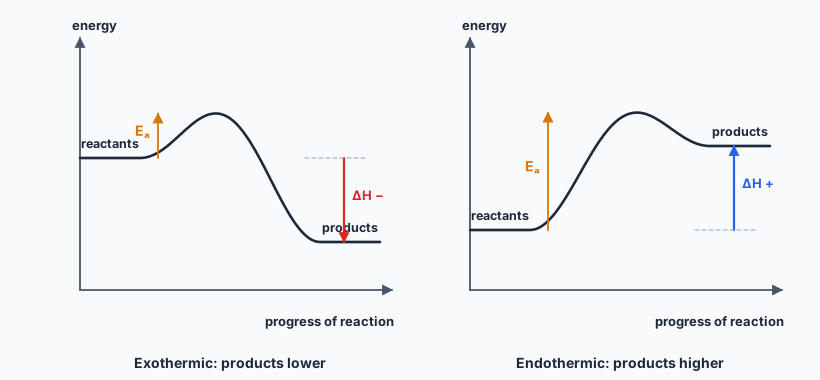
Particles must collide with at least a minimum energy, the activation energy \( E_a \), to react. That is why paper does not burst into flame by itself: a match supplies the activation energy, and after that the exothermic reaction releases enough energy to keep going. Catalysts lower \( E_a \) (Topic 11).
🔗Bond breaking and bond making
Breaking bonds takes in energy (endothermic); making bonds releases energy (exothermic). The overall energy change is the difference:
✏️Worked example: burning hydrogen
1. Bonds broken. 2 H–H + 1 O=O = 2(436) + 498 = 1370 kJ.
2. Bonds made. Each water molecule has 2 O–H bonds, so 4 O–H = 4(464) = 1856 kJ.
3. Overall. \( \Delta H = 1370 - 1856 = -486 \) kJ/mol. Negative, so exothermic.
🌡️Measuring energy changes
For reactions in solution, mix the reactants in an insulated polystyrene cup with a lid and record the highest (or lowest) temperature reached. For fuels, burn the fuel in a spirit burner under a copper can of water (calorimetry) and weigh the burner before and after. Energy transferred to the water:
Such simple calorimetry always gives lower values than data books, because heat is lost to the air and the can, and combustion is often incomplete (soot on the can).
🌎Science in context: choosing a fuel
A good fuel releases a lot of energy per gram, burns cleanly, is easy to store and transport, and is affordable. Hydrogen releases about three times as much energy per gram as petrol and produces only water — but storing it needs high pressure or very low temperatures, and most hydrogen today is made from natural gas. Weighing these trade-offs, and asking where each fuel comes from, is central to discussions about the energy transition.
🧠Quick check
1. A reaction makes the test tube feel cold. Is it exothermic or endothermic?
Endothermic: it is taking energy in from the surroundings (including your hand).
2. Is breaking bonds exothermic or endothermic?
Endothermic: energy must be supplied to break bonds.
3. What is activation energy?
The minimum energy that colliding particles must have to react.
4. 100 g of water is heated from 20.0 °C to 45.0 °C. How much energy did it absorb? (c = 4.18 J/(g °C))
\( Q = 100 \times 4.18 \times 25.0 = 10\,450 \) J = 10.45 kJ.
5. In a reaction, bonds broken total 2000 kJ and bonds made total 1600 kJ. Find ΔH and say whether it is exo- or endothermic.
\( \Delta H = 2000 - 1600 = +400 \) kJ: endothermic.
6. Give two reasons why a spirit-burner experiment underestimates the energy in a fuel.
Heat is lost to the surroundings (air, can, thermometer) and combustion is incomplete; some fuel may also evaporate from the wick.
📝Worksheet
Test yourself on the whole topic with a printable worksheet: questions for all four criteria, from recall to a design task, a data-analysis question and a short reflection, with a full mark scheme.
Worksheets are for members — sign in or join. The topic 1 worksheet is a free sample.