Rates of reaction and reversible reactions
🎯What you need to be able to do
- Explain reaction rate using collision theory and activation energy.
- Explain how temperature, concentration, pressure, surface area and catalysts affect the rate.
- Describe methods to measure rate (gas volume, mass loss, disappearing cross) and interpret rate graphs.
- Calculate mean rate from a graph or data.
- Describe reversible reactions and dynamic equilibrium, and predict simple shifts in position.
💥Collision theory
For particles to react they must collide, with enough energy — at least the activation energy — and in the right orientation. Only a fraction of collisions are successful. Anything that increases the frequency of successful collisions increases the rate.
| Factor | Effect on rate | Explanation |
|---|---|---|
| Higher temperature | increases | particles move faster: more frequent collisions, and a much larger fraction have at least the activation energy |
| Higher concentration (solutions) or pressure (gases) | increases | more particles in the same volume, so more frequent collisions |
| Larger surface area (smaller pieces, powder) | increases | more particles exposed on the surface for collisions |
| Catalyst | increases | provides an alternative pathway with a lower activation energy; not used up |
⏱️Measuring rate
Rate = amount of reactant used, or product formed, per unit time. Common methods:
- volume of gas collected in a gas syringe or upturned measuring cylinder at regular times;
- loss of mass on a balance as a gas escapes (put cotton wool in the flask neck to stop acid spray);
- disappearing cross: time how long a precipitate takes to hide a cross under the flask (sodium thiosulfate + acid);
- colour change measured with a colorimeter.
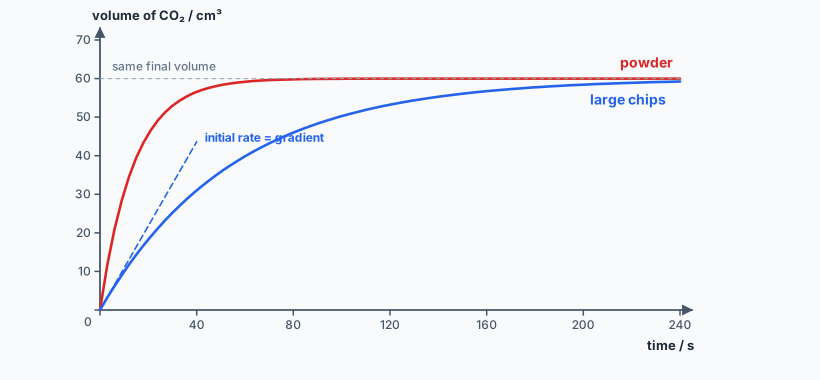
The gradient of a volume–time graph is the rate. The curve is steepest at the start, when the concentration of reactants is highest, and flattens when a reactant runs out. The final volume depends only on the amount of the limiting reactant, not on how fast the reaction went.
✏️Worked example: mean rate from data
First 40 s: \( 24 \div 40 = 0.60 \) cm3/s.
40–120 s: \( (48 - 24) \div (120 - 40) = 24 \div 80 = 0.30 \) cm3/s.
Why slower: the acid is being used up, so its concentration falls and there are fewer collisions per second (and the chips get smaller).
🔄Reversible reactions and equilibrium
A reversible reaction can go in both directions, shown by ⇌. Heating blue hydrated copper(II) sulfate gives white anhydrous copper(II) sulfate and water (endothermic); adding water back turns it blue and releases heat (exothermic) — the same amount of energy each way. This is a test for water.
In a closed system a reversible reaction reaches dynamic equilibrium: the forward and backward reactions carry on at the same rate, so the amounts of reactants and products stay constant. If conditions change, the position of equilibrium shifts to oppose the change (Le Chatelier’s principle):
- raising the temperature favours the endothermic direction;
- raising the pressure favours the side with fewer gas molecules;
- adding more of a reactant shifts the position towards the products.
A catalyst speeds up both directions equally, so equilibrium is reached sooner but its position does not change.
The Haber process makes ammonia for fertilizers: \( \text{N}_2 + 3\text{H}_2 \rightleftharpoons 2\text{NH}_3 \) (exothermic). High pressure (about 200 atm) favours ammonia (4 gas molecules become 2). A low temperature would also favour ammonia but would be too slow, so a compromise of about 450 °C is used with an iron catalyst.
🌎Science in context: dust explosions and food storage
Flour, sugar and coal dust have enormous surface areas; a spark in a dusty mill can set off an explosion. Factories control dust and ban flames. The same ideas keep food fresh: refrigeration lowers the temperature and slows the reactions that spoil food, and vacuum packing removes oxygen. Rate chemistry saves both lives and money.
🧠Quick check
1. Why does powdered calcium carbonate react faster with acid than a lump of the same mass?
The powder has a much larger surface area, so more particles are exposed and collisions with acid particles are more frequent.
2. Give two reasons why raising the temperature increases the rate.
Particles move faster, so they collide more often; and more of the collisions have energy equal to or above the activation energy.
3. How does a catalyst speed up a reaction?
It provides an alternative reaction pathway with a lower activation energy, so more collisions are successful. It is not used up.
4. Why does a volume–time graph for a reaction eventually become horizontal?
One reactant (the limiting reactant) has been used up, so no more gas is produced.
5. What is meant by dynamic equilibrium?
In a closed system, forward and backward reactions happen at the same rate, so the amounts of reactants and products stay constant.
6. In the Haber process, why is high pressure used?
The forward reaction reduces the number of gas molecules (4 → 2), so high pressure shifts the equilibrium towards ammonia; it also increases the rate.
📝Worksheet
Test yourself on the whole topic with a printable worksheet: questions for all four criteria, from recall to a design task, a data-analysis question and a short reflection, with a full mark scheme.
Worksheets are for members — sign in or join. The topic 1 worksheet is a free sample.