Organic chemistry and IUPAC naming
🎯What you need to be able to do
- Describe how crude oil is separated by fractional distillation, and the uses of its fractions.
- Define homologous series, functional group, saturated and unsaturated.
- Name and draw alkanes, alkenes, alcohols and carboxylic acids with up to four carbon atoms.
- Describe combustion, the bromine-water test for alkenes, and cracking.
- Describe how ethanol is made and how esters form from alcohols and carboxylic acids.
🛢️Crude oil and fractional distillation
Crude oil is a finite resource formed over millions of years from the remains of marine organisms. It is a mixture of hydrocarbons — compounds of hydrogen and carbon only. It is separated into fractions (groups of hydrocarbons with similar chain lengths and boiling points) by fractional distillation:
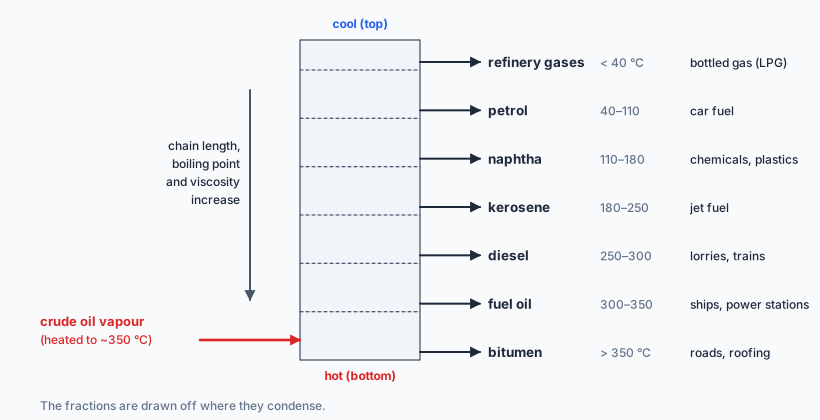
The oil is heated until most of it vaporizes and enters a column that is hot at the bottom and cooler at the top. Vapours rise and each fraction condenses at the level where the temperature falls below its boiling point. Longer-chain hydrocarbons have higher boiling points (stronger forces between larger molecules), are more viscous (thick), less flammable and burn with a smokier flame.
🔗Homologous series and IUPAC names
A homologous series is a family of compounds with the same functional group (the group of atoms that decides how they react), the same general formula, similar chemical properties, and a gradual trend in physical properties. Each member differs from the next by CH2.
IUPAC names have a stem for the number of carbons and a suffix for the series:
| Carbons | 1 | 2 | 3 | 4 |
|---|---|---|---|---|
| Stem | meth- | eth- | prop- | but- |
| Series | Functional group | General formula | Suffix | Example |
|---|---|---|---|---|
| alkanes | C–C single bonds only | CnH2n+2 | -ane | propane, C3H8 |
| alkenes | C=C double bond | CnH2n | -ene | ethene, C2H4 |
| alcohols | –OH | CnH2n+1OH | -anol | ethanol, C2H5OH |
| carboxylic acids | –COOH | Cn−1H2n−1COOH | -anoic acid | ethanoic acid, CH3COOH |
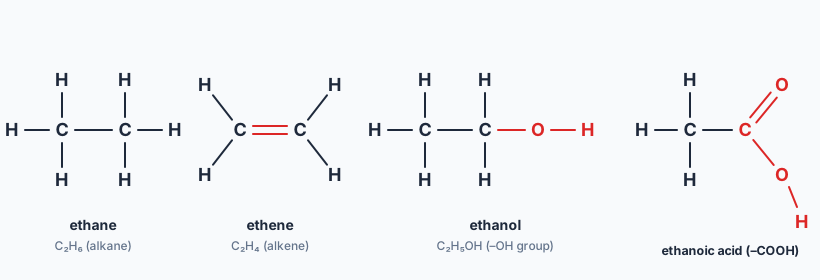
For alkenes, alcohols and acids with more than three carbons, a number shows the position of the functional group: but-1-ene and but-2-ene are different compounds with the same formula (isomers).
🔥Reactions of alkanes and alkenes
Alkanes are saturated (only single bonds) and fairly unreactive, but they burn well — they are our main fuels. Complete combustion (plenty of oxygen) gives carbon dioxide and water; incomplete combustion gives carbon monoxide (a toxic, odourless gas) and soot (carbon).
Alkenes are unsaturated: the C=C double bond can open up so other atoms add on. Test: shake with orange bromine water — an alkene decolorizes it; an alkane leaves it orange. Alkenes are used to make plastics by addition polymerization: thousands of ethene molecules join to form poly(ethene).
Cracking breaks long, less useful alkanes into shorter alkanes (for petrol) and alkenes (for plastics), using heat and a catalyst, because demand for short chains is greater than the supply from distillation. Example: C10H22 → C8H18 + C2H4.
✏️Worked example: naming and formulae
(a) CnH2n+2 with n = 5: C5H12, pentane.
(b) Three carbons (prop-) and an –OH on the end carbon: propan-1-ol.
(c) \( \text{C}_3\text{H}_8 + 5\text{O}_2 \rightarrow 3\text{CO}_2 + 4\text{H}_2\text{O} \) (C: 3 = 3; H: 8 = 8; O: 10 = 6 + 4).
🍺Alcohols, acids and esters
Ethanol is made in two ways: fermentation of sugars by yeast (about 30 °C, no oxygen) — renewable but slow, giving dilute ethanol that must be distilled; or hydration of ethene with steam (300 °C, catalyst) — fast and pure but from finite crude oil. Ethanol is a solvent, a fuel and the alcohol in drinks.
If ethanol is oxidized (left open to air with bacteria, as wine turns to vinegar) it becomes ethanoic acid, a weak acid. An alcohol and a carboxylic acid react, with a sulfuric acid catalyst, to form an ester and water. Esters have sweet, fruity smells and are used in perfumes and flavourings:
🌎Science in context: plastics and palm oil
Indonesia is among the countries most affected by plastic waste in the ocean. Poly(ethene) is cheap and useful precisely because its C–C bonds are unreactive — which also means it persists for centuries. Biofuels such as palm-oil biodiesel and sugar-cane ethanol reduce crude-oil use but can drive deforestation. Both are good Criterion D topics because the chemistry that makes a substance useful also causes the problem.
🧠Quick check
1. Why can crude oil be separated by fractional distillation?
Its hydrocarbons have different chain lengths and so different boiling points; each fraction condenses at a different temperature in the column.
2. What is the molecular formula of butene?
C4H8 (alkenes are CnH2n).
3. How would you tell ethane from ethene?
Shake each with bromine water: ethene decolorizes it (orange to colourless); ethane leaves it orange.
4. Why is incomplete combustion dangerous?
It produces carbon monoxide, a toxic, colourless, odourless gas that stops blood carrying oxygen; soot also forms.
5. Give one advantage and one disadvantage of making ethanol by fermentation rather than from ethene.
Advantage: uses renewable sugar crops and low temperatures. Disadvantage: slow, batch process, gives impure dilute ethanol that must be distilled (and uses farmland).
6. Name the ester formed from methanol and ethanoic acid.
Methyl ethanoate.
📝Worksheet
Test yourself on the whole topic with a printable worksheet: questions for all four criteria, from recall to a design task, a data-analysis question and a short reflection, with a full mark scheme.
Worksheets are for members — sign in or join. The topic 1 worksheet is a free sample.