Atomic structure and electron arrangement
🎯What you need to be able to do
- State the relative mass, charge and location of protons, neutrons and electrons.
- Use atomic number and mass number to find the numbers of particles in atoms and ions.
- Define isotopes and calculate relative atomic mass from isotope abundances.
- Write electron configurations (such as 2,8,1) for the first 20 elements and draw shell diagrams.
- Link the number of outer electrons to the group and the number of shells to the period.
⚛️Sub-atomic particles
| Particle | Relative mass | Relative charge | Location |
|---|---|---|---|
| proton | 1 | +1 | nucleus |
| neutron | 1 | 0 | nucleus |
| electron | 1/1840 (negligible) | −1 | shells around the nucleus |
The atomic number (proton number, Z) is the number of protons; it identifies the element. The mass number (nucleon number, A) is protons + neutrons. In a neutral atom, electrons = protons. An ion has gained or lost electrons: Na+ has 11 protons and 10 electrons; Cl− has 17 protons and 18 electrons.
👥Isotopes and relative atomic mass
Isotopes are atoms of the same element with different numbers of neutrons. They have the same chemical properties (same electron arrangement) but slightly different physical properties such as density. Chlorine is a mixture of about 75% chlorine-35 and 25% chlorine-37.
The relative atomic mass \( A_r \) is the weighted average mass of an element’s atoms compared with 1/12 of a carbon-12 atom. It accounts for the abundance of each isotope, which is why it is often not a whole number.
✏️Worked example: relative atomic mass of chlorine
Take 100 atoms: 75 have mass 35 and 25 have mass 37. \[ A_r = \frac{(75.0 \times 35) + (25.0 \times 37)}{100} = \frac{2625 + 925}{100} = 35.5 \]
🎯Electron arrangement
Electrons occupy shells (energy levels) around the nucleus, filling the lowest-energy shell first. For the first 20 elements:
- the first shell holds up to 2 electrons;
- the second holds up to 8;
- the third holds 8 before the fourth starts to fill (for elements up to calcium).
The electron configuration lists the number in each shell: sodium (11 electrons) is 2,8,1; chlorine (17) is 2,8,7; calcium (20) is 2,8,8,2.
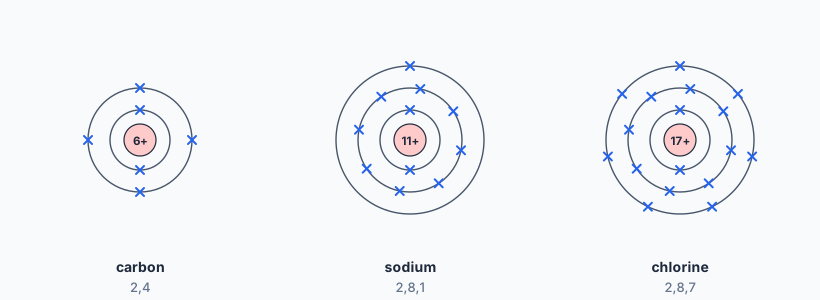
This arrangement links directly to the periodic table:
- the number of outer electrons equals the group number (for groups 1–7; group 0 has a full outer shell);
- the number of occupied shells equals the period number.
Sodium (2,8,1) has one outer electron and three shells: group 1, period 3. Elements in the same group have the same number of outer electrons, which is why they react in similar ways. The number of electrons an atom tends to gain, lose or share to reach a full outer shell is its valency — sodium 1, oxygen 2, carbon 4.
🌎Science in context: isotopes at work
Because isotopes behave identically in chemistry but can be told apart by mass or radioactivity, they make perfect tracers. Hydrogen-2 and oxygen-18 in water record past climates in ice cores; carbon-14 dates archaeological remains; and ratios of isotopes can reveal whether honey or coffee really comes from the region on its label. Food-fraud testing is a good example of chemistry protecting both consumers and honest farmers.
🧠Quick check
1. How many protons, neutrons and electrons are in \( ^{40}_{20}\text{Ca} \)?
20 protons, 20 neutrons, 20 electrons.
2. How many electrons are in an Al3+ ion (Z = 13)?
13 − 3 = 10 electrons.
3. Why do isotopes of the same element have the same chemical properties?
They have the same number of electrons in the same arrangement, and chemical reactions involve only the electrons.
4. Write the electron configuration of sulfur (Z = 16) and state its group and period.
2,8,6: six outer electrons (group 6), three shells (period 3).
5. Boron is 20% boron-10 and 80% boron-11. Calculate its Ar.
\( (20 \times 10 + 80 \times 11) \div 100 = (200 + 880) \div 100 = 10.8 \).
6. Why do lithium, sodium and potassium react in similar ways?
They are all in group 1: each has one outer-shell electron, which it loses easily in reactions.
📝Worksheet
Test yourself on the whole topic with a printable worksheet: questions for all four criteria, from recall to a design task, a data-analysis question and a short reflection, with a full mark scheme.
Worksheets are for members — sign in or join. The topic 1 worksheet is a free sample.