Bonding and structure
🎯What you need to be able to do
- Explain ionic bonding and draw dot-and-cross diagrams for ionic compounds.
- Explain covalent bonding and draw dot-and-cross diagrams for simple molecules, including double bonds.
- Describe metallic bonding.
- Link each type of structure (giant ionic, simple molecular, giant covalent, metallic) to its properties.
- Explain why alloys are harder than pure metals.
⚡Ionic bonding
Ionic bonding happens between a metal and a non-metal. The metal atom transfers its outer electrons to the non-metal atom. Both end up with full outer shells, as ions: the metal as a positive ion, the non-metal as a negative ion. The ionic bond is the strong electrostatic attraction between these oppositely charged ions.
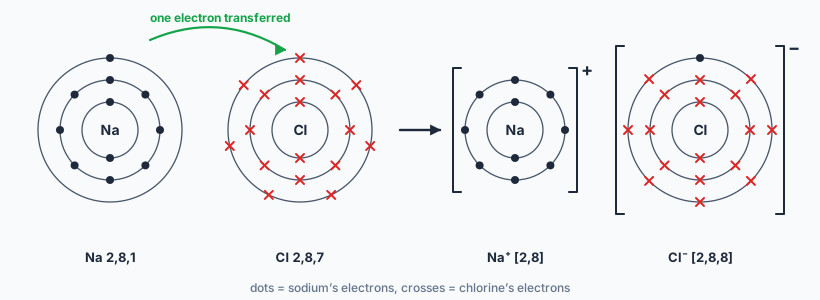
Ionic compounds form a giant ionic lattice: a regular 3D arrangement of alternating positive and negative ions held by strong attractions in every direction. So they:
- have high melting and boiling points (lots of energy to break many strong bonds);
- conduct electricity only when molten or dissolved, when the ions are free to move — not as solids;
- are often soluble in water, and are hard but brittle.
🤝Covalent bonding
Covalent bonding happens between non-metal atoms. Each bond is a shared pair of electrons, attracted to both nuclei. Atoms share enough electrons to fill their outer shells: hydrogen forms 1 bond, oxygen 2, nitrogen 3, carbon 4. Two shared pairs make a double bond, as in O=O and in carbon dioxide, O=C=O.
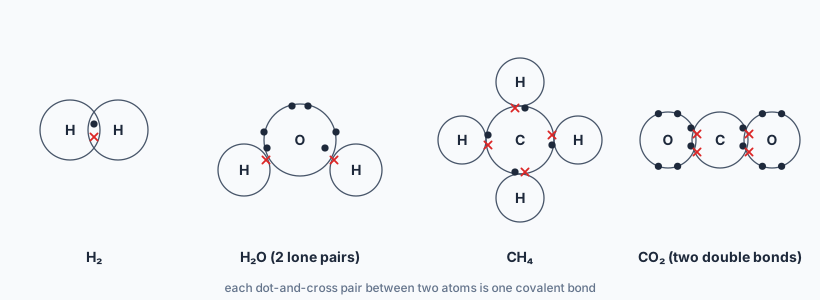
Simple molecular versus giant covalent
Simple molecular substances (H2O, CO2, CH4, I2) contain small molecules. The covalent bonds inside each molecule are strong, but the forces between molecules are weak, so little energy is needed to separate them: low melting and boiling points, and many are gases or liquids. They do not conduct electricity (no ions or free electrons).
Giant covalent (macromolecular) substances have a huge network of covalent bonds with no separate molecules, so they have very high melting points:
- diamond — each carbon bonded to four others in a rigid 3D network: extremely hard, used in cutting tools, does not conduct;
- graphite — each carbon bonded to three others in flat layers that slide over each other (a lubricant, pencil “lead”); the fourth electron of each carbon is delocalized, so graphite conducts;
- silicon dioxide (sand, quartz).
🧰Metallic bonding and alloys
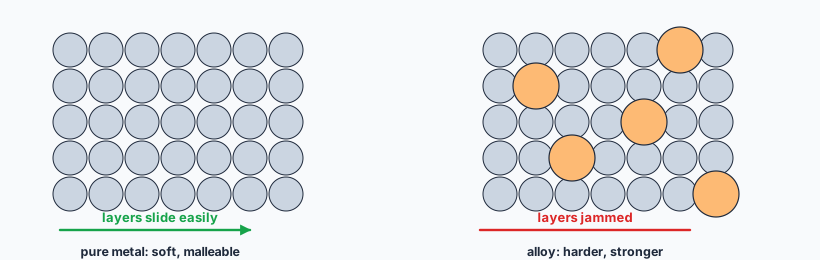
In a metal, the atoms lose their outer electrons to form a lattice of positive ions in a “sea” of delocalized electrons. The metallic bond is the attraction between the ions and the delocalized electrons. The free electrons carry charge and heat, so metals conduct well; and the layers of ions can slide over each other without the bonding breaking, so metals are malleable and ductile.
An alloy is a mixture of a metal with other elements. The different-sized atoms disrupt the regular layers, so they cannot slide as easily: alloys are harder and stronger than the pure metal. Steel (iron + carbon), brass (copper + zinc), bronze (copper + tin) and solder are alloys; pure gold is too soft for jewellery, so it is alloyed with copper or silver (18-carat gold is 75% gold).
✏️Worked example: identifying structure from properties
X: giant ionic. High melting point means strong bonds throughout; conducting only when molten means the charge carriers are ions that must be free to move. (It is sodium chloride.)
Y: simple molecular. Low melting point means weak forces between molecules; no ions or free electrons.
Z: graphite (giant covalent with delocalized electrons). A metal would also conduct, but almost no metal melts above 3500 °C; graphite does.
🌎Science in context: new materials
Graphene — a single layer of graphite — is one atom thick, stronger than steel and an excellent conductor. Researchers hope to use it for flexible screens, better batteries and water filters. As with any new material, questions about cost, large-scale manufacture and the health effects of nanoparticles have to be answered before it replaces existing materials.
🧠Quick check
1. What type of bonding is found in magnesium oxide, and what are the charges on its ions?
Ionic. Magnesium (2,8,2) loses two electrons to form Mg2+; oxygen (2,6) gains two to form O2−.
2. Why does solid sodium chloride not conduct electricity?
Its ions are held in fixed positions in the lattice and cannot move to carry charge. When molten or dissolved, they can.
3. How many covalent bonds does nitrogen form in ammonia, NH3?
Three: nitrogen has 5 outer electrons and shares 3 of them, one with each hydrogen, keeping one lone pair.
4. Why does water have a much lower boiling point than sodium chloride?
Water is simple molecular: boiling only overcomes weak forces between molecules. Sodium chloride is giant ionic: boiling must break many strong ionic bonds.
5. Why does graphite conduct electricity but diamond does not?
In graphite each carbon uses only three electrons in bonds; the fourth is delocalized and can move. In diamond all four are held in bonds.
6. Why is bronze harder than pure copper?
The tin atoms are a different size and distort the layers of copper atoms, so the layers cannot slide over each other easily.
📝Worksheet
Test yourself on the whole topic with a printable worksheet: questions for all four criteria, from recall to a design task, a data-analysis question and a short reflection, with a full mark scheme.
Worksheets are for members — sign in or join. The topic 1 worksheet is a free sample.