Acids, bases and salts
🎯What you need to be able to do
- Describe acids and alkalis in terms of H+ and OH− ions and the pH scale.
- Use indicators, including universal indicator and litmus, to measure pH.
- Write equations for the reactions of acids with metals, bases, alkalis and carbonates.
- Describe how to prepare a soluble salt and an insoluble salt.
- Describe a titration and use it to calculate a concentration.
🧪Acids, bases and alkalis
An acid is a substance that produces hydrogen ions, H+(aq), when dissolved in water. Common laboratory acids are hydrochloric acid (HCl), sulfuric acid (H2SO4) and nitric acid (HNO3); ethanoic acid is in vinegar and citric acid in fruit.
A base is a substance that neutralizes an acid; metal oxides and hydroxides are bases. An alkali is a base that dissolves in water, producing hydroxide ions, OH−(aq): sodium hydroxide, potassium hydroxide, calcium hydroxide and ammonia solution. All alkalis are bases, but not all bases are alkalis (copper(II) oxide is insoluble).
Strong acids (HCl, H2SO4, HNO3) ionize completely in water; weak acids (ethanoic, citric) only partly, so at the same concentration they have a higher pH. Strong and weak are not the same as concentrated and dilute: concentration is how much acid is dissolved per dm3.
🌈The pH scale and indicators
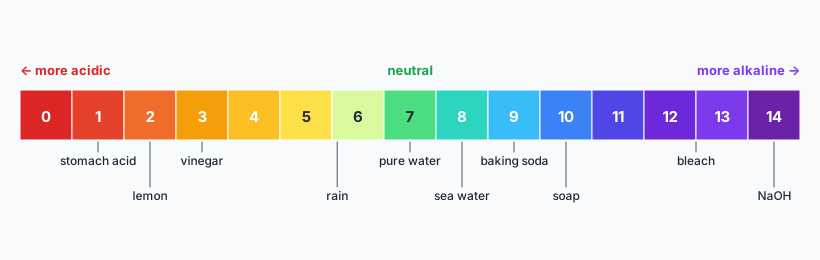
pH measures acidity: below 7 is acidic, 7 is neutral, above 7 is alkaline. The lower the pH, the higher the concentration of H+. Indicators change colour with pH: litmus is red in acid and blue in alkali; phenolphthalein is colourless in acid and pink in alkali; methyl orange is red in acid and yellow in alkali; universal indicator gives a range of colours and so an approximate pH. A pH meter gives a precise digital reading.
⚖️Reactions of acids
Every one of these reactions makes a salt: the H of the acid is replaced by a metal (or ammonium). Hydrochloric acid makes chlorides, sulfuric acid sulfates, nitric acid nitrates.
| Reaction | General equation | Example |
|---|---|---|
| with a metal | acid + metal → salt + hydrogen | Mg + 2HCl → MgCl2 + H2 |
| with a base (metal oxide) | acid + base → salt + water | CuO + H2SO4 → CuSO4 + H2O |
| with an alkali | acid + alkali → salt + water | HCl + NaOH → NaCl + H2O |
| with a carbonate | acid + carbonate → salt + water + carbon dioxide | CaCO3 + 2HCl → CaCl2 + H2O + CO2 |
The essential reaction in every neutralization is H+(aq) + OH−(aq) → H2O(l). Tests for the gases: hydrogen gives a squeaky pop with a lighted splint; carbon dioxide turns limewater milky.
🧊Making salts
Soluble salt from an insoluble base or metal (e.g. copper(II) sulfate from copper(II) oxide):
- Warm the acid and add the solid base a little at a time, stirring, until no more dissolves (the base is in excess, so all the acid has reacted).
- Filter off the unreacted solid.
- Heat the filtrate to evaporate some water until crystals start to form, then leave to crystallize. Filter and dry the crystals.
Soluble salt from an alkali (e.g. sodium chloride): both reactants are solutions, so excess cannot be filtered off. Use a titration with an indicator to find the exact volumes, repeat without indicator, then crystallize.
Insoluble salt (e.g. barium sulfate): mix two solutions containing its ions to form a precipitate; filter, wash with distilled water and dry.
📏Titration
A pipette delivers an exact volume (say 25.0 cm3) of alkali into a conical flask with a few drops of indicator. Acid is added from a burette until the indicator just changes colour — the end point. Repeat until two results (titres) agree within 0.10 cm3, and average those concordant titres.
✏️Worked example: titration calculation
1. Moles of acid. \( n = c \times V = 0.100 \times \dfrac{20.0}{1000} = 0.00200 \) mol.
2. Ratio. 1 : 1, so 0.00200 mol of NaOH.
3. Concentration of NaOH. \( c = \dfrac{0.00200}{25.0/1000} = 0.0800 \) mol/dm3.
🌎Science in context: acidic soils and rice
Heavy fertilizer use and acid rain can make farmland too acidic for crops; many soils in Indonesia’s wetter regions are naturally acidic too. Farmers spread powdered limestone or lime (bases) to raise the pH. Overdoing it is costly and can make other nutrients less available, so soil testing matters. The same chemistry explains antacid tablets and why toothpaste is slightly alkaline.
🧠Quick check
1. What ion do all acids produce in water, and what ion do alkalis produce?
Acids: H+(aq). Alkalis: OH−(aq).
2. Name the salt formed when zinc oxide reacts with nitric acid.
Zinc nitrate, Zn(NO3)2 (plus water).
3. Write a balanced equation for magnesium carbonate reacting with hydrochloric acid.
MgCO3 + 2HCl → MgCl2 + H2O + CO2.
4. Why is the base added in excess when making copper(II) sulfate?
To make sure all the acid reacts; the leftover solid base is easily removed by filtration, leaving only salt solution.
5. A solution has pH 3. Another has pH 5. How many times greater is the H+ concentration of the first?
100 times (10 × 10), because each pH unit is a factor of 10.
6. Describe the test for carbon dioxide.
Bubble the gas through limewater (calcium hydroxide solution): it turns milky/cloudy.
📝Worksheet
Test yourself on the whole topic with a printable worksheet: questions for all four criteria, from recall to a design task, a data-analysis question and a short reflection, with a full mark scheme.
Worksheets are for members — sign in or join. The topic 1 worksheet is a free sample.