IELTS Academic: The Test and Band Scores
🎯After this lesson you will know
- What happens in each of the four papers, how long each takes and how many questions it has.
- How a raw score becomes a band, and how the four bands become your overall band.
- What Bands 5 to 8 mean in practice, and which band your university or scholarship is likely to ask for.
- How to plan your preparation week by week.
📅The test at a glance
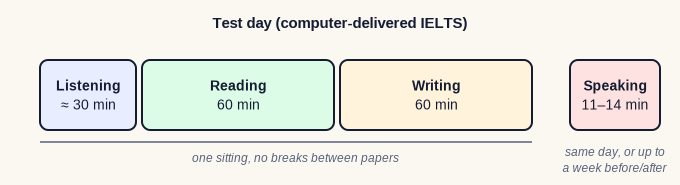
| Paper | Time | Questions | What it involves |
|---|---|---|---|
| Listening | about 30 min + 2 min check | 40 | Four recordings, heard once: an everyday conversation, an everyday talk, an academic discussion and a lecture. |
| Reading | 60 min | 40 | Three long passages (about 2,150 to 2,750 words in total) from books, journals, magazines and newspapers, getting harder. |
| Writing | 60 min | 2 tasks | Task 1: describe a graph, table, chart, map or process (at least 150 words). Task 2: an essay (at least 250 words). Task 2 carries twice the weight of Task 1. |
| Speaking | 11–14 min | 3 parts | A recorded interview with an examiner: questions about you, a two-minute talk from a cue card, then a discussion. |
On computer
The IELTS partners stopped paper-based testing in most countries in mid-2026. The British Council says that in Indonesia every IELTS test has been on computer since 21 June 2026. Questions, timings and marking are the same as on paper, but a few things change:
- You type every answer, so your spelling must be right: a misspelt answer is wrong.
- In Listening there is no 10-minute transfer time. You get 2 minutes at the end to check your answers.
- You can highlight words in a passage, and a word counter shows how much you have written in Writing.
- Speaking is still with a real examiner, face to face or by video call.
Our Practice Test 1 works the same way: you type your answers, the timer runs, and Writing counts your words.
📈How band scores work
Each paper gets a band from 0 to 9, in whole or half bands (6.0, 6.5, 7.0 …). Listening and Reading are marked out of 40 and the raw score is converted to a band. Writing and Speaking are marked by trained examiners against four published criteria each.
Raw scores to bands (Listening and Academic Reading)
The conversion changes slightly from test to test, so these are approximate. They are the figures our practice tests use.
| Band | Listening (out of 40) | Academic Reading (out of 40) |
|---|---|---|
| 9 | 39–40 | 39–40 |
| 8.5 | 37–38 | 37–38 |
| 8 | 35–36 | 35–36 |
| 7.5 | 32–34 | 33–34 |
| 7 | 30–31 | 30–32 |
| 6.5 | 26–29 | 27–29 |
| 6 | 23–25 | 23–26 |
| 5.5 | 18–22 | 19–22 |
| 5 | 16–17 | 15–18 |
| 4.5 | 13–15 | 13–14 |
| 4 | 10–12 | 10–12 |
Notice how few marks separate the bands at the top: in Reading, 30 correct is Band 7 but 29 is Band 6.5. One careless spelling mistake can cost half a band.
The overall band
Your overall band is the average of the four papers, rounded to the nearest half band. An average ending in .25 rounds up to .5, and one ending in .75 rounds up to the next whole band.
| Listening | Reading | Writing | Speaking | Average | Overall |
|---|---|---|---|---|---|
| 7.0 | 7.5 | 6.0 | 6.5 | 6.75 | 7.0 |
| 6.5 | 6.5 | 5.5 | 6.5 | 6.25 | 6.5 |
| 8.0 | 7.0 | 6.0 | 7.0 | 7.0 | 7.0 |
| 6.0 | 6.5 | 5.5 | 6.0 | 6.0 | 6.0 |
🎓What the bands mean
| Band | In practice | Often asked for |
|---|---|---|
| 8–9 | Expert. Rare, minor slips only. | Medicine, law and other professional registration in some countries |
| 7–7.5 | Good user. Handles complex language well, with occasional inaccuracies. | Top universities, competitive and doctoral programmes, many teaching and nursing boards |
| 6–6.5 | Competent. Communicates effectively, with some errors and misunderstandings. | Most undergraduate and master's courses; LPDP overseas master's has typically asked for 6.5 |
| 5–5.5 | Modest. Gets the general meaning but makes many mistakes. | Foundation and pre-sessional English courses |
Requirements change every year and differ by programme. Always check the current figure on the university's or the scholarship body's own website (for LPDP, the official announcement for your intake).
🕑How long does preparation take?
Experience suggests that moving up one full band takes about two to three months of regular study, more at higher bands. Technique alone (knowing the question types, managing time) can add half a band in a few weeks; the rest comes from improving your English itself.
An eight-week plan
| Week | Focus |
|---|---|
| 1 | Take Practice Test 1 Reading and Listening, timed. Note which question types cost you marks. Read this lesson and the four overview lessons. |
| 2–3 | Listening and Reading lessons, one question type a day. Practise spelling numbers, dates and common words. |
| 4–5 | Writing Task 1 and Task 2 lessons. Write one Task 1 and one Task 2 a week, timed, and check them against the criteria. |
| 6 | Speaking lessons. Record yourself answering Part 1, 2 and 3 questions every day and listen back. |
| 7 | Take the whole of Practice Test 1 again, including Writing and Speaking. Compare with week 1. |
| 8 | Revise your weakest question types, and do the official free practice tests from the test organisers. |
Every day, whatever the week: read one article in English (science, environment, education, technology: the topics IELTS uses), listen to 20 minutes of English podcasts or lectures, and learn ten words from them with the words they are used with.
🇮🇩 Catatan untuk peserta dari Indonesia
- Pastikan kamu mendaftar IELTS Academic, bukan General Training, untuk kuliah dan beasiswa seperti LPDP.
- Hasil IELTS umumnya dianggap berlaku dua tahun. Rencanakan tanggal tes agar sertifikat masih berlaku saat pendaftaran beasiswa atau kampus ditutup.
- Skor Writing biasanya yang paling rendah bagi peserta Indonesia. Mulailah berlatih menulis sejak minggu pertama, jangan menunggu sampai akhir.