Writing Task 1: Maps and Plans
🎯After this lesson you can
- Compare two maps systematically so that you miss nothing.
- Write an overview of the general direction of change (more developed, more residential, less green).
- Use the passive to describe changes: was built, were cut down, has been converted.
- Use location language accurately.
🗺The task
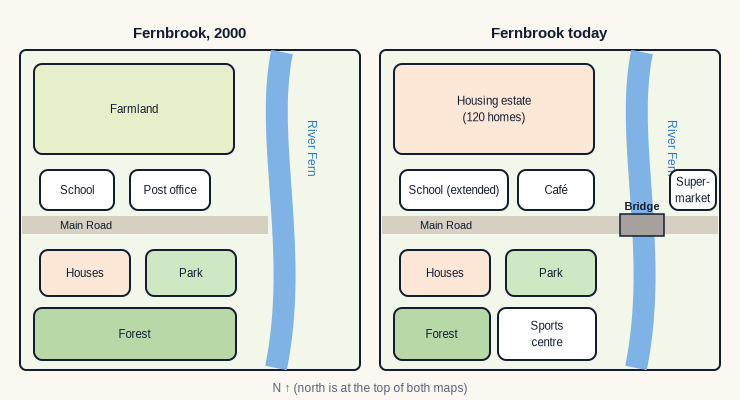
Analyse: a checklist
| Change | In Fernbrook |
|---|---|
| Removed / replaced | farmland → housing estate; part of the forest → sports centre |
| Converted | post office → café |
| Extended | school |
| Added (new) | bridge over the river; supermarket on the east bank |
| Unchanged | Main Road (now extended across the river), houses, park, river |
Group by area (north of the road / south of the road / the river and east bank) or by type of change (residential / leisure and services / transport). Either is clear.
🔧The passive and change verbs
| Change | Passive (past / present perfect) |
|---|---|
| new | was built / has been constructed / was erected / was added |
| gone | was demolished / was knocked down / was removed / were cut down (trees) / was cleared |
| different use | was converted into / was replaced by / made way for / was redeveloped as |
| bigger | was extended / was enlarged / was expanded |
| same | remained / was unchanged / was retained |
Tense. 2000 → today: present perfect or past simple both work (has been extended / was extended). Present map → plan: future passive (will be built, is to be replaced).
✎Model answer (Band 9)
The maps illustrate the changes that have taken place in the village of Fernbrook between 2000 and the present day.
Overall, Fernbrook has become a more developed and more residential village, with new housing, services and leisure facilities, and it is now connected to the east bank of the River Fern. These changes have come partly at the expense of farmland and woodland.
The most dramatic change is in the north of the village, where the farmland has been replaced by a housing estate of 120 homes. To the south of this, the school has been extended eastwards, and the post office beside it has been converted into a café.
South of Main Road, the houses and the park are unchanged, but roughly half of the forest in the south-west has been cleared to make way for a sports centre. The most significant transport development is a bridge, which now carries Main Road across the river, where it previously ended. A supermarket has also been built on the east bank, just north of the road.
📍Location phrases
in the north / north-east of the village · to the south of the road · on the east bank of the river · next to / beside / opposite the school · between the park and the forest · in the place where the post office used to be · further along the road
🇮🇩 Catatan untuk peserta dari Indonesia
- Kalimat pasif bahasa Indonesia (dibangun) tidak memerlukan be; dalam bahasa Inggris wajib: a bridge was built, houses have been built.
- Gunakan bentuk ketiga (past participle): built, cut down, replaced, bukan build atau cutted.