Listening: Map, Plan and Diagram Labelling
🎯After this lesson you can
- Orient yourself on a map before the recording starts.
- Understand the prepositions and phrases speakers use for location and direction.
- Follow a speaker's route and keep track of where they are.
- Label a diagram of a machine or a process when the parts are described.
🧭Before you listen
- Find the starting point. It is usually marked: Entrance, You are here, Reception.
- Find north if there is a compass, and note the places already named. Speakers use them as landmarks.
- Look at the questions. They are listed in the order you will hear them, which is usually the order of the route.
- Turn the map in your head. If the speaker walks "up" the map, their left is your left. If they walk "down", their left is your right.
📍Location language
| Position | Direction and movement |
|---|---|
| next to / beside opposite / facing between the café and the shop in the far corner at the end of the path just behind / in front of to the north of / in the north-east corner |
go straight ahead / carry on past turn left at the fountain take the first path on your right follow the path round cross the bridge it's on your left as you go in just before you reach the gate |
🗺Practice: a garden plan
Look at the plan for 30 seconds. The entrance is at the bottom; you start there, facing north (up the page).
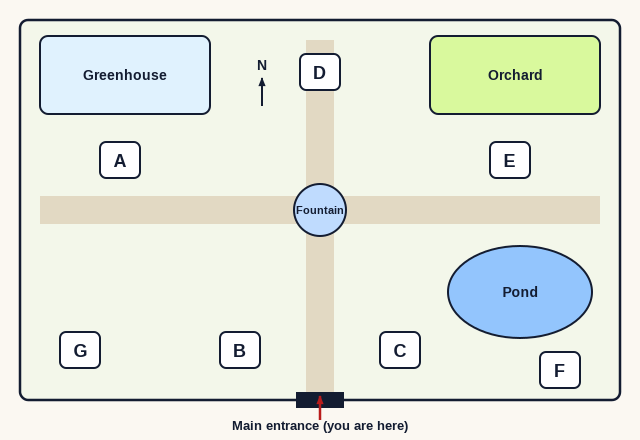
Questions 1–5: Which place on the plan is each of the following? Write the correct letter, A–G. Tap Play all to hear the guide.
GuideWelcome to Hilltop Community Garden. We're standing at the main entrance, so let me tell you where everything is. As you walk in, the first building on your left is the tool shed. Members can borrow anything they need from there.
GuideOn your right, opposite the tool shed and just before you get to the pond, you'll find the toilets.
GuideCarry on up the main path and you'll come to the fountain. If you turn right there, the herb beds are on your left, just below the orchard. Please don't pick the herbs without asking.
GuideNow, families often ask about the children's garden. People expect it to be near the pond, but for safety reasons we put it right at the top, at the very end of the main path, between the greenhouse and the orchard.
GuideAnd finally, if you want to eat your lunch outside, go back to the fountain, turn left, follow the path to the end, and the picnic area is in the corner on your left.
📝Questions 1–5
1. Tool shed
2. Toilets
3. Herb beds
4. Children's garden
5. Picnic area
✎Why question 5 is the hard one
When you walk west along the cross path, you face the left side of the page. Your left is then south (the bottom of the page) and your right is north. Turn the map in your head, or trace the route with your finger and imagine facing the way you are walking.
⚙Diagrams of objects and processes
Sometimes the picture is a machine, a piece of equipment or a natural process, and you write a word in each gap (a completion task) or choose from a list. Speakers describe parts with:
- Position: at the base, on top, attached to the side, inside the chamber.
- Shape: a cylinder, a curved pipe, a flat panel, a spiral.
- Function: this is what collects the water, the part that controls the speed.
Prepare as you would for a map: find the labelled parts, then follow the speaker from one part to the next.
🇮🇩 Catatan untuk peserta dari Indonesia
- Opposite berarti "di seberang / berhadapan", bukan "berlawanan arah".
- On your left mengikuti arah orang yang berjalan, bukan arah peta. Selalu bayangkan kamu sedang berjalan di peta.