IELTS Academic Practice Test 1: Listening
📋Before you start
- Use headphones and a quiet room. The recordings are read by your browser's built-in voices, with a different voice for each speaker where your device has one. They sound different on different devices. Chrome or Edge on a computer usually has the most natural voices.
- In the real test you hear each recording once. Use the full-test mode for an honest score.
- Type your answers as you listen; spelling counts. Your answers are saved on this device.
- Your score and estimated band appear when you check. Members also see the correct answers, an explanation for each question, the transcripts and their score by question type.
- The recordings and questions were written by the AccelerateMyEdu team for practice. They are not official IELTS material.
🎧Part 1
Questions 1–10. A woman phones a community centre to book a class.
Questions 1–10
Complete the form below.
Write ONE WORD AND/OR A NUMBER for each answer.
Riverside Community Centre: class booking
| Name | Sarah 1 |
| Address | Flat 3, 2 Kingsley Road |
| Mobile | 07700 3 |
| Class | 4 for beginners |
| Evening | 5 |
| First class | 6 October |
| Cost | £7 (local resident) |
| Bring | a/an 8 |
| Parking | public car park behind the 9 |
| Heard about class from | an advert in the 10 |
Answers and explanations: Questions 1–10
- Delaney: spelt D-E-L-A-N-E-Y.
- 47: the clerk checks "47 or 74?" and she says "Four seven".
- 900 461: "nine oh oh, four six one"; "double oh" belongs to 07700, already printed.
- pottery: she was looking at painting (distractor) but chooses pottery.
- Wednesday: Tuesday is full.
- 12 (12th): the clerk first reads last year's date (the fifth), then corrects it.
- 85: £95 minus £10 for local residents.
- apron: "Just an apron". Tools are provided.
- library: "the public car park behind the library". The centre's own car park is for staff.
- newspaper: "an advert in the local newspaper", not the website. Local newspaper is two words, over the limit.
Transcript: Part 1
ClerkGood morning, Riverside Community Centre. How can I help?
SarahHi. I saw that you run evening classes, and I'd like to book a place on one, if there are any left.
ClerkOf course. Let me take a few details first. Could I have your name?
SarahYes, it's Sarah Delaney.
ClerkCould you spell the surname for me?
SarahSure. D, E, L, A, N, E, Y.
ClerkThank you. And your address?
SarahIt's flat 3, 47 Kingsley Road.
ClerkWas that 47 or 74?
SarahFour seven. Forty-seven.
ClerkLovely. And a phone number, in case we need to contact you?
SarahMy mobile is oh seven seven double oh, nine oh oh, four six one.
ClerkSo that's 07700 900 461.
SarahThat's right.
ClerkNow, which class were you interested in?
SarahWell, I was looking at the painting course, but my friend said the pottery one is better for complete beginners, so I'll go for pottery.
ClerkGood choice. We run it on two evenings. Tuesday is completely full, I'm afraid, but there are still a few places on Wednesday.
SarahWednesday is fine.
ClerkThe Wednesday group starts on the fifth of October. Oh, sorry, no, I'm looking at last year's list. This year it starts on the twelfth.
SarahThe twelfth of October. Great. And how much is it?
ClerkThe full price for the ten weeks is ninety-five pounds, but if you live in the borough, you get ten pounds off.
SarahI do, I live just round the corner.
ClerkThen it's eighty-five pounds, and that includes all the clay and the use of the kiln.
SarahDo I need to bring anything?
ClerkJust an apron, because it gets very messy. We provide all the tools.
SarahAnd is there anywhere to park? I'll be coming straight from work.
ClerkOur own car park is very small, and it's for staff only, but you can use the public car park behind the library. It's free after six.
SarahPerfect.
ClerkOne last question, for our records. How did you hear about the class? Was it our website?
SarahNo, I saw an advert in the local newspaper, actually.
ClerkThat's good to know. Right, you're booked in. See you on the twelfth.
🎧Part 2
Questions 11–20. The manager of an outdoor centre talks to new volunteers.
Questions 11–15
Choose the correct letter, A, B or C (questions 11, 12 and 15), or TWO letters (questions 13–14).
11The buildings at Pinewood were originally
12Most of the centre's income comes from
13–14Which TWO things must volunteers do on their first day?
15Volunteers who work at weekends receive
Answers and explanations: Questions 11–15
- B: "built as a boarding school". The land was farmed (A is the distractor).
- C: "around seventy percent, comes from schools that book residential trips".
- A and D (in either order): "Everyone must attend the safety talk … and you need to sign the volunteer agreement form". Lunch is provided (B); the director is away (C).
- A: "you'll get all your meals free". Accommodation cannot be offered.
Questions 16–20
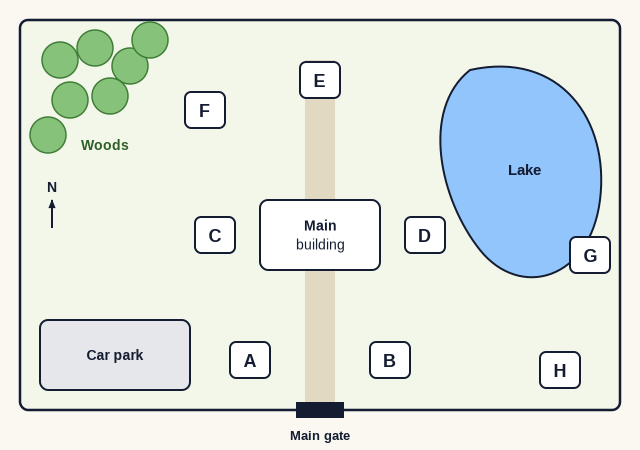
Label the map below.
Write the correct letter, A–H, next to questions 16–20.
Answers and explanations: Questions 16–20
- B: "the first building on your right" as you come in through the gate.
- C: an extension on the left-hand side of the main building.
- D: "between it and the lake".
- E: "right to the top where [the drive] ends".
- F: "at the edge of the woods, in the north-west". The lake (G) is where it used to be.
Transcript: Part 2
Greg (manager)Morning, everyone, and welcome to Pinewood Outdoor Centre. I'm Greg, the manager. Before we head out, let me tell you a little about the place.
Greg (manager)People often assume the site was a farm, and the land around us was farmed for centuries, but the buildings you see were actually built as a boarding school in the nineteen-thirties. The school closed in 1987, and the centre opened two years later.
Greg (manager)We're a charity, so you might expect most of our money to come from donations. They do help, and we get a small grant from the council, but the bulk of our income, around seventy percent, comes from schools that book residential trips.
Greg (manager)Now, your first day. There are two things you absolutely have to do. Everyone must attend the safety talk at nine, no exceptions, and you need to sign the volunteer agreement form before you work with any children. You don't need to bring lunch on your first day; it's on us. And don't worry about meeting the director; she'll be away until next month.
Greg (manager)If you volunteer at weekends, which we really appreciate, you'll get all your meals free. We can't offer accommodation, I'm afraid, as the dormitories are always full of visiting groups.
Greg (manager)Right, have a look at the map. We're standing at the main gate, at the bottom of the map. As you come in through the gate, the first building on your right is the volunteers' office. Pop in there whenever you arrive, to sign in.
Greg (manager)Carry on up the drive and you'll reach the main building. On its left-hand side, attached to the wall, there's a small extension. That's the first-aid room. Please make sure you know where it is.
Greg (manager)On the other side of the main building, between it and the lake, is the equipment store, where we keep the canoes, life jackets and so on.
Greg (manager)If you follow the drive past the main building, right to the top where it ends, you'll find the climbing wall. It's the most popular activity we have.
Greg (manager)And finally, the campfire area. A lot of people expect it to be down by the lake, and it used to be, but the ground there got too wet. So now it's at the edge of the woods, in the north-west of the site, to the left of the top of the drive.
🎧Part 3
Questions 21–30. Two students discuss their project with their tutor.
Questions 21–24
Choose TWO letters for questions 21–22, and the correct letter, A, B or C, for 23–24.
21–22Which TWO problems did the students have with the survey?
23How did the students solve the problem with the scales?
24What was the main source of food waste?
Answers and explanations: Questions 21–24
- A and C: people gave up "because it was too long", and one question was confusing ("usually" – per meal or per week?). The staff were "brilliant" (D); the scales broke once but were replaced (E is not a survey problem).
- B: "we borrowed some from the chemistry department".
- B: "food that was cooked but never served". Plates (A) were what they expected.
Questions 25–30
What do the students decide to do with each section of their report?
Choose SIX answers from the box and write the correct letter, A–G, next to questions 25–30.
Actions
- A keep it as it is
- B shorten it
- C add more detail
- D move it to an appendix
- E combine it with another section
- F remove it
- G rewrite it completely
Answers and explanations: Questions 25–30
- A: "I wouldn't change it".
- B: "cut it down to about half".
- C: "add more detail about how you chose the participants".
- D: "put them at the end, in an appendix".
- E: "combine them with the results section".
- F: "Take it out". G is not used.
Transcript: Part 3
Dr HughesSo, Maya, Tom, how is the food waste project going?
MayaMostly well, I think. We weighed the waste from the canteen every day for three weeks. But the student survey was harder than we expected.
Dr HughesIn what way?
MayaWell, we had hoped for about two hundred replies, and we only got eighty-five. A lot of people started it and gave up, because it was too long.
TomAnd some of the questions were confusing. One asked how much food people "usually" left, and they didn't know if that meant per meal or per week. So the answers weren't really comparable.
Dr HughesThose are both useful lessons. What about the weighing? Any problems there?
TomNot really. The kitchen staff were brilliant. The only thing was one day when the scales broke, but we borrowed some from the chemistry department.
Dr HughesGood. And what was your main finding?
MayaThe biggest single source of waste wasn't from students' plates, as we'd expected. It was food that was cooked but never served, mostly rice and vegetables at the end of lunch.
Dr HughesInteresting. So the issue is really about planning the quantities, not about what students choose to eat.
MayaExactly.
Dr HughesLet's go through the draft report section by section. The introduction?
TomWe thought it was fine as it is.
Dr HughesI agree, I wouldn't change it. The literature review, though, is very long. Twelve pages for a project this size is too much. Could you cut it down to about half?
MayaSure, we can shorten it.
Dr HughesThe methods section is clear, but it's quite thin on the survey. You need to add more detail about how you chose the participants and why the response rate was low.
TomOK, so we should expand that.
Dr HughesYes. Now, you've got twenty photos of the waste bins in the middle of the results. They break up the text. I'd put them at the end, in an appendix.
MayaThat makes sense.
Dr HughesWhat about the interviews with the kitchen staff? At the moment they're a separate section, but they really explain the results about unserved food.
TomSo should we combine them with the results section?
Dr HughesI think that would work much better. And finally, the recommendations. You have one about banning plastic containers.
MayaYes, we added that at the end.
Dr HughesIt's a reasonable idea, but you didn't collect any data about packaging, so it doesn't belong in this report. Take it out, and keep the recommendations to what your data shows.
TomFair enough. We'll remove it.
🎧Part 4
Questions 31–40. A lecture on the history of the shipping container.
Questions 31–40
Complete the notes below.
Write ONE WORD AND/OR A NUMBER for each answer.
The shipping container
- Before containers: cargo loaded piece by piece by large teams of 31
- ships could spend longer in 32 than at sea
- much cargo was lost through 33
- 1956: the Ideal X sailed to Houston from 34 with 58 containers
- Malcolm McLean came from the 35 industry
- cost of loading fell to about 36 cents a ton
- Standard sizes agreed in the 37
- capacity measured in TEU = twenty-foot 38 units
- Ports: moved out of city centres; needed flat land and deep water for larger 39
- Global economy: goods can be made far from where they are 40
Answers and explanations: Questions 31–40
- dockworkers (dockers also accepted)
- port: "more time in port … than it did actually sailing at sea"
- theft
- Newark: "from Newark, near New York, to Houston"
- trucking: "His background was in the trucking industry"
- 16: "from almost six dollars a ton to around sixteen cents"
- 1960s
- equivalent: "twenty-foot equivalent units"
- ships: "deep water for ever larger ships"
- sold: "thousands of kilometres from where they are sold"
Transcript: Part 4
LecturerGood afternoon. Today I want to look at an invention that most people never think about, but which has shaped the modern world as much as the computer: the shipping container.
LecturerLet's start with how goods were moved before containers. Until the nineteen-fifties, cargo was loaded onto ships piece by piece: sacks, barrels, crates, all carried and stacked by large teams of dockworkers. It was slow, dangerous and expensive. A typical cargo ship could spend more time in port, being loaded and unloaded, than it did actually sailing at sea. And because goods passed through so many hands, a great deal was lost to theft along the way.
LecturerThe man usually credited with changing this is Malcolm McLean, an American who, interestingly, had nothing to do with shipping. His background was in the trucking industry. His idea was simple: instead of unloading a truck's contents onto a ship, why not lift the whole box off the truck and put it on the ship?
LecturerIn 1956, an old tanker called the Ideal X, which McLean had converted, sailed from Newark, near New York, to Houston with fifty-eight containers on board. The savings were dramatic. By one estimate, the cost of loading fell from almost six dollars a ton to around sixteen cents a ton.
LecturerFor containers to be used worldwide, though, they had to be the same size everywhere, so that any crane, ship, train or truck could handle any box. After years of negotiation, international standard sizes were agreed in the nineteen-sixties. Even today, the capacity of a container ship is measured in TEU, which stands for twenty-foot equivalent units, the size of the standard smaller box.
LecturerThe effects on ports were enormous. Many old ports in the centres of cities, such as the London docks, closed down. Container ports needed huge areas of flat land for stacking boxes, and deep water for ever larger ships, so new ports were built away from city centres. The number of dock jobs fell sharply, which caused real hardship in many port communities.
LecturerBut perhaps the most important effect was on the global economy. Because transport became so cheap, it became possible to manufacture goods thousands of kilometres from where they are sold. Many economists argue that the container did more to drive globalisation than any trade agreement.