Writing Task 1: Process Diagrams
🎯After this lesson you can
- Count the stages and identify the start, the end and any cycle.
- Write an overview that says how many stages there are and what the process turns into what.
- Use the present simple passive and a range of sequencers.
- Turn the short labels on a diagram into full, accurate sentences.
♻The task
🔧Language for processes
The present simple passive
In a man-made process the person doing the action is unimportant, so use the passive: is/are + past participle.
Label Sorted by colour
Sentence The bottles are then sorted according to their colour.
For natural processes use active verbs: the water evaporates, the larva emerges, the frog lays eggs.
Sequencers
| Start | Middle | End |
|---|---|---|
| First, / To begin with, / The process begins when … | Next, / Then / After that, / Once this has been done, / At the following stage, / Subsequently, / before / after being + past participle | Finally, / In the final stage, / … at which point the cycle begins again |
Vary your sentences: After being washed, the glass is crushed (a participle clause) · The glass is crushed into small pieces, which are known as cullet (a relative clause) · The mixture is melted in a furnace, where the temperature reaches 1,500 °C.
✎Model answer (Band 9)
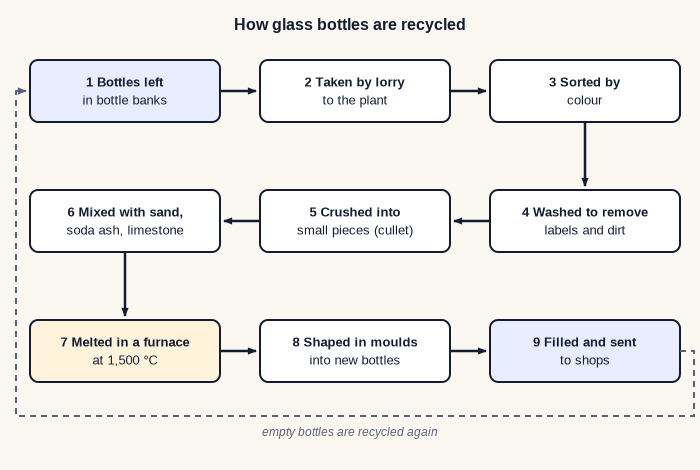
The diagram illustrates the process by which used glass bottles are recycled to make new ones.
Overall, there are nine stages, beginning with the collection of empty bottles and ending with new bottles being sold. The central stages involve cleaning and crushing the glass before it is melted and moulded, and the process is cyclical, since the new bottles can themselves be recycled.
To begin with, people leave their empty bottles in bottle banks, from which they are collected and taken by lorry to a recycling plant. There, they are sorted according to their colour and then washed to remove any labels and dirt. After being cleaned, the glass is crushed into small pieces, which are known as cullet.
At the next stage, the cullet is mixed with three raw materials, namely sand, soda ash and limestone, and the mixture is melted in a furnace at a temperature of 1,500 °C. The molten glass is then shaped in moulds to produce new bottles. Finally, these are filled and delivered to shops, at which point the cycle can begin again.
⚠Common mistakes
- Leaving out a stage. Process tasks expect every stage, unlike charts where you select.
- Copying the labels as notes: "Then sorted by colour. Then washed." Each stage needs a full sentence with a subject and verb.
- "The bottles are sort by colour." The passive needs the past participle: are sorted.
- Adding your own knowledge ("this protects the environment"). Report only what is shown.
🇮🇩 Catatan untuk peserta dari Indonesia
- Subjek jamak memakai are (the bottles are washed); subjek tunggal atau tak terhitung memakai is (the glass is melted).
- Jangan memulai setiap kalimat dengan Then. Variasikan dengan Next, After that, Once … dan klausa after being ….
📝Practice
1. Turn the label into a sentence: "Leaves picked by hand"
2. Join with a participle clause: "The beans are roasted. Then they are ground."
3. Active or passive? A diagram shows the life cycle of a butterfly: "egg → caterpillar hatches".
4. Write an overview for a seven-stage process that turns raw cotton into T-shirts.
5. Correct: "After wash, the glass crush into cullet."
6. Timed task (20 minutes): describe this process in at least 150 words. Rainwater harvesting at a school: (1) rain falls on the roof → (2) flows into gutters → (3) passes through a mesh filter that removes leaves → (4) stored in an underground tank → (5) pumped to a header tank on the roof → (6) used to flush toilets and water the garden. Overflow from the tank goes to a soakaway.
The diagram shows how a school collects rainwater and uses it.
Overall, there are six main stages, from rain falling on the roof to the water being used in the toilets and garden. The water is filtered and stored before use, and the system includes an overflow for excess water.
First, rain falls on the school roof and runs into gutters along its edges. From there, it flows down through a mesh filter, which removes leaves and other large debris, before being stored in a tank underground. If the tank becomes full, the excess water drains away into a soakaway.
When the water is needed, it is pumped back up to a header tank on the roof. From this tank it is supplied for two purposes: flushing the school's toilets and watering the garden.
(about 150 words)