Writing Task 2: Overview, Planning and Assessment
🎯After this lesson you can
- Recognise the five common question types and what each one requires.
- Analyse a question: topic, specific focus, and instruction.
- Plan an essay in five minutes, with a position and two developed main ideas.
- Explain what moves an essay from Band 6 to Band 7 on each criterion.
📑The five question types
| Type | The instruction looks like | You must |
|---|---|---|
| Opinion | To what extent do you agree or disagree? | give your view and keep to it throughout |
| Discussion | Discuss both these views and give your own opinion. | explain both views fairly, then give yours |
| Problem / solution | What problems does this cause? What can be done? | explain problems (or causes) and matching solutions |
| Advantages / disadvantages | Do the advantages outweigh the disadvantages? | weigh both sides and say which is greater |
| Two-part | Why is this happening? Is it a positive or negative development? | answer both questions fully |
🔍Analyse the question
Most low Task Response scores come from writing about the general topic instead of the specific question. Break every question into three parts:
Question Some people believe that the main purpose of secondary school is to prepare young people for work. Others feel that schools should mainly help students become well-rounded individuals and responsible citizens. Discuss both views and give your own opinion.
Topic secondary schools
Focus the main purpose of school: preparing for jobs vs developing the whole person and citizen
Instruction discuss both views + give my opinion
📝Plan in five minutes
- Decide your position. One clear sentence. It does not have to be your real opinion: choose the side you can support best.
- Choose two main ideas (one per body paragraph). Two well-developed ideas beat four short ones.
- For each idea, note the development: an explanation (why? what happens as a result?) and an example (a realistic, specific case).
- Plan the introduction: paraphrase the topic + state your position (+ outline if you like).
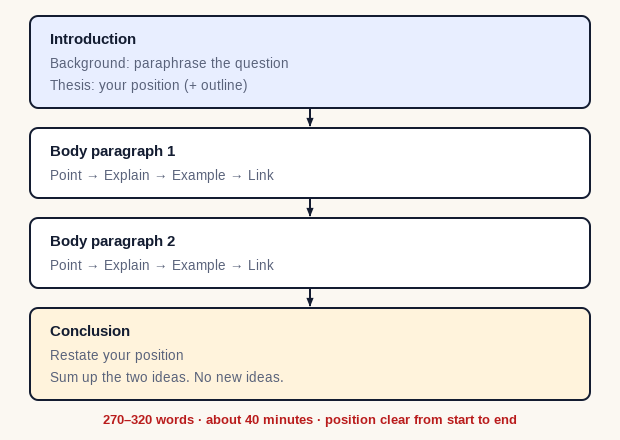
The body paragraph: PEEL
Point One clear topic sentence that answers the question.
Explain Why is it true? What follows from it? (two or three sentences)
Example A specific, realistic example. Invented statistics are not needed and can look false.
Link Optional: one sentence connecting back to your position.
📊The four criteria: Band 6 vs Band 7
Our summary, in our own words, of the difference examiners look for (the official descriptors are on ielts.org).
| Criterion | Band 6 | Band 7 |
|---|---|---|
| Task Response | addresses all parts, but some more fully than others; position may be unclear in places; ideas sometimes underdeveloped | addresses all parts; a clear position throughout; main ideas extended and supported |
| Coherence and Cohesion | organised, but linkers may be mechanical or faulty; paragraphs not always logical | logical progression; a range of linkers used naturally; each paragraph has a clear central topic |
| Lexical Resource | adequate range; some errors in word choice or spelling that do not block meaning | enough range for flexibility and precision; some less common words and collocations; occasional errors |
| Grammatical Range and Accuracy | a mix of simple and complex sentences; some errors | a variety of complex structures; frequent error-free sentences |
⏳Forty minutes
| Minutes | Do |
|---|---|
| 0–5 | Analyse the question and plan. |
| 5–10 | Introduction. |
| 10–32 | Two body paragraphs (about 100 words each). |
| 32–36 | Conclusion. |
| 36–40 | Check: does every paragraph answer the question? Then articles, plurals, verb forms, spelling. |
Aim for 270–320 words. Under 250 words is penalised in Task Response. Memorised phrases and "template" sentences that could fit any essay ("This is a controversial issue that has sparked heated debate") earn no credit, and examiners recognise them.
🇮🇩 Catatan untuk peserta dari Indonesia
- Esai bahasa Inggris langsung ke pokok: posisi di paragraf pertama, satu gagasan per paragraf. Pembukaan panjang tidak menambah nilai.
- Hindari in my opinion, I think that, I believe that dalam satu kalimat; cukup satu.
- Contoh yang spesifik (kota, kebijakan, pengalaman yang realistis) lebih kuat daripada kalimat umum seperti "many people say".