IELTS Academic Practice Test 1: Writing
📋Before you start
- Press Start timed test for a 60-minute countdown. When the time is up the boxes lock, as in the real test; you can unlock them with Keep editing if you are practising.
- After writing, check your work against the checklist under each task. Members can compare it with our Band 9 model answers.
- Your writing stays on this device: it is not sent to us or marked automatically. Paid members who want a teacher's feedback can send a request to our teaching team from the account page.
📊Writing Task 1
You should spend about 20 minutes on this task.
Write at least 150 words.
Self-check: Task 1
- Did I paraphrase the task in the introduction, without copying it?
- Is there an overview with the main features and no numbers? (e.g. the youngest group used social media most; time on social media fell with age while reading rose)
- Did I group the data and compare, rather than describe each bar?
- Is every main point supported by an accurate figure, with units (hours a week)?
- Did I use the past tense for 2025, and check articles, plurals and spelling?
- Is it at least 150 words? Did I avoid opinions and reasons that are not in the chart?
Model answer: Task 1 (Band 9)
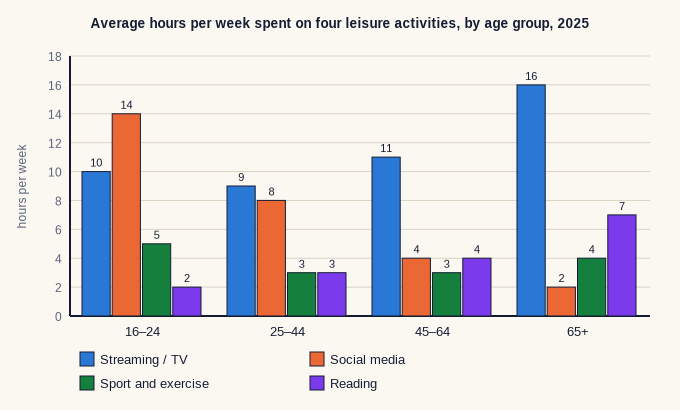
The bar chart compares the average amount of time that people in four age groups spent each week on streaming or television, social media, sport and exercise, and reading in 2025.
Overall, streaming and television took up the most leisure time in every age group except the youngest, who spent longest on social media. Time spent on social media fell sharply with age, whereas reading rose steadily, and sport and exercise occupied relatively little time in all four groups.
Young people aged 16 to 24 spent 14 hours a week on social media, seven times as long as people aged 65 and over, who spent just two hours. The figure dropped to eight hours for 25 to 44-year-olds and to four hours for the 45 to 64 group. Viewing time, by contrast, was fairly similar for the three younger groups, at between nine and eleven hours, but rose to 16 hours among the oldest.
Reading increased with every age group, from only two hours a week among the youngest to seven hours among the over-65s. Sport and exercise was highest among 16 to 24-year-olds, at five hours, and stood at three to four hours for the other groups.
✍Writing Task 2
You should spend about 40 minutes on this task.
Write about the following topic:
In many countries, the number of people who own a car continues to rise, even though public transport has improved. Why do many people still prefer to travel by car? What can be done to encourage them to use public transport instead?
Give reasons for your answer and include any relevant examples from your own knowledge or experience.
Write at least 250 words.
Self-check: Task 2
- Did I answer both questions (why people prefer cars; what can be done) fully?
- Does the introduction give a short answer to both questions?
- Does each body paragraph have one main idea, explained and supported with an example?
- Do my solutions match the reasons I gave, and say who should act?
- Did I use a range of linking words naturally, not at the start of every sentence?
- Did I check articles, plurals, verb forms and spelling? Is it at least 250 words?
Model answer: Task 2 (Band 9)
Although buses and trains in many cities are faster and more comfortable than they once were, car ownership keeps growing. This preference is largely a matter of convenience and status, and changing it will require public transport to compete more effectively while driving becomes less attractive.
The main reason people choose cars is that they offer door-to-door travel. Public transport rarely runs from exactly where someone lives to exactly where they work, so a journey may involve a walk, a wait and a change, which is particularly difficult for parents with young children or people carrying shopping. In many places services are also infrequent in the evenings and at weekends. Beyond practicality, a car remains a symbol of success for many families: in parts of Indonesia, for instance, buying a first car is still seen as a sign that a household has moved up in the world.
To change these habits, governments need to act on both sides. First, public transport must fill the gaps that push people towards cars. Feeder buses linking housing estates to train stations, later services and integrated tickets that cover a whole journey would remove much of the inconvenience. Second, the true cost of driving should be made more visible. Congestion charges, higher parking fees in city centres and dedicated bus lanes that let buses overtake queuing traffic all make public transport the quicker and cheaper choice. Singapore, which combines very high costs for car ownership with an efficient metro, shows how effective such a combination can be.
In conclusion, people prefer cars mainly because they are convenient and carry social status. Only a combination of better connected public transport and policies that make driving less attractive is likely to persuade them to leave their cars at home.