Understand integration as the reverse of differentiation, and include the arbitrary constant in indefinite integrals.
Integrate sums of powers of \(x\), including \( \dfrac{1}{x} \) and \( \dfrac{1}{ax + b} \).
Integrate \( (ax + b)^{n} \) for any rational \(n\), \( \sin(ax + b) \), \( \cos(ax + b) \), \( \sec^{2}(ax + b) \) and \( e^{ax + b} \).
Find a curve from its gradient function and a point on it.
Evaluate definite integrals, including “hence” questions that use a derivative found earlier.
Find plane areas: under a curve, between a line and a curve, between two curves, and areas made of two parts.
📚The mathematics
Reverse differentiation
If \( \dfrac{d}{dx}F(x) = f(x) \), then \( \displaystyle\int f(x)\,dx = F(x) + c \). The constant matters: every
curve \( y = F(x) + c \) has the same gradient function, and the syllabus says indefinite integrals must include it.
To find which curve, substitute a known point to find \(c\).
\( \displaystyle\int \sin(ax + b)\,dx = -\frac{1}{a}\cos(ax + b) + c \)
\( \displaystyle\int \cos(ax + b)\,dx = \frac{1}{a}\sin(ax + b) + c \)
\( \displaystyle\int \sec^{2}(ax + b)\,dx = \frac{1}{a}\tan(ax + b) + c \)
Every result on the second row, and the two with \( ax + b \) on the first, follow one rule:
integrate as if the bracket were \(x\), then divide by \(a\). Check any answer by differentiating it.
Angles are in radians. Products and quotients are not integrated directly at this level: expand or divide
first, so \( \dfrac{x^{3} - 4}{x^{2}} = x - 4x^{-2} \).
Definite integrals and “hence” questions
\( \displaystyle\int_{a}^{b} f(x)\,dx = F(b) - F(a) \); the constant cancels, so leave it out. On Paper 1 the
limits are chosen to give exact values: \( \tan\tfrac{\pi}{3} = \sqrt{3} \), \( \ln e = 1 \), \( e^{0} = 1 \).
A common 0606 structure is “(a) Differentiate \( F(x) \). (b) Hence find \( \int f(x)\,dx \)”.
Part (a) gives \( F'(x) = \) something close to \( f(x) \); rearrange so that the integral you want is isolated,
and integrate both sides.
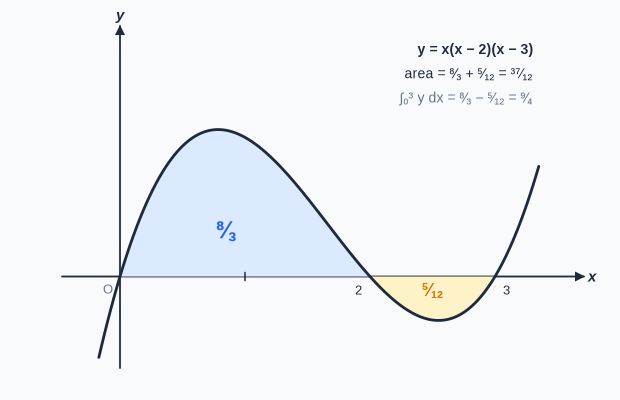
Why a definite integral is an area. Cover the region from \(a\) to \(b\) with \(n\) thin rectangles and add their areas: press “Play” to double \(n\) and watch the sum close in on \( \int_a^b f(x)\,dx \). Choose \( y = x(x-2)(x-3) \) and the strips below the axis count as negative, the reason a region that crosses the axis must be split.
Areas
Under a curve (above the axis): \( \int_{a}^{b} y\,dx \).
Below the axis the integral is negative. For a region that crosses the axis, integrate each part
separately and add the sizes — the “sum of two areas” in the syllabus.
Between two graphs: \( \int_{a}^{b} (\text{upper} - \text{lower})\,dx \), with \(a\) and \(b\) where they meet.
This works whether or not the region is above the axis.
\( \int_{0}^{3} \) gives \( \tfrac{8}{3} - \tfrac{5}{12} = \tfrac{9}{4} \). The shaded area is \( \tfrac{8}{3} + \tfrac{5}{12} = \tfrac{37}{12} \).
Try it yourself. On Integral, shape \(f(x)\) and watch the integral build up: area above the \(x\)-axis adds, area below subtracts. That is why a region that crosses the axis must be split before you add the areas. Simulation: Calculus Grapher by PhET Interactive Simulations, University of Colorado Boulder, licensed CC BY 4.0. On a phone, open it full screen.
✏️Worked example 1 (no calculator)
(a) A curve has gradient \( \dfrac{dy}{dx} = 6x^{2} - \dfrac{2}{x^{2}} \) and passes through \( (1, 5) \). Find its equation. [4]
(b) Find the exact value of \( \displaystyle\int_{0}^{\pi/6} \left(\sec^{2}2x + 4\cos 2x\right)dx \). [4]
(c) Differentiate \( x\ln x \). Hence find the exact value of \( \displaystyle\int_{1}^{e} \ln x\,dx \). [4]
(a) \( y = \displaystyle\int \left(6x^{2} - 2x^{-2}\right)dx = 2x^{3} + 2x^{-1} + c \). At \( (1, 5) \):
\( 5 = 2 + 2 + c \), so \( c = 1 \) and \( y = 2x^{3} + \dfrac{2}{x} + 1 \).
(c) Product rule: \( \dfrac{d}{dx}(x\ln x) = \ln x + 1 \). Integrating both sides,
\( x\ln x = \int \ln x\,dx + x \), so \( \int \ln x\,dx = x\ln x - x + c \). Then
\[ \int_{1}^{e} \ln x\,dx = \Big[x\ln x - x\Big]_{1}^{e} = (e - e) - (0 - 1) = 1 \]
Check it. Differentiate each answer. (a) \( \dfrac{d}{dx}\left(2x^{3} + 2x^{-1} + 1\right) = 6x^{2} - 2x^{-2} \) ✓.
(c) \( \dfrac{d}{dx}(x\ln x - x) = \ln x + 1 - 1 = \ln x \) ✓.
Forgetting to divide by \(a\). \( \int \sec^{2}2x\,dx = \tfrac{1}{2}\tan 2x \), not \( \tan 2x \); and
\( \int \cos 2x\,dx = \tfrac{1}{2}\sin 2x \). Differentiating your answer would show the stray factor of 2 at once.
✏️Worked example 2 (no calculator)
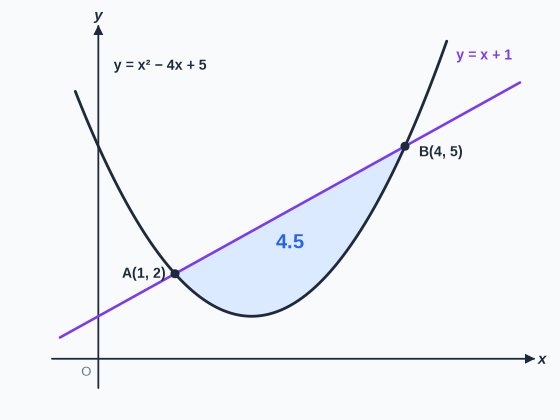
The line \( y = x + 1 \) meets the curve \( y = x^{2} - 4x + 5 \) at \(A\) and \(B\). Find the area of the region
enclosed by the line and the curve. [6]
Upper minus lower, integrated between the intersections.
Intersections: \( x^{2} - 4x + 5 = x + 1 \Rightarrow x^{2} - 5x + 4 = 0 \Rightarrow x = 1, 4 \), so \( A(1, 2) \) and
\( B(4, 5) \). Between them the line is above the curve (at \( x = 2 \): \( 3 > 1 \)):
Check it. Any parabola \( y = x^{2} + \ldots \) cut by a chord between \( x = p \) and \( x = q \) encloses
\( \tfrac{(q - p)^{3}}{6} \): here \( \tfrac{27}{6} = 4.5 \) ✓. (A useful check, not a method the mark scheme will accept on its own.)
📝Practise
Written in the style of the current Paper 1 (no calculator) and Paper 2 (calculator) questions.
6. (Calculator.) Find the area of the region enclosed by the curve \( y = 6 - x^{2} \) and the line \( y = x \). [5]
\( 6 - x^{2} = x \Rightarrow x^{2} + x - 6 = 0 \Rightarrow x = -3, 2 \). Area \( = \displaystyle\int_{-3}^{2} (6 - x - x^{2})\,dx = \Big[6x - \tfrac{x^{2}}{2} - \tfrac{x^{3}}{3}\Big]_{-3}^{2} = \tfrac{22}{3} - \left(-\tfrac{27}{2}\right) = \tfrac{125}{6} = 20.8 \).
7. (Calculator.) Find the total area between the curve \( y = 2\sin x \) and the \(x\)-axis for \( 0 \le x \le \tfrac{3\pi}{2} \). [4]
Split at \( x = \pi \), where the curve crosses the axis. \( \int_{0}^{\pi} 2\sin x\,dx = \Big[-2\cos x\Big]_{0}^{\pi} = 4 \). \( \int_{\pi}^{3\pi/2} 2\sin x\,dx = \Big[-2\cos x\Big]_{\pi}^{3\pi/2} = 0 - 2 = -2 \), an area of 2 below the axis. Total area \( = 4 + 2 = 6 \). (The single integral from 0 to \( \tfrac{3\pi}{2} \) is 2, which is not the area.)
🔗Go deeper — other people’s work
These are external resources, not mine. If one stops working, tell me and
everything above it on this page still stands.
Desmos — type an integral with limits to check a Paper 1 answer numerically
Khan Academy — definite integrals and the area between curves
🃏Flash cards
11 flash cards on this topic (1 definition, 6 equations, 2 exam traps and 2 method cards), written from these notes. Spaced repetition brings back the cards you find hard until you know them.