Coordinate geometry of the circle
🎯What you need to be able to do
- Use \( (x - a)^{2} + (y - b)^{2} = r^{2} \), and find the centre and radius from \( x^{2} + y^{2} + 2gx + 2fy + c = 0 \).
- Find where a line meets a circle, and decide whether it is a chord, a tangent or misses.
- Find the equation of a tangent to a circle at a given point, without calculus.
- Decide whether two circles intersect, touch or do not meet; find their points of intersection and the equation of the common chord.
📚The mathematics
Two forms of the equation
A circle with centre \( (a, b) \) and radius \(r\) is \( (x - a)^{2} + (y - b)^{2} = r^{2} \) — this one is in the List of formulas. Expanded, every circle looks like
Rather than memorise that, complete the square in \(x\) and in \(y\). It always works and it shows the working the mark scheme wants. Note that an equation of a circle has equal coefficients of \( x^{2} \) and \( y^{2} \) and no \( xy \) term; if they differ, divide through first.
A line and a circle
Substitute the line into the circle to get a quadratic. Then, exactly as in Topic 2:
Tangents
A tangent is perpendicular to the radius at the point of contact. So: find the gradient of the radius from the centre to the point, take the negative reciprocal, and use \( y - y_{1} = m(x - x_{1}) \). No calculus is expected. The perpendicular from the centre to any chord bisects the chord, which gives the second most useful right angle in circle questions.
The length of a tangent from an outside point \(P\) comes from Pythagoras: if \(C\) is the centre and \(T\) the point of contact, \( PT^{2} = PC^{2} - r^{2} \).
Two circles
Compare the distance \(d\) between the centres with the radii \( r_{1} \ge r_{2} \):
To find where two circles meet, write both in expanded form and subtract: the \( x^{2} \) and \( y^{2} \) terms cancel, leaving a straight line. That line is the common chord (or the common tangent, if they touch). Then solve it simultaneously with either circle.
✏️Worked example
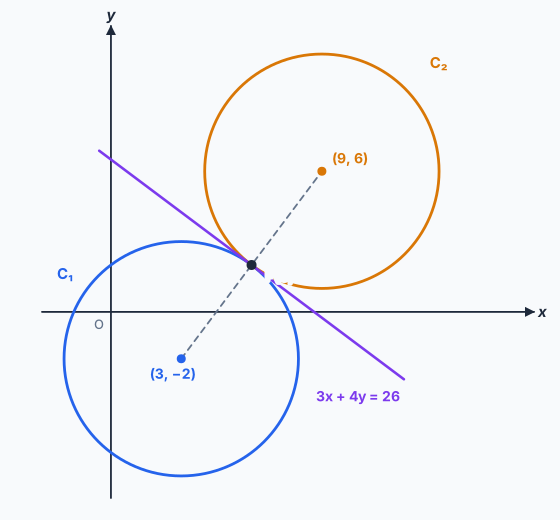
(a) \( (x - 3)^{2} - 9 + (y + 2)^{2} - 4 - 12 = 0 \), so \( (x - 3)^{2} + (y + 2)^{2} = 25 \). Centre \( (3, -2) \), radius 5.
(b) \( (6 - 3)^{2} + (2 + 2)^{2} = 9 + 16 = 25 \), so \(P\) is on the circle. The radius to \(P\) has gradient \( \dfrac{2 - (-2)}{6 - 3} = \tfrac{4}{3} \), so the tangent has gradient \( -\tfrac{3}{4} \):
(c) The distance between the centres is \( \sqrt{(9 - 3)^{2} + (6 + 2)^{2}} = \sqrt{100} = 10 = 5 + 5 \), so the circles touch externally. The point of contact is on the line of centres, 5 from each centre — the midpoint of \( (3, -2) \) and \( (9, 6) \), which is \( (6, 2) = P \).
📝Practise
Circle questions usually appear on Paper 1; one here needs a calculator.
1. (No calculator.) Find the centre and radius of the circle \( x^{2} + y^{2} + 8x - 10y + 5 = 0 \). [3]
2. (No calculator.) \( A(-1, 4) \) and \( B(5, -4) \) are the ends of a diameter of a circle. Find the equation of the circle. [3]
3. (No calculator.) Show that the line \( 3x - 4y = 25 \) is a tangent to the circle \( x^{2} + y^{2} = 25 \), and find the point of contact. [4]
4. (No calculator.) Find the values of \(k\) for which the line \( y = x + k \) is a tangent to \( x^{2} + y^{2} = 8 \). [3]
5. (No calculator.) Show that the circles \( (x - 1)^{2} + (y - 2)^{2} = 9 \) and \( (x - 7)^{2} + (y + 6)^{2} = 36 \) do not meet. [3]
6. (Calculator.) The circles \( x^{2} + y^{2} - 4x - 6y - 12 = 0 \) and \( x^{2} + y^{2} - 12x - 6y + 20 = 0 \) intersect at \(A\) and \(B\). Find the equation of the common chord and the length \(AB\). [5]
7. (No calculator.) Find the length of the tangent from \( P(1, 7) \) to the circle \( (x - 4)^{2} + (y - 3)^{2} = 9 \). [3]
🔗Go deeper — other people’s work
These are external resources, not mine. If one stops working, tell me and everything above it on this page still stands.
- GeoGebra — drag the centre of one circle and watch the common chord appear, shrink and become a tangent
- Desmos — enter a circle in expanded form to check your completed square