Factors of polynomials
🎯What you need to be able to do
- State and use the remainder theorem and the factor theorem, including for divisors like \( 2x - 1 \).
- Find unknown coefficients from given factors and remainders.
- Write a cubic as a linear factor times a quadratic factor, by inspection or by algebraic long division.
- Factorise completely, and solve cubic equations — including ones with surd roots, or only one real root.
📚The mathematics
The remainder theorem
When a polynomial \( p(x) \) is divided by \( x - a \), the remainder is \( p(a) \). More generally, dividing by \( ax - b \) leaves the remainder \( p\!\left(\tfrac{b}{a}\right) \) — substitute the value of \(x\) that makes the divisor zero.
The sign is where marks go: \( x + 2 \) is \( x - (-2) \), so you substitute \(-2\).
The factor theorem
The special case of remainder zero: \( x - a \) is a factor of \( p(x) \) if and only if \( p(a) = 0 \). To show that something is a factor, substitute and write the conclusion: “\( p(2) = 0 \), so \( x - 2 \) is a factor.”
To find a factor of a cubic with integer coefficients, try the divisors of the constant term (and, if the leading coefficient is not 1, fractions such as \( \pm\tfrac{1}{2} \)). Start with \( \pm 1, \pm 2, \pm 3 \).
From one factor to all of them
Once you have a linear factor, the syllabus expects you to write the cubic as (linear) × (quadratic), then deal with the quadratic. Two methods:
- Algebraic long division of \( p(x) \) by the factor.
- Comparing coefficients (“by observation”): write \( 2x^{3} + x^{2} - 13x + 6 = (x - 2)(2x^{2} + cx - 3) \). The \( 2x^{2} \) and \( -3 \) are forced by the \( x^{3} \) and constant terms; matching the \( x^{2} \) terms gives \( c - 4 = 1 \), so \( c = 5 \).
Then factorise the quadratic, or use the formula. If its discriminant is negative, the cubic has only one real root — a common “show that” ending.
✏️Worked example
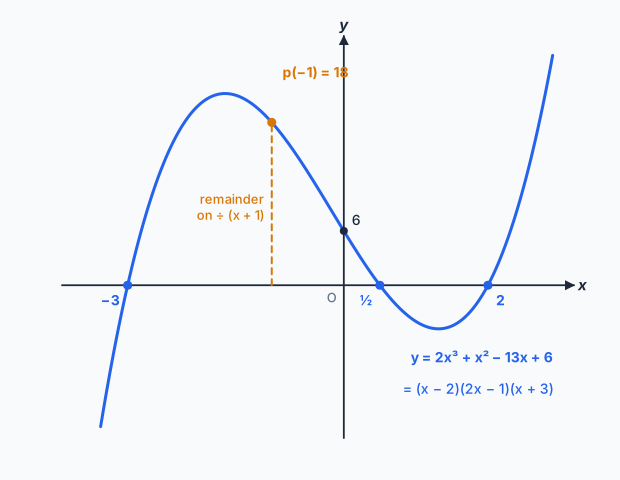
(a) Factor theorem: \( p(2) = 16 + 4a + 2b + 6 = 0 \), so \( 2a + b = -11 \). Remainder theorem: \( p(-1) = -2 + a - b + 6 = 18 \), so \( a - b = 14 \). Adding the two equations, \( 3a = 3 \), so \( a = 1 \) and \( b = -13 \).
(b) \( p(x) = 2x^{3} + x^{2} - 13x + 6 = (x - 2)(2x^{2} + 5x - 3) \), by comparing coefficients as above. Then \( 2x^{2} + 5x - 3 = (2x - 1)(x + 3) \), so
📝Practise
All of these are Paper 1 (no calculator) style: that is where polynomial work usually appears.
1. Find the remainder when \( 4x^{3} - 3x^{2} + 2x - 7 \) is divided by \( 2x - 1 \). [2]
2. Show that \( x + 2 \) is a factor of \( p(x) = x^{3} - 3x^{2} - 6x + 8 \), and hence factorise \( p(x) \) completely. [4]
3. When \( x^{3} + kx^{2} - 5x + 6 \) is divided by \( x - 3 \) the remainder is 36. Find \(k\). [2]
4. Solve \( x^{3} - 7x - 6 = 0 \). [4]
5. Solve \( 2x^{3} - 5x^{2} - 4x + 3 = 0 \). [5]
6. Show that \( x = 1 \) is a root of \( x^{3} - 3x^{2} - 2x + 4 = 0 \), and find the other two roots in exact form. [5]
7. \( p(x) = 2x^{3} + ax^{2} + bx + 4 \) has a factor \( x + 2 \), and leaves a remainder of 12 when divided by \( x - 1 \). (a) Find \(a\) and \(b\). (b) Show that \( p(x) = 0 \) has only one real root. [6]
🔗Go deeper — other people’s work
These are external resources, not mine. If one stops working, tell me and everything above it on this page still stands.
- Desmos — graph your cubic to check the roots you found, and read off \( p(a) \) as a height
- Khan Academy — polynomial long division, worked step by step