Circular measure
🎯What you need to be able to do
- Convert between degrees and radians, and know the common angles exactly.
- Use \( s = r\theta \) and \( A = \tfrac{1}{2}r^{2}\theta \) — which are not given in the exam.
- Combine sectors with triangles to find chord lengths, segment areas and perimeters.
- Solve problems on compound shapes, giving exact answers on Paper 1.
📚The mathematics
What a radian is
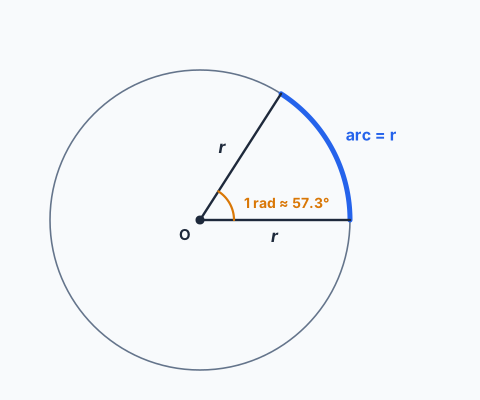
One radian is the angle at the centre of a circle subtended by an arc equal in length to the radius. A full turn is an arc of \( 2\pi r \), so it is \( 2\pi \) radians:
Arcs, sectors, chords and segments
With \( \theta \) in radians:
The syllabus states that these formulas are not given. The last two are not new formulas at all: the chord comes from splitting the isosceles triangle \(OAB\) into two right-angled triangles, and the segment is the sector minus the triangle, whose area is \( \tfrac{1}{2}ab\sin C \) (that one is in the List of formulas). The chord can also come from the cosine rule.
Your calculator must be in radian mode for \( \sin\theta \) when \( \theta \) is in radians. \( \sin 1.2 \) in degree mode is 0.0209, not 0.932, and it is the most common way to lose every accuracy mark in a Paper 2 sector question.
Compound shapes
Break the shape into sectors, triangles and rectangles, and write the plan down before calculating. A perimeter only includes the edges on the outside: arcs and the straight edges that are actually boundaries, not the radii that are hidden inside the shape.
✏️Worked example (calculator)
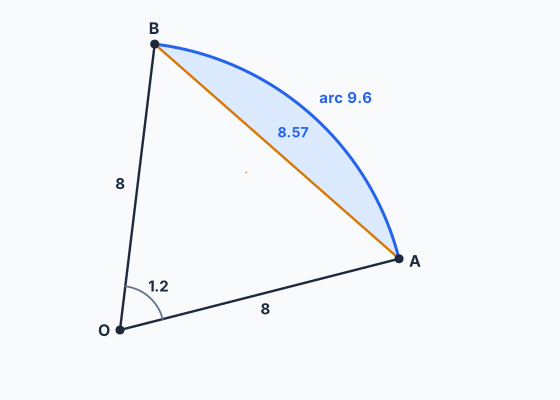
(a) Arc \( = 8 \times 1.2 = 9.6 \). Perimeter \( = 8 + 8 + 9.6 = 25.6 \) cm.
(b) Sector \( = \tfrac{1}{2}(8^{2})(1.2) = 38.4 \); triangle \( = \tfrac{1}{2}(8^{2})\sin 1.2 = 29.825\ldots \). Segment \( = 38.4 - 29.825 = 8.57 \) cm².
(c) Chord \( AB = 2(8)\sin 0.6 = 9.034\ldots \). Perimeter of the segment \( = 9.6 + 9.034 = 18.6 \) cm.
📝Practise
Written in the style of the current Paper 1 (no calculator) and Paper 2 (calculator) questions.
1. (No calculator.) Convert \( 150^{\circ} \) to radians, and \( 0.4\pi \) radians to degrees. [2]
2. (No calculator.) A sector has angle \( \tfrac{\pi}{3} \) and area \( 6\pi \) cm². Find its radius and its exact perimeter. [4]
3. (No calculator.) A chord of a circle of radius 6 cm subtends an angle of \( \tfrac{2\pi}{3} \) at the centre. Find the exact area of the minor segment. [4]
4. (Calculator.) A sector of radius 8 cm has perimeter 30 cm. Find the angle of the sector and its area. [3]
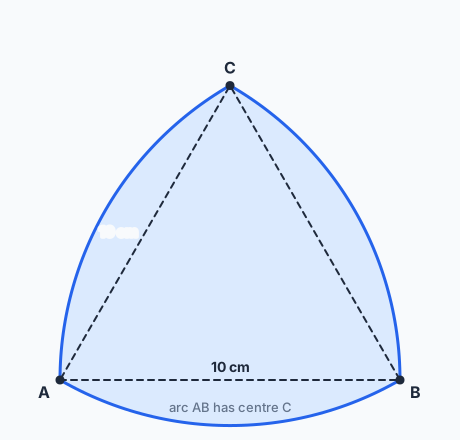
5. (Calculator.) \(ABC\) is an equilateral triangle of side 10 cm. Three arcs are drawn: arc \(BC\) with centre \(A\), arc \(CA\) with centre \(B\) and arc \(AB\) with centre \(C\), each of radius 10 cm. Find the perimeter and the area of the curved shape they enclose. [6]
6. (Calculator.) A sector of radius 5 cm has area 15 cm². Find the length of the chord joining the ends of its arc. [3]
🔗Go deeper — other people’s work
These are external resources, not mine. If one stops working, tell me and everything above it on this page still stands.
- GeoGebra — a sector with a slider for \( \theta \), to see the segment shrink as the angle does
- Your calculator manual — know how to switch to radian mode before the exam, not during it