Series
🎯What you need to be able to do
- Expand \( (a + b)^{n} \) for a positive integer \(n\), simplifying the coefficients.
- Use the general term \( \binom{n}{r}a^{n - r}b^{r} \) to find a particular coefficient, including the term independent of \(x\).
- Recognise arithmetic and geometric progressions and explain the difference.
- Use the \(n\)th term and sum formulas for both, including in context.
- State when a geometric progression has a sum to infinity, explain why, and find it.
📚The mathematics
The binomial theorem
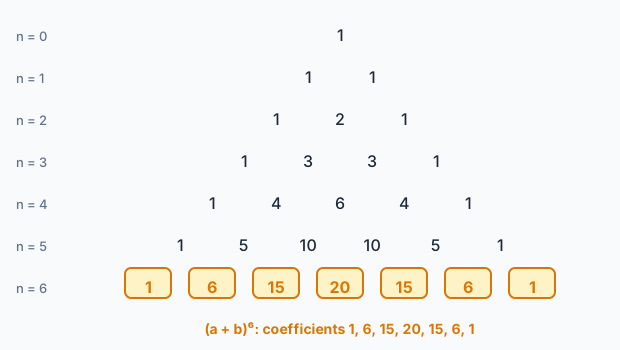
This is in the List of formulas. The coefficients \( \binom{n}{r} \) are the rows of Pascal’s triangle, which is quicker for small \(n\) on Paper 1. Two habits prevent almost every error: put \(b\) in a bracket with its sign, so \( \left(-\tfrac{x}{4}\right)^{2} \) is \( +\tfrac{x^{2}}{16} \), and raise the whole bracket to the power, coefficient and all.
The general term
The term containing \( b^{r} \) is \( \binom{n}{r}a^{n - r}b^{r} \). To find a specific power of \(x\), write the general term, collect the powers of \(x\) into one exponent in terms of \(r\), and solve for \(r\). The term independent of \(x\) is the one where that exponent is zero. It is a number: give it as one.
For a product such as \( (1 + 3x)(2 - \tfrac{x}{4})^{6} \), find the few terms of the expansion that can combine to give the power you want, and add the products.
Arithmetic and geometric progressions
These are all in the List of formulas. To show a sequence is an AP, show the differences are equal; for a GP, show the ratios are. For “find the least \(n\)” with a GP, the inequality ends in \( r^{n} < \ldots \); take logs, and remember that dividing by \( \ln r \) (negative when \( 0 < r < 1 \)) reverses the inequality.
Sum to infinity
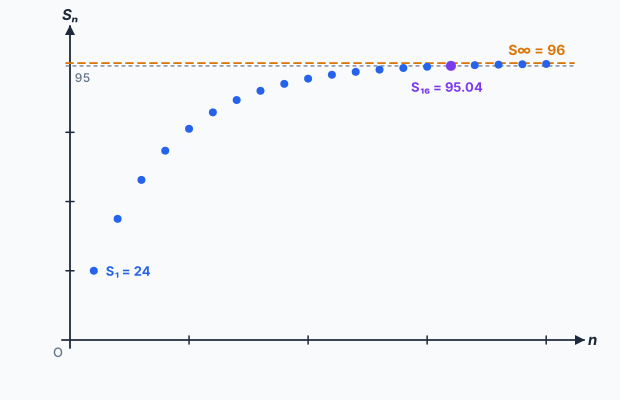
A GP converges only if \( |r| < 1 \): then \( r^{n} \to 0 \) and
To explain why a GP has no sum to infinity, state the ratio and that its modulus is not less than 1. An AP never has a sum to infinity (unless every term is zero).
✏️Worked example
(a) \( 2^{6} + 6(2^{5})\left(-\tfrac{x}{4}\right) + 15(2^{4})\left(-\tfrac{x}{4}\right)^{2} = 64 - 48x + 15x^{2} \).
(b) \( x^{2} \) terms come from \( 1 \times 15x^{2} \) and \( 3x \times (-48x) \): \( 15 - 144 = -129 \).
(c) General term: \( \binom{9}{r}(x^{2})^{9 - r}\left(-\tfrac{2}{x}\right)^{r} = \binom{9}{r}(-2)^{r}x^{18 - 3r} \). Independent of \(x\) when \( 18 - 3r = 0 \), \( r = 6 \): \( \binom{9}{6}(-2)^{6} = 84 \times 64 = 5376 \).
(d) \( \dfrac{24}{1 - r} = 96 \Rightarrow 1 - r = \tfrac{1}{4} \Rightarrow r = \tfrac{3}{4} \). Then \( S_{n} = 96\left(1 - 0.75^{n}\right) > 95 \) gives \( 0.75^{n} < \tfrac{1}{96} \), so \( n\ln 0.75 < -\ln 96 \) and, dividing by the negative \( \ln 0.75 \),
📝Practise
Written in the style of the current Paper 1 (no calculator) and Paper 2 (calculator) questions.
1. (No calculator.) Find the first four terms of \( (1 + 2x)^{5} \) in ascending powers of \(x\). [3]
2. (No calculator.) Find the coefficient of \( x^{3} \) in the expansion of \( (3 - 2x)^{7} \). [2]
3. (No calculator.) Find the term independent of \(x\) in \( \left(2x + \dfrac{1}{x^{2}}\right)^{6} \). [3]
4. (No calculator.) An arithmetic progression has first term 7 and common difference 4. Find the sum of the 10th to the 25th terms inclusive. [3]
5. (No calculator.) A geometric progression has second term 12 and fifth term 1.5. Find the first term, the common ratio and the sum to infinity. [4]
6. (No calculator.) Explain why the geometric progression \( 5, -7.5, 11.25, \ldots \) does not have a sum to infinity. [1]
7. (Calculator.) Ari’s starting salary is $30 000. Plan A raises it by 4% each year; Plan B raises it by $1500 each year. Find the total earned over the first 10 years under each plan, and state which is greater. [5]
🔗Go deeper — other people’s work
These are external resources, not mine. If one stops working, tell me and everything above it on this page still stands.
- Desmos — plot \( S_{n} \) for a GP and watch it level off at \( \tfrac{a}{1 - r} \)
- Khan Academy — the binomial theorem and arithmetic and geometric series