Logarithmic and exponential functions
🎯What you need to be able to do
- Move between index form and logarithm form, in any base, including \( \lg \) (base 10) and \( \ln \) (base \(e\)).
- Use the laws of logarithms, including change of base, to simplify and to combine logarithms.
- Solve equations of the form \( a^{x} = b \), and equations involving logarithms.
- Sketch \( y = ke^{nx} + a \) and \( y = k\ln(ax + b) \), with intercepts and the equations of asymptotes.
- Know that \( e^{x} \) and \( \ln x \) are inverse functions.
📚The mathematics
What a logarithm is
A logarithm is a power: \( \log_{2} 32 = 5 \) because \( 2^{5} = 32 \). Two special ones have their own names: \( \lg x = \log_{10} x \) and \( \ln x = \log_{e} x \). You can only take the log of a positive number, which is why answers to log equations must be checked.
The laws
None of these are in the List of formulas — learn them. And note what is not a law: \( \log(x + y) \) does not split, and \( \dfrac{\log x}{\log y} \) is not \( \log x - \log y \).
To write something like \( 3 + 2\lg p - \lg q \) as a single logarithm, turn the number into a log of the same base first: \( 3 = \lg 1000 \). Then \( 3 + 2\lg p - \lg q = \lg \dfrac{1000p^{2}}{q} \).
Solving equations
- \( a^{x} = b \): take logs of both sides (\( \ln \) or \( \lg \)), bring the power down, solve the linear equation.
- Logs on both sides: combine each side into a single log of the same base, then drop the logs (or rewrite in index form).
- Different bases: change them to one base first. \( \log_{4} X = \tfrac{1}{2}\log_{2} X \), because \( \log_{2} 4 = 2 \).
Then check every answer in the original: any value that makes the argument of a log zero or negative must be rejected.
Graphs and asymptotes
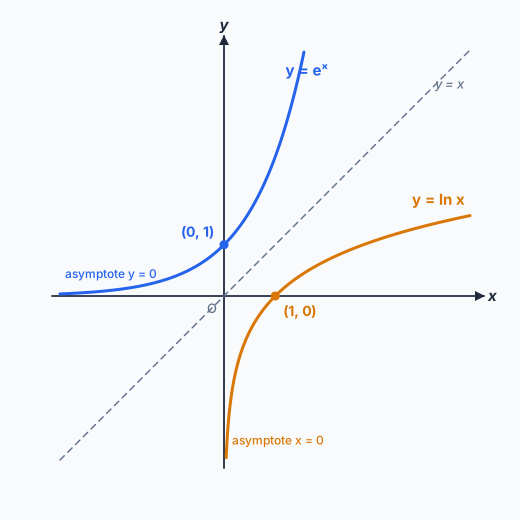
\( y = e^{x} \) and \( y = \ln x \) are inverses, so each is the reflection of the other in \( y = x \): \( e^{x} \) passes through \( (0, 1) \) with asymptote \( y = 0 \); \( \ln x \) passes through \( (1, 0) \) with asymptote \( x = 0 \).
The syllabus limits the graphs to two families:
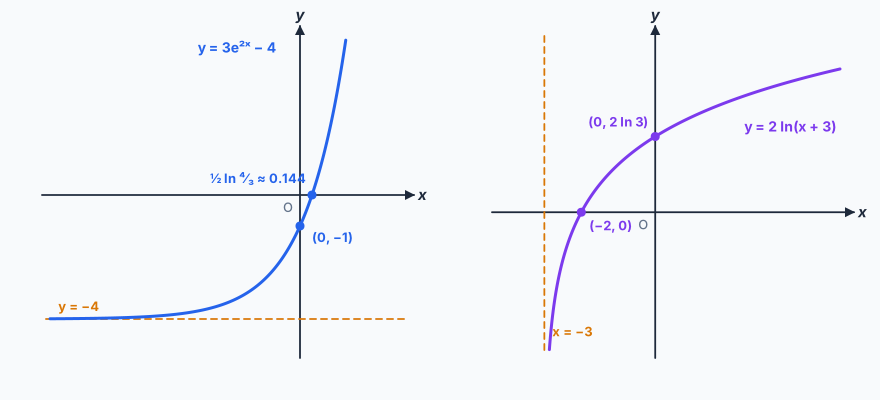
- \( y = ke^{nx} + a \): horizontal asymptote \( y = a \) (the exponential part tends to 0 at one end); \(y\)-intercept \( k + a \).
- \( y = k\ln(ax + b) \): vertical asymptote where \( ax + b = 0 \); crosses the \(x\)-axis where \( ax + b = 1 \).
✏️Worked example
(a) Take natural logs: \( (2x + 1)\ln 3 = x\ln 5 \). Collect the \(x\) terms: \( x(2\ln 3 - \ln 5) = -\ln 3 \), so
(b) Combine: \( \log_{2} x(x - 2) = 3 \), so \( x(x - 2) = 2^{3} = 8 \) and \( x^{2} - 2x - 8 = 0 \), giving \( (x - 4)(x + 2) = 0 \). But \( x = -2 \) would need \( \log_{2}(-2) \), which does not exist, so \( x = 4 \) only.
(c) Change base: \( \log_{x} 3 = \dfrac{1}{\log_{3} x} \). Let \( u = \log_{3} x \):
So \( \log_{3} x = 4 \Rightarrow x = 81 \), or \( \log_{3} x = -1 \Rightarrow x = \tfrac{1}{3} \).
📝Practise
Written in the style of the current Paper 1 (no calculator) and Paper 2 (calculator) questions.
1. (No calculator.) Write \( 3 + 2\lg p - \lg q \) as a single logarithm. [3]
2. (No calculator.) Write \( \dfrac{2}{\log_{3} e} \) as a single natural logarithm. [2]
3. (No calculator.) Solve \( \log_{4}(x + 6) - \log_{4} x = \tfrac{1}{2} \). [3]
4. (Calculator.) Solve \( 5^{x - 1} = 2^{x + 2} \). [3]
5. (No calculator.) Solve \( \log_{2} x = \log_{4}(x + 12) \). [4]
6. (No calculator.) The curve \( y = 5e^{-2x} + 3 \). (a) State the equation of the asymptote and the \(y\)-intercept. (b) Find the exact value of \(x\) for which \( y = 13 \). [4]
7. (Calculator.) The number of bacteria in a sample is modelled by \( N = 250e^{kt} \), where \(t\) is in hours. After 5 hours there are 400 bacteria. (a) Find \(k\). (b) Find the time at which there are 1000 bacteria. [5]
🔗Go deeper — other people’s work
These are external resources, not mine. If one stops working, tell me and everything above it on this page still stands.
- Desmos — plot \( y = ke^{nx} + a \) with sliders to see how each constant moves the asymptote and intercept
- Khan Academy — properties of logarithms and change of base