Circular motion and gravitational fields
🎯What you need to be able to do
- Define the radian and express angular displacement in radians; understand and use angular speed, \( \omega = 2\pi/T \) and \( v = r\omega \).
- Understand that a body in circular motion at constant speed has an acceleration directed towards the centre, and that a resultant force is needed to produce it.
- Recall and use \( a = r\omega^{2} = v^{2}/r \), and \( F = mr\omega^{2} = mv^{2}/r \).
- Understand that a gravitational field is a field of force, and define gravitational field strength as force per unit mass.
- State and use Newton’s law of gravitation, \( F = Gm_1m_2/r^{2} \), and analyse circular orbits using it.
- Derive and use \( g = GM/r^{2} \) for the field of a point mass, and understand why a uniform sphere behaves as a point mass at its centre for external points.
- Define gravitational potential, use \( \phi = -GM/r \), and relate it to potential energy \( E_p = -GMm/r \).
- Understand geostationary orbits and their uses.
📚The physics
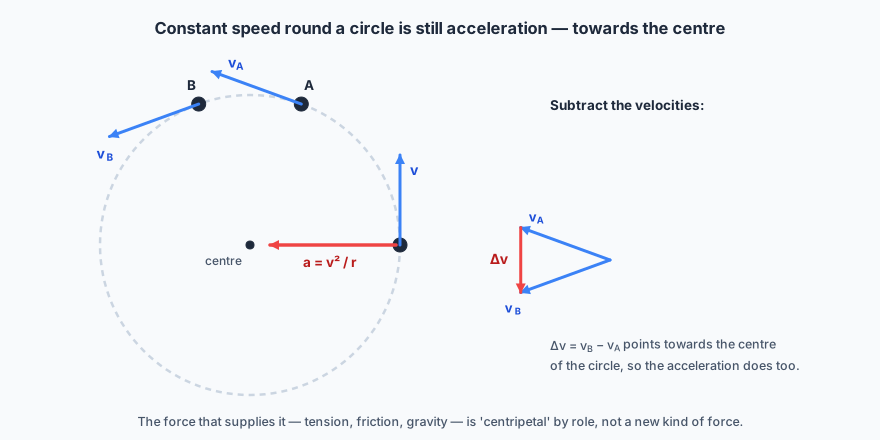
Circular motion is accelerated motion even at constant speed, because the velocity is a vector and its direction changes. The acceleration points towards the centre and has magnitude \( v^{2}/r \). There is no such thing as a “centrifugal force” in an inertial frame; centripetal force is a role, filled by whatever real force is available — tension, friction, the normal contact force, gravity. Every question in this topic reduces to identifying which force is playing that role and setting it equal to \( mv^{2}/r \).
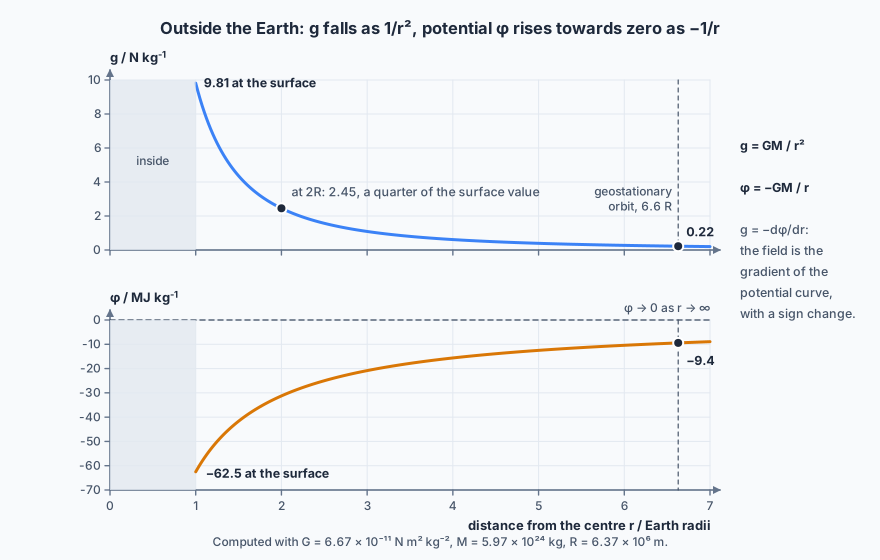
Newton’s law of gravitation is an inverse-square law between point masses, always attractive, with \( G = 6.67 \times 10^{-11} \) N m\(^{2}\) kg\(^{-2}\). Dividing by the mass being acted on gives the field strength \( g = GM/r^{2} \), which is also the free-fall acceleration at that point — the same quantity in two guises, N kg\(^{-1}\) and m s\(^{-2}\).
Orbits. For a satellite, gravity provides the centripetal force:
The satellite’s own mass cancels, which is why every satellite at a given radius has the same speed and period. Substituting \( v = 2\pi r/T \) gives Kepler’s third law, derived in three lines.
Potential is negative because the zero is defined at infinity and gravity is attractive: bringing a mass in from infinity releases energy, so the potential energy falls below zero. \( \phi = -GM/r \). Escape from a body requires kinetic energy at least equal to the depth of the well, \( \tfrac{1}{2}mv^{2} = GMm/r \), giving \( v_{\text{esc}} = \sqrt{2GM/r} \).
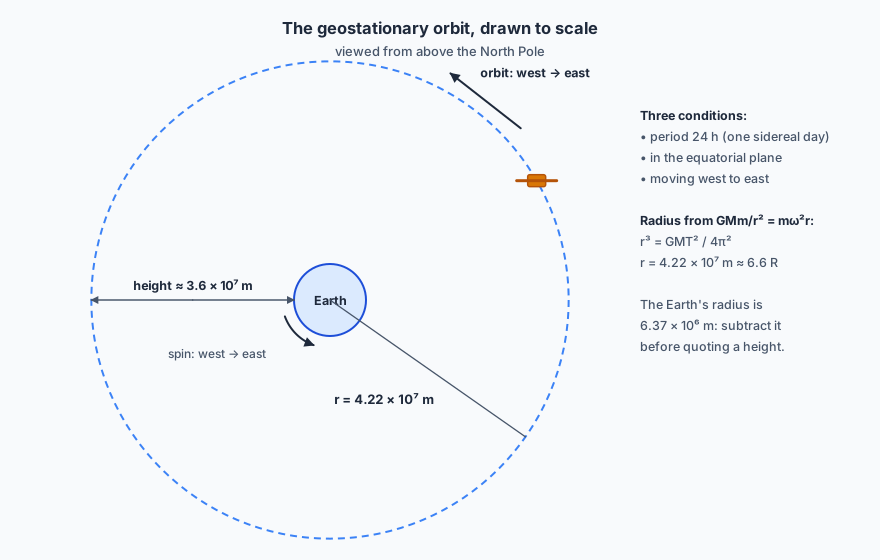
Geostationary orbits require three conditions together: period exactly 24 hours (strictly, one sidereal day), orbit in the plane of the equator, and travelling west to east. Only one radius satisfies the first, about \( 4.2 \times 10^{7} \) m from the Earth’s centre.
✏️Worked example
\( T = 24 \times 3600 = 8.64 \times 10^{4} \) s.
\( r^{3} = GMT^{2}/4\pi^{2} = (6.67 \times 10^{-11} \times 5.97 \times 10^{24} \times (8.64 \times 10^{4})^{2})/(4\pi^{2}) \)
🔭See it happen
Whirl a bung on a string through a glass tube with a weight hanging below, and vary the radius: the tension is set by the hanging weight, so \( v^{2}/r \) is fixed and the period changes visibly with radius. It is one of the few A Level experiments where the relationship can be felt in the hand as well as measured.
🔗Go deeper — other people’s work
The links below are not mine. They are here because they are good, and they may move or disappear without warning.
- PhET, Gravity and Orbits — turn gravity off mid-orbit and watch the satellite leave along the tangent.
- The Physics Classroom, “Circular Motion and Satellite Motion”.
- Isaac Physics, “Circular Motion” and “Gravitational Fields”.