Electricity and d.c. circuits
🎯What you need to be able to do
- Understand electric current as the rate of flow of charge, and use \( Q = It \).
- Understand that charge is quantised, and recall the elementary charge \( e = 1.60 \times 10^{-19} \) C.
- Derive and use \( I = Anvq \) for charge carriers moving with drift speed \(v\).
- Define potential difference and the volt; define and use the electromotive force of a source.
- Distinguish e.m.f. and p.d. in terms of energy transferred per unit charge.
- Use \( P = VI \), \( P = I^{2}R \) and \( P = V^{2}/R \).
- Define resistance, sketch and explain the \(I\)–\(V\) characteristics of a metallic conductor at constant temperature, a semiconductor diode and a filament lamp.
- Define resistivity and use \( R = \rho L/A \).
- Recall and use Kirchhoff’s first and second laws, and understand that they express conservation of charge and of energy.
- Derive and use the formulae for resistors in series and in parallel.
- Understand and use potential dividers, including with a thermistor or light-dependent resistor.
- Explain the effect of the internal resistance of a source on terminal p.d. and on power transfer.
📚The physics
Current and drift. \( I = \Delta Q/\Delta t \). In a wire of cross-section \(A\) containing \(n\) free carriers per unit volume, each of charge \(q\), moving at mean drift speed \(v\), the charge passing a point per second is \( Anvq \). Real drift speeds in copper are of the order of a tenth of a millimetre per second, which surprises students who expect electrons to race. The lamp lights immediately because the field, not the electrons, propagates at nearly the speed of light.
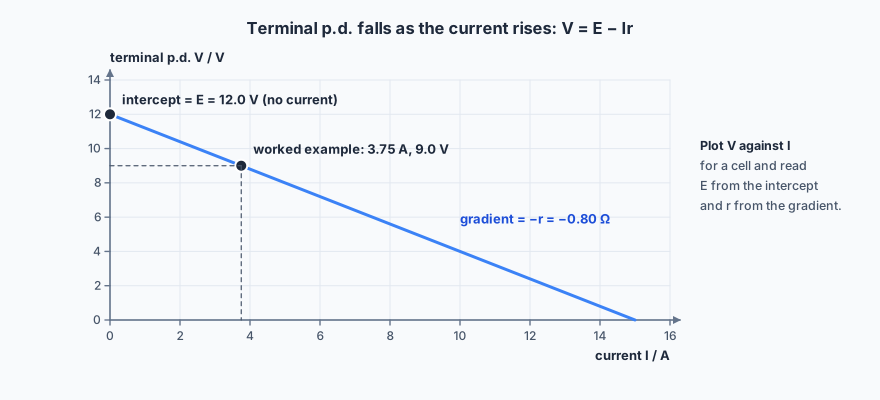
E.m.f. versus p.d. Both are energy per unit charge, both are measured in volts, and the difference is direction of transfer. E.m.f. is chemical or other energy converted into electrical energy per coulomb by the source; p.d. is electrical energy converted into other forms per coulomb in a component. A cell of e.m.f. \(E\) and internal resistance \(r\) delivering current \(I\) has terminal p.d. \( V = E - Ir \), so the terminal p.d. is only equal to the e.m.f. when no current flows.
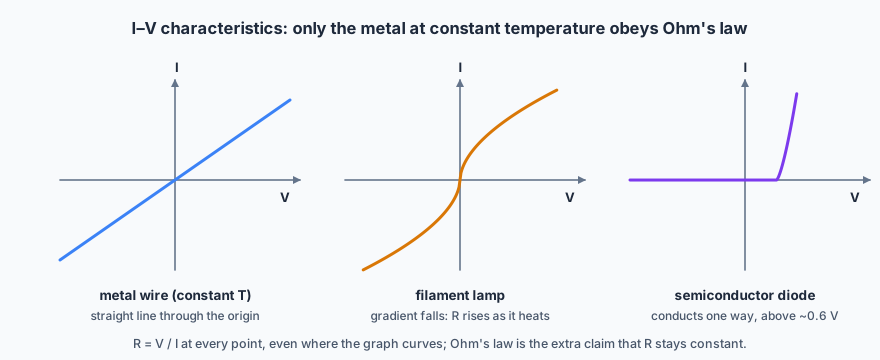
Resistance and resistivity. \( R = V/I \) always; Ohm’s law is the additional, restricted claim that \(R\) is constant, which holds for a metal only at constant temperature. A filament lamp curves because it gets hot: more current, higher temperature, more lattice vibration, more resistance. Resistivity \(\rho\) is the material property, \( R = \rho L/A \).
Kirchhoff’s laws. The first says the sum of currents into a junction equals the sum out — conservation of charge. The second says that round any closed loop the sum of the e.m.f.s equals the sum of the p.d.s — conservation of energy. Cambridge asks candidates to name the conservation law behind each, so learn them as a pair.
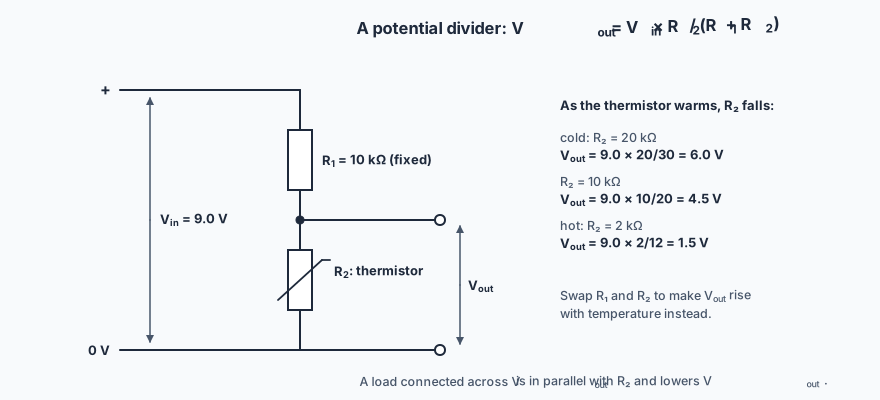
Potential dividers. Two resistors in series across a supply split the p.d. in the ratio of their resistances: \( V_{\text{out}} = V_{\text{in}} R_2/(R_1 + R_2) \). Replace one with a thermistor or LDR and you have a temperature or light sensor. Note that connecting a load across the output changes the division, because the load is in parallel with \( R_2 \).
✏️Worked example
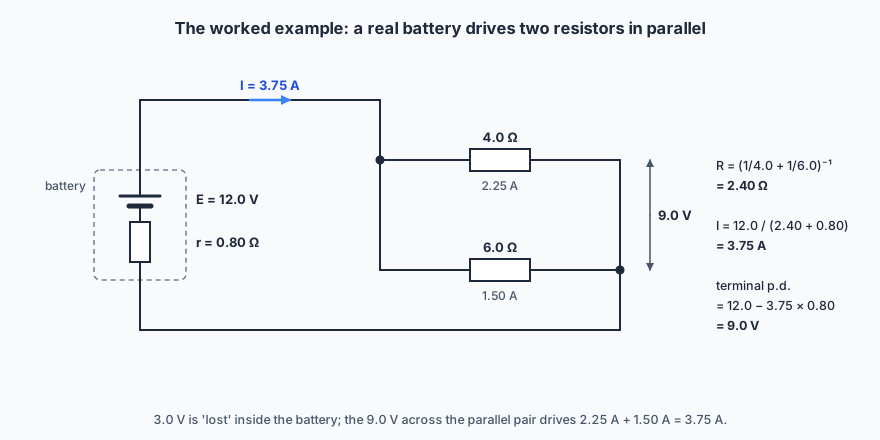
Parallel combination: \( 1/R = 1/4.0 + 1/6.0 = 0.4167 \), so \( R = 2.40 \) Ω.
Total circuit resistance \( = 2.40 + 0.80 = 3.20 \) Ω.
\( I = E/(R + r) = 12.0/3.20 = 3.75 \) A.
🔭See it happen
Measure the terminal p.d. of an old AA cell as you increase the current through it. The intercept of the \(V\)–\(I\) graph is the e.m.f. and the gradient is \(-r\), and an old cell shows a dramatically steeper gradient than a new one — internal resistance is what “going flat” actually means. For resistivity, measure the resistance of a reel of nichrome wire at several lengths and plot \(R\) against \(L\).
🔗Go deeper — other people’s work
The links below are not mine. They are here because they are good, and they may move or disappear without warning.
- PhET, Circuit Construction Kit: DC — includes internal resistance and a working ammeter and voltmeter.
- The Physics Classroom, “Electric Circuits”.
- Isaac Physics, “Circuits” problem sets.