Work, energy and power
🎯What you need to be able to do
- Understand work done as the product of force and displacement in the direction of the force, and use \( W = Fs\cos\theta \).
- Recall and apply the principle of conservation of energy.
- Derive and use \( E_k = \tfrac{1}{2}mv^{2} \), and use \( \Delta E_p = mg\Delta h \) for changes in gravitational potential energy near the Earth’s surface.
- Understand and use the concept of efficiency, and calculate it as useful output divided by total input.
- Define power as work done per unit time, and derive and use \( P = Fv \).
📚The physics
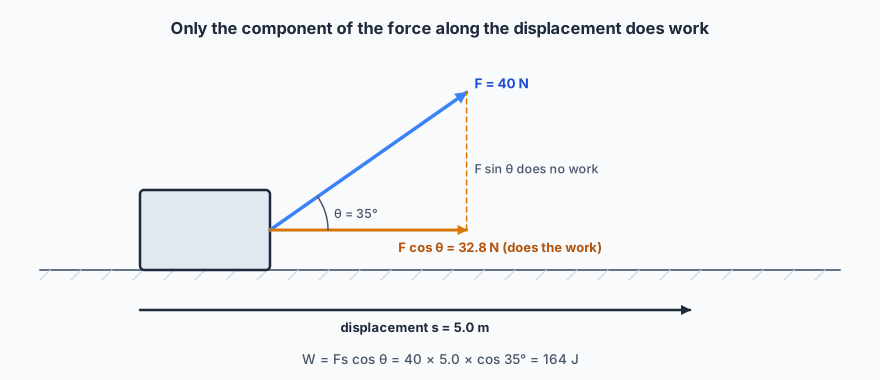
Work transfers energy. If the force and the displacement are not parallel, only the component of the force along the displacement does work: \( W = Fs\cos\theta \). Three consequences follow immediately. A force perpendicular to the motion does no work, which is why the tension in a string does no work on a mass whirling in a circle, and why the normal contact force on a body sliding along a floor does none. A force opposing the motion does negative work. And a force acting on a stationary body does no work no matter how large it is.
A note for later. When a gas at constant pressure \(p\) expands by \(\Delta V\), it pushes the surroundings back and does work \( p\Delta V \). That is a topic 16 objective rather than a topic 5 one, but it is the same idea of work done by a force through a distance, and it is worth meeting here.
Kinetic energy is derived, not assumed. Apply \( W = Fs \) with \( F = ma \) and \( v^{2} = u^{2} + 2as \) to a body starting from rest: \( W = mas = m(v^{2}/2s)s = \tfrac{1}{2}mv^{2} \). Being able to reproduce that derivation is itself examinable.
Potential energy. \( \Delta E_p = mg\Delta h \) is valid only where the field is effectively uniform, i.e. over heights small compared with the radius of the Earth. Topic 13 replaces it with the general expression.
Efficiency = useful output energy / total input energy, and it can never exceed 1. If a calculation gives more than 100% you have either counted an energy twice or mislabelled the input.
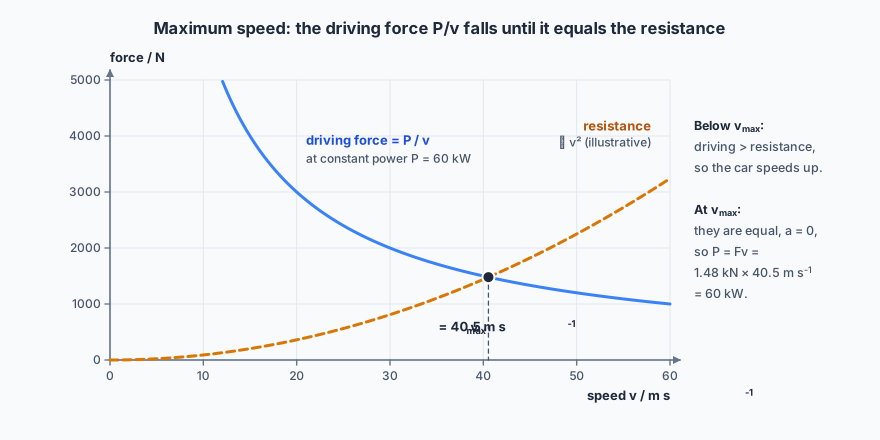
Power. \( P = W/t \). For a body moving at speed \(v\) against a resistive force, the driving force does work \( Fv \) per second, so \( P = Fv \). At the maximum speed of a vehicle the driving force equals the total resistive force, and the output power is a maximum — this is the standard exam scenario.
✏️Worked example
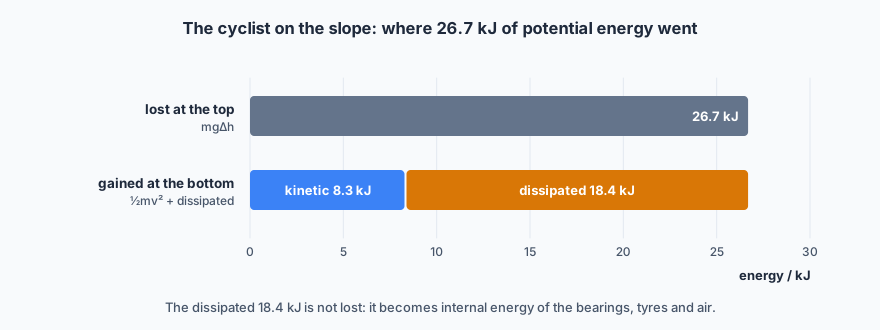
Loss of gravitational potential energy \( = mg\Delta h = 85 \times 9.81 \times 32 = 2.67 \times 10^{4} \) J.
Gain in kinetic energy \( = \tfrac{1}{2}mv^{2} = 0.5 \times 85 \times 14^{2} = 8.33 \times 10^{3} \) J.
🔭See it happen
Drop a bouncing ball beside a metre rule and film it. The ratio of rebound height to drop height gives you the fraction of energy returned in a single bounce, and repeating with a squash ball warmed in your hand versus one straight from a cold room makes the energy accounting visible rather than theoretical.
🔗Go deeper — other people’s work
The links below are not mine. They are here because they are good, and they may move or disappear without warning.
- PhET, Energy Skate Park — the bar chart makes the transfers explicit, including the thermal share when friction is on.
- The Physics Classroom, “Work, Energy and Power”.
- Isaac Physics, “Energy” problem sets.