Magnetic fields and alternating currents
🎯What you need to be able to do
- Understand that a magnetic field is a field of force produced by moving charges or by permanent magnets, and represent it by field lines.
- Determine the direction of the force on a current-carrying conductor and on a moving charge in a magnetic field.
- Recall and use \( F = BIL\sin\theta \), and define magnetic flux density and the tesla.
- Recall and use \( F = BQv\sin\theta \), and describe the motion of a charged particle in a uniform magnetic field.
- Explain the use of velocity selectors with crossed electric and magnetic fields.
- Define magnetic flux and magnetic flux linkage, and use \( \Phi = BA \).
- State and use Faraday’s and Lenz’s laws of electromagnetic induction, and relate Lenz’s law to conservation of energy.
- Understand and use the terms period, frequency, peak value and root-mean-square value for an alternating current or voltage.
- Use \( I_{\text{rms}} = I_0/\sqrt{2} \) and the corresponding relation for voltage, and calculate mean power in a resistive load.
- Understand half-wave and full-wave rectification, and the use of a capacitor to smooth a rectified output.
- Understand the origin of the Hall voltage, and derive and use \( V_H = BI/ntq \).
- Sketch the magnetic field patterns due to a long straight wire, a flat circular coil and a long solenoid, and understand the forces between current-carrying conductors.
📚The physics
Getting the direction right. Fleming’s left-hand rule gives the force on a current-carrying conductor: first finger field, second finger current, thumb motion. For a moving negative charge, point the second finger along the conventional current, which is opposite to the electron’s velocity. Draw the axes on the page every time; the mental rotation is where marks disappear.
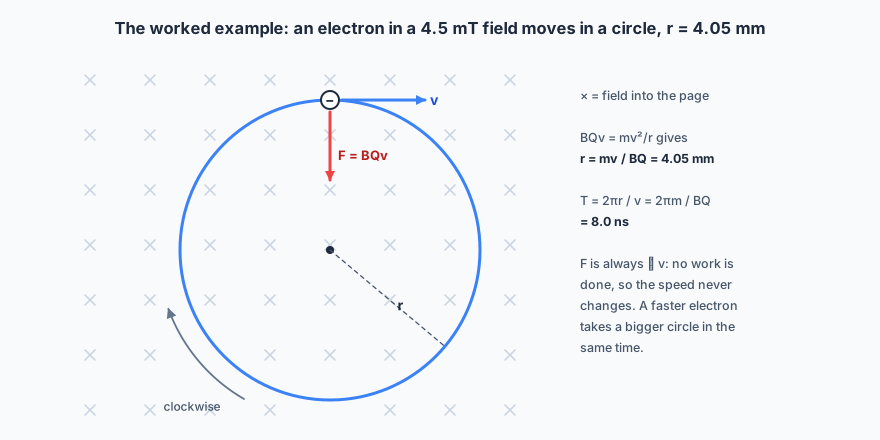
Circular motion in a field. Because \( F = BQv \) is always perpendicular to \(v\), the force does no work and the speed is constant — only the direction changes. Setting \( BQv = mv^{2}/r \) gives \( r = mv/BQ \). The radius is proportional to momentum, which is the working principle of every mass spectrometer and bubble chamber.
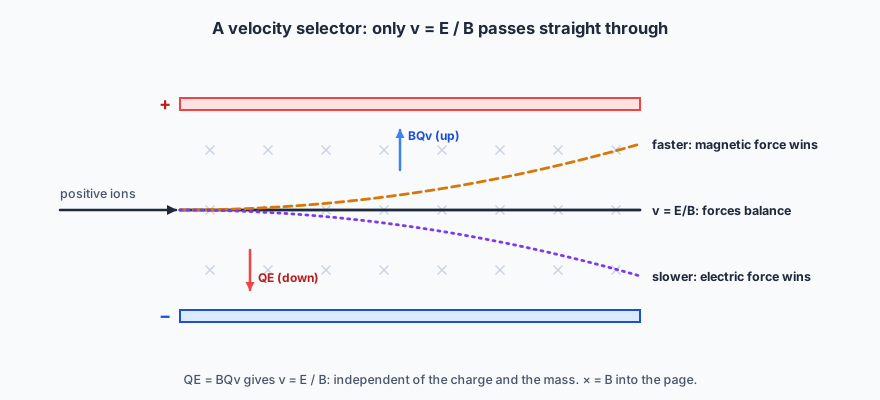
Velocity selector. With \(E\) and \(B\) at right angles, a charge passes undeflected when \( QE = BQv \), so \( v = E/B \). Note that this selects on speed alone — independent of the charge and mass of the particle.
Induction. Faraday: the induced e.m.f. is proportional to the rate of change of flux linkage, \( \mathcal{E} = -N\,\mathrm{d}\Phi/\mathrm{d}t \). Lenz: the induced current opposes the change producing it. Lenz’s law is a statement of energy conservation — if the induced effect helped the change, you would get energy from nothing. That sentence is worth a mark on its own and candidates rarely write it.
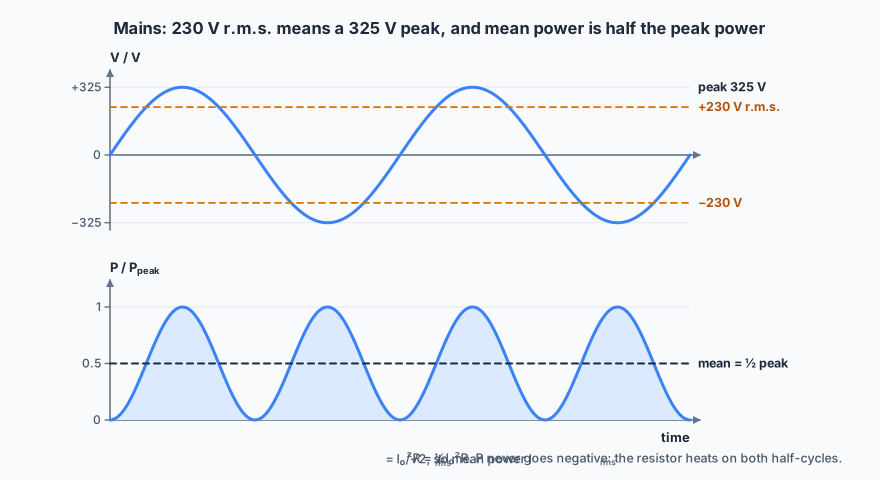
R.m.s. values. The r.m.s. value of an alternating current is the direct current that would dissipate the same mean power in the same resistor. For a sinusoid, \( I_{\text{rms}} = I_0/\sqrt{2} \). Mean power is \( I_{\text{rms}}^{2}R \), which is exactly half the peak power. The 230 V mains supply has a peak of about 325 V, which is what the insulation must withstand.
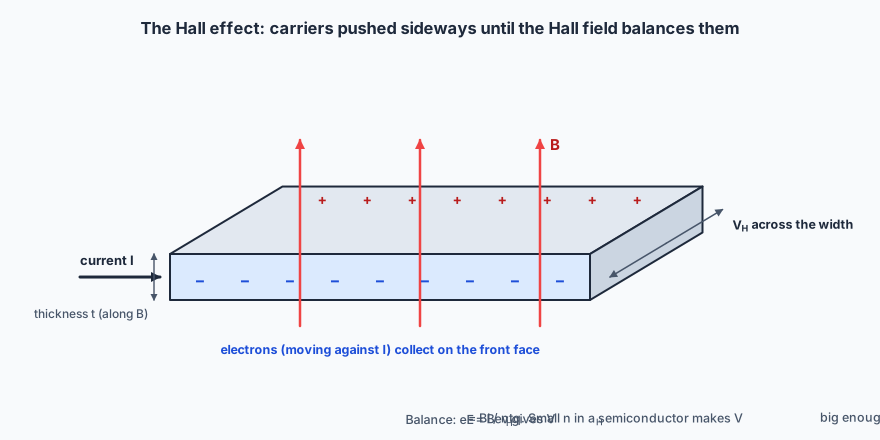
The Hall effect. When a current flows through a slice of material placed in a perpendicular magnetic field, the carriers are pushed sideways until the electric field they build up balances the magnetic force. That gives \( V_H = BI/ntq \), where \(t\) is the thickness along the field. Because \(n\) is small in a semiconductor, Hall probes are made of semiconductor rather than metal.
✏️Worked example
\( r = mv/BQ = (9.11 \times 10^{-31} \times 3.2 \times 10^{6})/(4.5 \times 10^{-3} \times 1.60 \times 10^{-19}) = 4.05 \times 10^{-3} \) m.
🔭See it happen
Drop a strong magnet down a copper pipe next to an identical non-magnetic slug: the magnet takes several seconds while the slug falls in a fraction of one. Nothing touches the magnet, and there is no visible circuit — it is the clearest demonstration of Lenz’s law available, and students remember it years later. A fine-beam tube, if your lab has one, makes the circular electron path visible directly.
🔗Go deeper — other people’s work
The links below are not mine. They are here because they are good, and they may move or disappear without warning.
- PhET, Faraday’s Law and Generator.
- The Physics Classroom, “Magnetism”.
- Isaac Physics, “Magnetic Fields” and “Electromagnetic Induction”.