Astronomy and cosmology
🎯What you need to be able to do
- Understand the term luminosity as the total power radiated by a star, and radiant flux intensity as the radiant power passing normally through unit area.
- Recall and use the inverse square law for radiant flux intensity, \( F = L/4\pi d^{2} \).
- Understand the meaning of a standard candle and its use in determining distances.
- Recall and use Wien’s displacement law, \( \lambda_{\max}T \approx 2.9 \times 10^{-3} \) m K, to estimate the surface temperature of a star.
- Recall and use the Stefan–Boltzmann law, \( L = 4\pi\sigma r^{2}T^{4} \).
- Use Wien’s law and the Stefan–Boltzmann law together to estimate the radius of a star.
- Understand that the lines in an emission or absorption spectrum are characteristic of particular elements, and that a Doppler shift of those lines gives the radial velocity.
- Recall and use \( \Delta\lambda/\lambda \approx \Delta f/f \approx v/c \) for the redshift of electromagnetic radiation.
- Explain why the redshift of galaxies leads to the idea of an expanding universe; recall and use Hubble’s law, \( v \approx H_0 d \).
📚The physics
Luminosity and flux. Luminosity is intrinsic to the star, measured in watts; radiant flux intensity is what reaches us, in W m\(^{-2}\), and falls as \( 1/d^{2} \). A bright star in the sky may be a modest star nearby or a vast one far away, and separating the two is the central problem of observational astronomy.
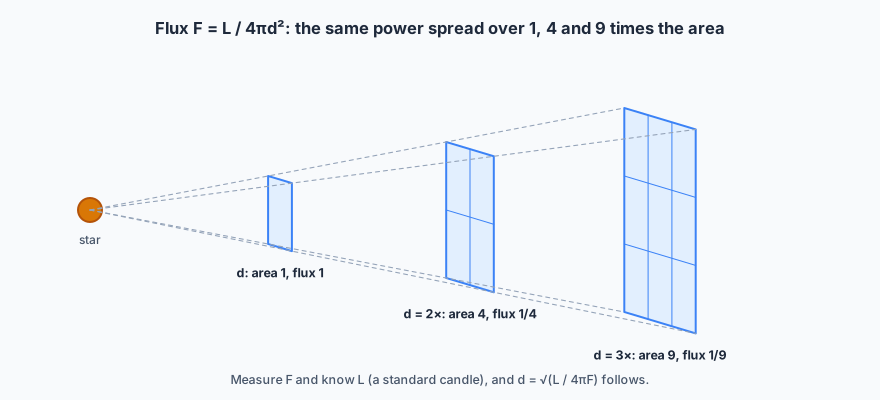
Standard candles solve it. If a class of object has a known luminosity — Cepheid variables, or type Ia supernovae — then measuring \(F\) gives \(d\) from \( d = \sqrt{L/4\pi F} \). Everything we claim to know about extragalactic distances rests on this.
Temperature from colour. A star radiates approximately as a black body, so the wavelength at which its spectrum peaks is inversely proportional to its temperature. A red star is cool; a blue-white one is hot. That is Wien’s law, and it needs no more than a spectrum.
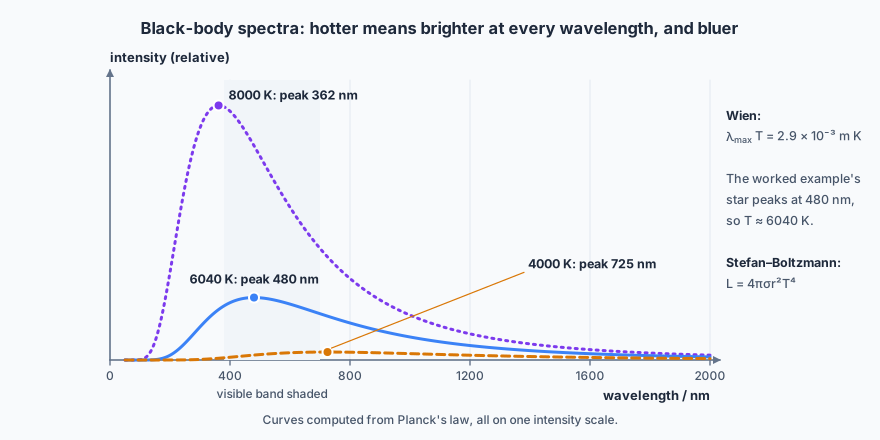
Radius from the two laws together. Wien’s law gives \(T\) from \( \lambda_{\max} \); a standard candle or parallax gives \(d\), hence \(L\) from the measured \(F\); then \( L = 4\pi\sigma r^{2}T^{4} \) gives \(r\). This chain — measure light, deduce the physical size of an object trillions of kilometres away — is one of the most satisfying things in the whole syllabus.
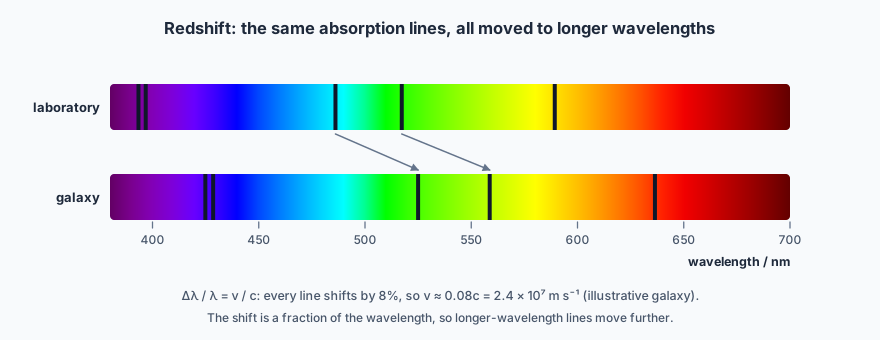
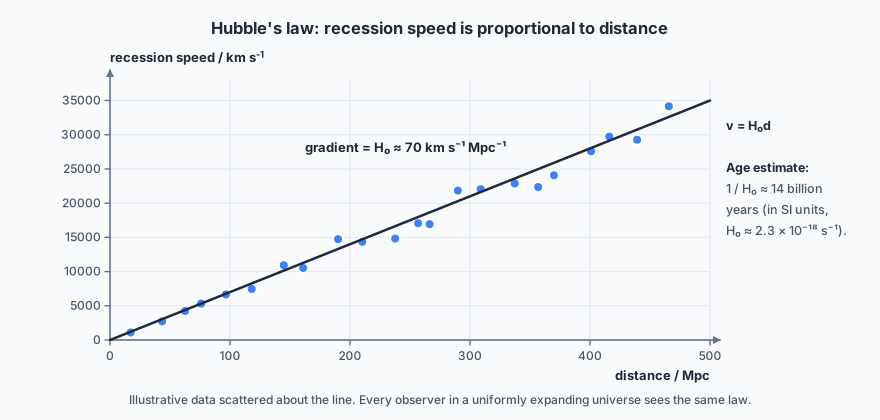
Redshift and expansion. Absorption lines in galactic spectra appear at longer wavelengths than in the laboratory, and the shift is larger for more distant galaxies. Hubble’s law, \( v = H_0 d \), follows. The usual misreading is that we are at the centre of the expansion: in fact every observer in a uniformly expanding universe sees the same law, because it is space itself that is expanding rather than galaxies flying apart through it. Inverting \( H_0 \) gives an estimate of the age of the universe.
✏️Worked example
\( T = 2.9 \times 10^{-3}/480 \times 10^{-9} = 6.04 \times 10^{3} \) K.
\( L = 4\pi d^{2}F = 4\pi \times (2.6 \times 10^{18})^{2} \times 3.2 \times 10^{-9} = 2.72 \times 10^{29} \) W.
\( r^{2} = L/(4\pi\sigma T^{4}) = 2.72 \times 10^{29}/(4\pi \times 5.67 \times 10^{-8} \times (6.04 \times 10^{3})^{4}) = 2.87 \times 10^{20} \) m\(^{2}\).
🔭See it happen
A diffraction grating held up to a sodium street lamp and then to a compact fluorescent bulb shows two completely different line spectra with the naked eye, which is the whole basis of stellar spectroscopy in ten seconds. For redshift, a sound source swung on a string past the class gives the Doppler shift in a form students can hear before they meet it as an equation.
🔗Go deeper — other people’s work
The links below are not mine. They are here because they are good, and they may move or disappear without warning.
- NASA and ESA public archives — real spectra and images, freely available.
- HyperPhysics, “Astrophysics”.
- Isaac Physics, “Astrophysics” problem sets.