Temperature and ideal gases
🎯What you need to be able to do
- Understand that thermal energy is transferred from a region of higher temperature to one of lower temperature, and that regions of equal temperature are in thermal equilibrium.
- Understand that a physical property varying with temperature may be used for its measurement, and state examples of such properties.
- Understand the thermodynamic (Kelvin) scale, know that it does not depend on the property of any particular substance, and convert using \( T/\mathrm{K} = \theta/^\circ\mathrm{C} + 273.15 \).
- Define and use specific heat capacity, and define and use specific latent heat, distinguishing fusion from vaporisation.
- Understand the concept of the mole and the Avogadro constant.
- Recall and use \( pV = nRT \) as the equation of state of an ideal gas.
- State the basic assumptions of the kinetic theory of gases, and explain how molecular movement causes the pressure exerted by a gas.
- Recall and use \( pV = \tfrac{1}{3}Nm\langle c^{2}\rangle \), and compare it with \( pV = NkT \).
- Deduce and use \( E_k = \tfrac{3}{2}kT \) for the mean translational kinetic energy of a molecule.
📚The physics
Temperature is not heat. Temperature tells you the direction of net thermal energy transfer; it is not a measure of the total energy a body contains. A bath at 40 °C contains far more internal energy than a spark at 1000 °C. Two bodies at the same temperature are in thermal equilibrium and there is no net transfer between them.
The thermodynamic scale is defined without reference to any substance, which is why it is the scale physics uses. Absolute zero is the temperature at which a body has minimum internal energy; it is not where all motion stops in the classical sense, but for this course “minimum internal energy” is the phrase examiners want.
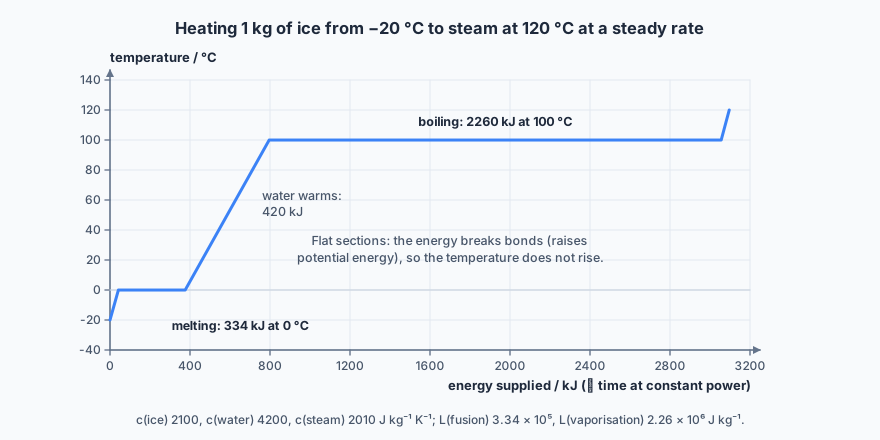
Specific heat capacity \(c\) is the energy needed per kilogram per kelvin, \( Q = mc\Delta T \); specific latent heat \(L\) is the energy per kilogram to change state at constant temperature, \( Q = mL \). During a change of state the temperature does not rise because the energy supplied goes into breaking bonds — increasing the potential energy of the molecules, not their kinetic energy. That single sentence explains the flat sections of every heating curve.
The ideal gas equation. \( pV = nRT \) with \( R = 8.31 \) J mol\(^{-1}\) K\(^{-1}\), or equivalently \( pV = NkT \) with \( k = R/N_A = 1.38 \times 10^{-23} \) J K\(^{-1}\). The temperature must be in kelvin. Always.
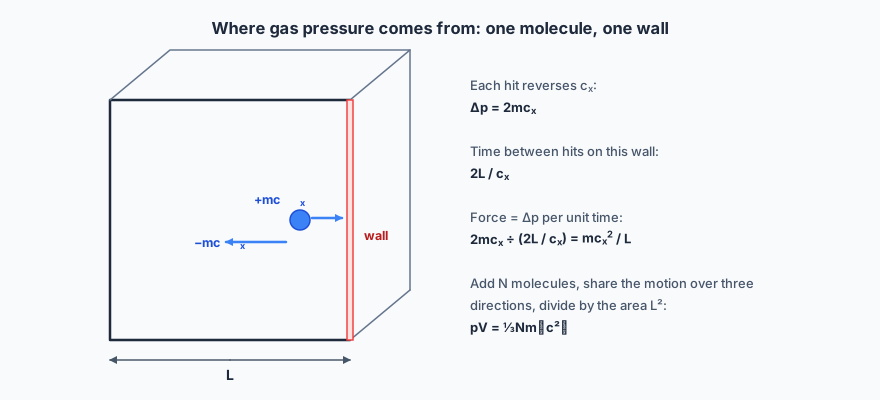
Kinetic theory assumptions: a large number of molecules in random motion; molecular volume negligible compared with the volume of the container; no intermolecular forces except during collisions; collisions are perfectly elastic and of negligible duration; Newtonian mechanics applies. From these follows \( pV = \tfrac{1}{3}Nm\langle c^{2}\rangle \).
The punchline. Setting \( \tfrac{1}{3}Nm\langle c^{2}\rangle = NkT \) gives
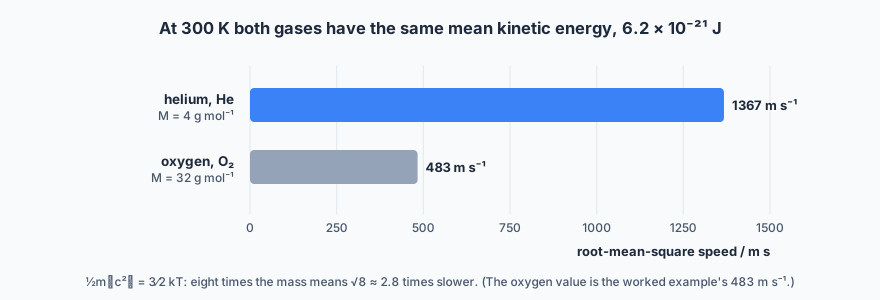
The mean translational kinetic energy of a molecule is proportional to the absolute temperature and to nothing else — not to the mass of the molecule, not to the pressure. At the same temperature, a helium molecule and an oxygen molecule have the same mean kinetic energy, so the lighter one moves faster.
✏️Worked example
\( T = 27 + 273 = 300 \) K.
\( n = pV/RT = (1.8 \times 10^{6} \times 0.020)/(8.31 \times 300) = 14.4 \) mol.
Mass of one molecule \( m = 0.032/6.02 \times 10^{23} = 5.32 \times 10^{-26} \) kg.
\( \tfrac{1}{2}m\langle c^{2}\rangle = \tfrac{3}{2}kT \) gives \( \langle c^{2}\rangle = 3kT/m = (3 \times 1.38 \times 10^{-23} \times 300)/5.32 \times 10^{-26} = 2.33 \times 10^{5} \) m\(^{2}\) s\(^{-2}\).
🔭See it happen
A Brownian motion smoke cell under a microscope is still the most direct evidence that air molecules exist and move randomly: the smoke particles jitter because they are being struck unevenly by things too small to see. For the gas laws, a syringe sealed with a pressure sensor gives \(p\) against \(1/V\) as a straight line through the origin in a single lesson.
🔗Go deeper — other people’s work
The links below are not mine. They are here because they are good, and they may move or disappear without warning.
- PhET, Gas Properties — you can watch the speed distribution shift as you change the temperature.
- The Physics Classroom, “Thermal Physics”.
- Isaac Physics, “Gases” problem sets.