Thermodynamics
🎯What you need to be able to do
- Understand that internal energy is the sum of the random distribution of kinetic and potential energies associated with the molecules of a system.
- Relate a rise in temperature of a body to an increase in its internal energy.
- Recall and use \( W = p\Delta V \) for the work done when the volume of a gas changes at constant pressure.
- Recall and use the first law of thermodynamics, \( \Delta U = q + W \), expressed in terms of the increase in internal energy, the heating of the system and the work done on the system.
📚The physics
Internal energy has two parts: the random kinetic energy of the molecules, which depends on temperature, and the potential energy associated with the forces between them, which depends on separation and therefore on state. For an ideal gas there are no intermolecular forces, so the potential part is zero and the internal energy depends on temperature alone. That is why an ideal gas at constant temperature has constant internal energy no matter how its pressure and volume change.
The word random matters. A cylinder of gas moving along on a lorry has extra kinetic energy, but not extra internal energy: that motion is ordered, not random. Cambridge asks for the definition with “random distribution” in it.
The first law is conservation of energy for a thermodynamic system:
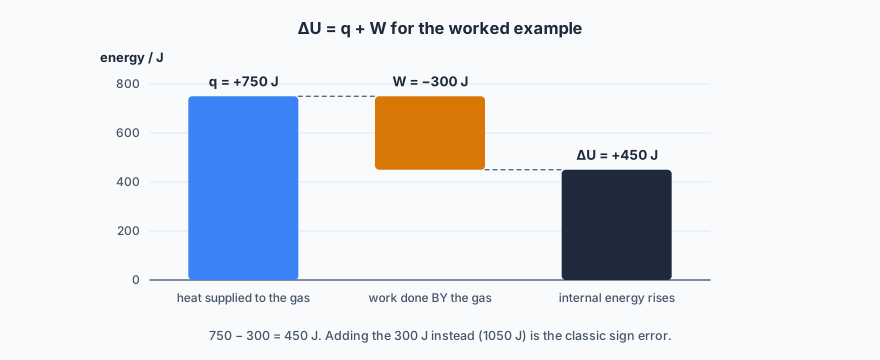
where \(q\) is the thermal energy supplied to the system and \(W\) is the work done on the system. Both signs follow from that phrasing. Compressing a gas does positive work on it. A gas expanding against the atmosphere does work on the surroundings, so \(W\) is negative for the gas.
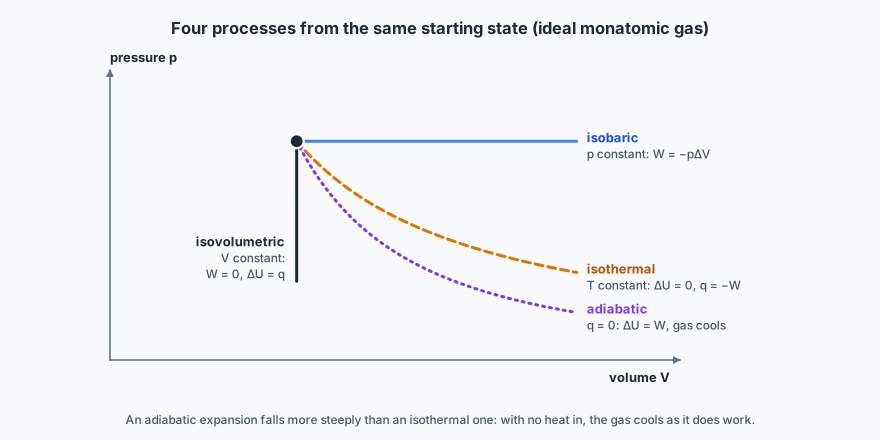
Four standard processes. Isothermal: \( \Delta T = 0 \), so for an ideal gas \( \Delta U = 0 \) and \( q = -W \). Isovolumetric: \( \Delta V = 0 \), so \( W = 0 \) and \( \Delta U = q \). Isobaric: \(p\) constant, \( W = -p\Delta V \) for the gas. Adiabatic: \( q = 0 \), so \( \Delta U = W \) — which is why a gas cools when it expands adiabatically and warms when it is compressed adiabatically. A bicycle pump getting hot is the adiabatic case in your hand.
✏️Worked example
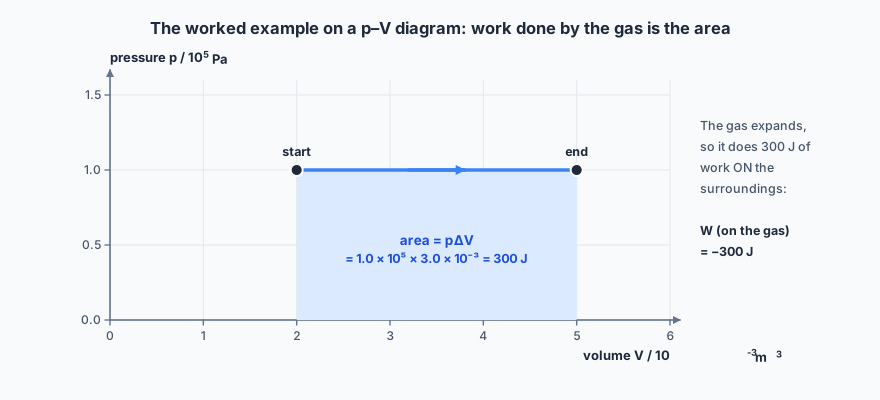
Work done by the gas \( = p\Delta V = 1.0 \times 10^{5} \times (5.0 - 2.0) \times 10^{-3} = 300 \) J.
So the work done on the gas is \( W = -300 \) J.
🔭See it happen
A fire syringe — a thick-walled tube in which a rapid compression ignites a scrap of cotton wool — is the adiabatic case at its most dramatic, and takes ten seconds. Safer and nearly as good: release a can of compressed air for several seconds and let students feel the can go cold. No heat was removed; the gas did work on its surroundings as it expanded, and paid for it out of its own internal energy.
🔗Go deeper — other people’s work
The links below are not mine. They are here because they are good, and they may move or disappear without warning.
- HyperPhysics, “Thermodynamics” — concise, and consistent about sign conventions.
- Isaac Physics, “Thermodynamics” problem sets.