Oscillations
🎯What you need to be able to do
- Understand and use the terms displacement, amplitude, period, frequency, angular frequency and phase difference for an oscillation.
- Understand that the frequency is \( 1/T \), and use \( \omega = 2\pi f \).
- Understand that simple harmonic motion occurs when acceleration is proportional to displacement from a fixed point and always directed towards that point; use \( a = -\omega^{2}x \).
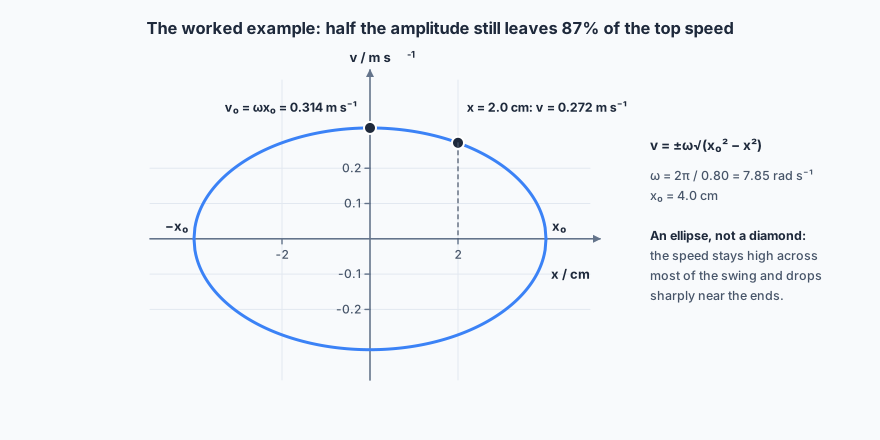
- Use \( x = x_0\sin\omega t \) and \( v = v_0\cos\omega t \) as solutions, and use \( v = \pm\omega\sqrt{x_0^{2} - x^{2}} \).
- Analyse and interpret graphs of displacement, velocity and acceleration against time, and against each other.
- Describe the interchange between kinetic and potential energy during simple harmonic motion, and recall \( E = \tfrac{1}{2}m\omega^{2}x_0^{2} \).
- Understand that a resistive force causes damping, and distinguish light, critical and heavy damping.
- Understand forced oscillations and resonance, and describe practical examples of both.
📚The physics
The defining condition is \( a = -\omega^{2}x \). Two features matter equally: the magnitude of the acceleration is proportional to the displacement, and the minus sign puts it in the opposite direction, always back towards the equilibrium position. A mass on a spring satisfies it because \( F = -kx \). A simple pendulum satisfies it only for small angles, because only then is \( \sin\theta \approx \theta \).
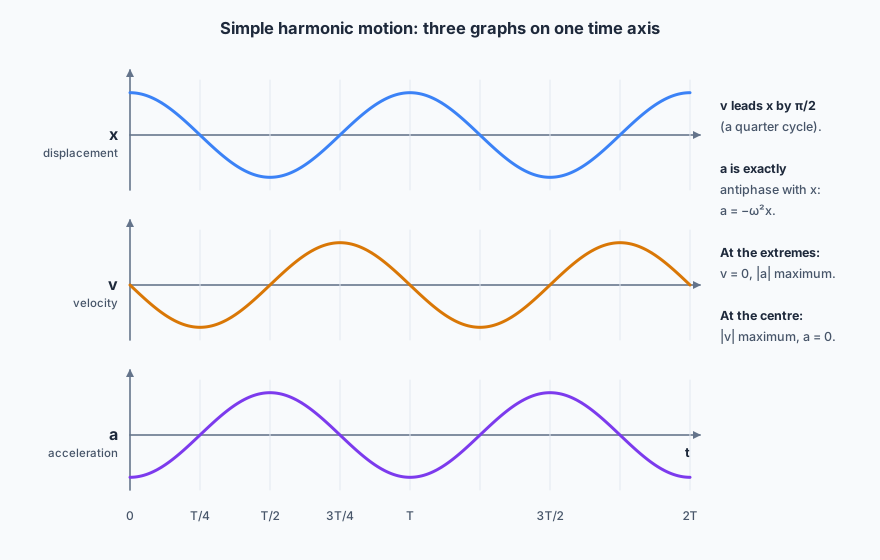
Phase relationships. Velocity leads displacement by \( \pi/2 \), and acceleration is exactly antiphase with displacement. At maximum displacement the velocity is zero and the acceleration is maximum; at the equilibrium position the velocity is maximum and the acceleration is zero. Sketching all three graphs one above another, with the same time axis, settles most exam questions on sight.
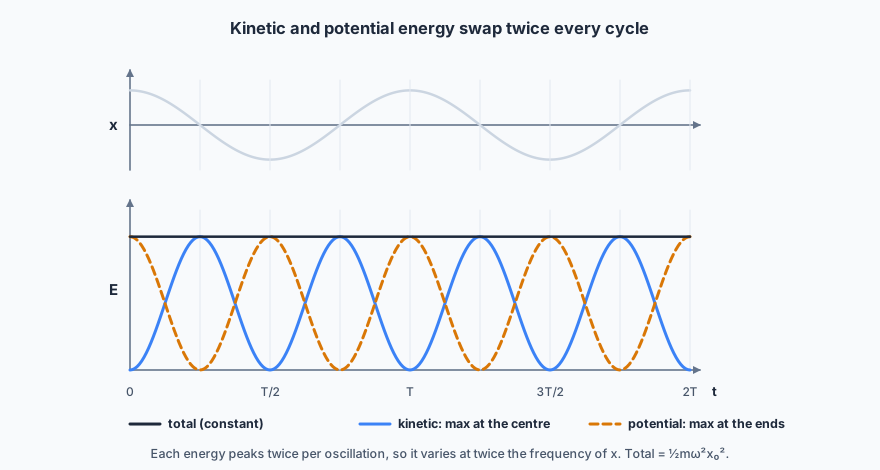
Energy. Kinetic energy is maximum at the centre, potential energy at the extremes, and the total is constant at \( \tfrac{1}{2}m\omega^{2}x_0^{2} \). Both energies vary at twice the frequency of the displacement, because each passes through its maximum twice per cycle. That factor of two is a favourite exam trap.
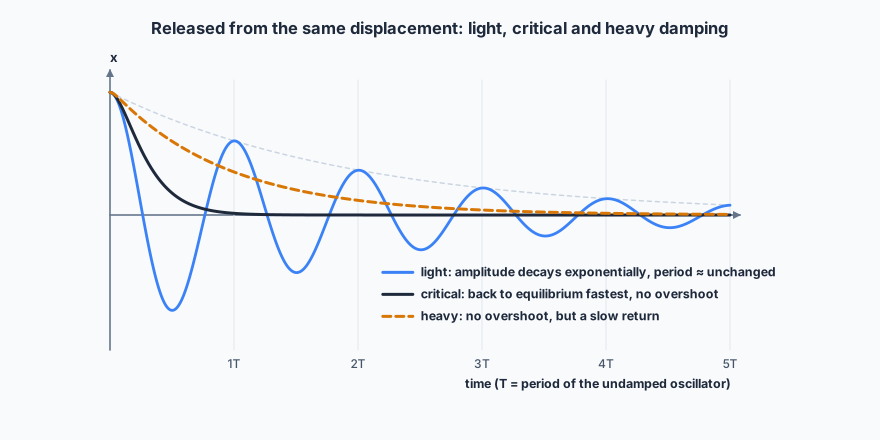
Damping removes energy. Light damping: the amplitude decays exponentially over many cycles and the period is almost unchanged. Critical damping: the system returns to equilibrium in the shortest possible time without oscillating — what car suspension and door closers are designed for. Heavy damping: it returns without oscillating, but slowly.
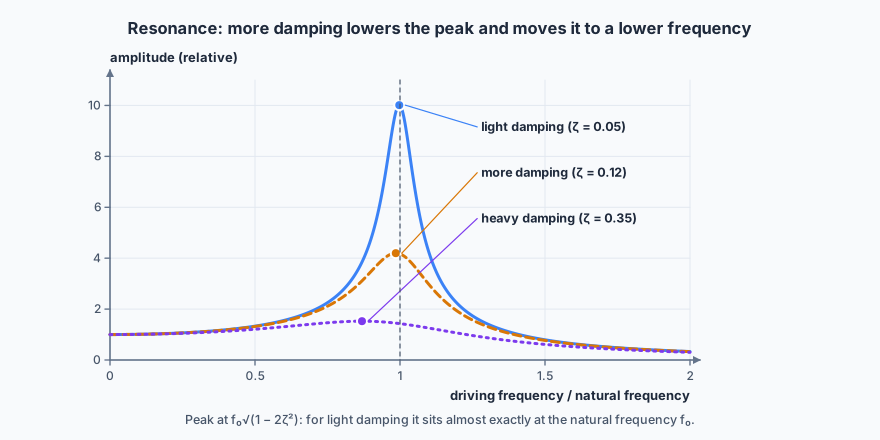
Resonance occurs when the driving frequency equals the natural frequency of the system; the amplitude reaches a maximum because energy is transferred to the system most efficiently. Increasing the damping lowers the peak and shifts it slightly to a lower frequency — both effects are examinable.
✏️Worked example
\( \omega = 2\pi/T = 2\pi/0.80 = 7.85 \) rad s\(^{-1}\).
\( v_0 = \omega x_0 = 7.85 \times 0.040 = 0.314 \) m s\(^{-1}\).
🔭See it happen
Barton’s pendulums — a set of pendulums of different lengths hanging from a common string, driven by one of them — show resonance and phase together: only the pendulum matching the driver’s length swings widely, and it lags the driver by a quarter of a cycle. A mass on a spring filmed against a metre rule and tracked frame by frame gives a displacement–time curve students have measured themselves rather than been shown.
🔗Go deeper — other people’s work
The links below are not mine. They are here because they are good, and they may move or disappear without warning.
- PhET, Masses and Springs and Pendulum Lab — both show the energy bar chart alongside the motion.
- The Physics Classroom, “Vibrations and Waves”.
- Isaac Physics, “Simple Harmonic Motion” problem sets.