Electric fields and capacitance
🎯What you need to be able to do
- Understand that an electric field is a field of force, and define electric field strength as force per unit positive charge.
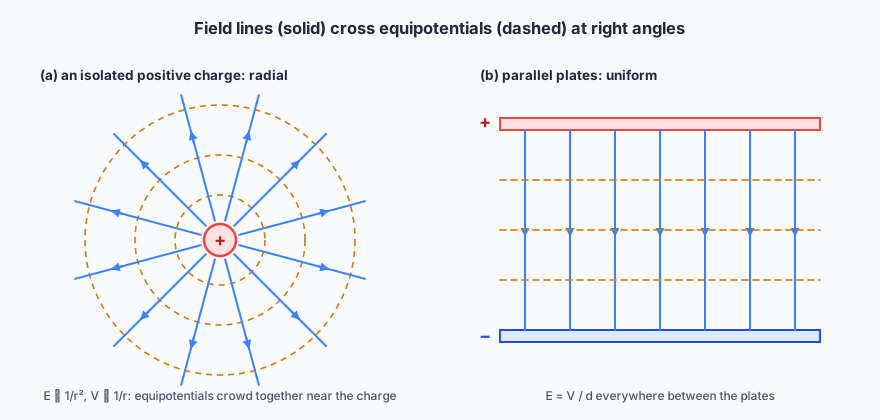
- Represent electric fields by field lines, and describe the field of a point charge, of a uniformly charged sphere and between charged parallel plates.
- Recall and use \( E = V/d \) for the uniform field between parallel plates.
- Recall and use Coulomb’s law, \( F = Q_1Q_2/4\pi\varepsilon_0 r^{2} \), and \( E = Q/4\pi\varepsilon_0 r^{2} \) for a point charge.
- Define electric potential, use \( V = Q/4\pi\varepsilon_0 r \), and relate field strength to the potential gradient.
- Use \( E_p = Qq/4\pi\varepsilon_0 r \) for the electric potential energy of two point charges.
- Define capacitance and use \( C = Q/V \), for an isolated conductor and for a parallel-plate capacitor.
- Derive and use the formulae for capacitors in series and in parallel.
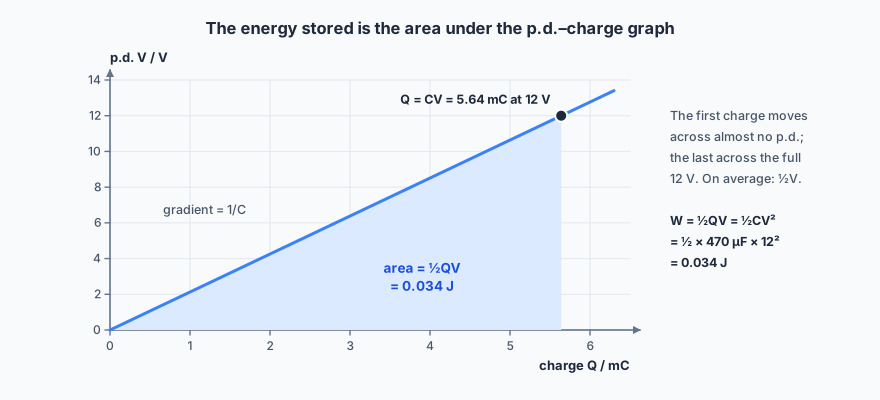
- Deduce from the area under a potential–charge graph that the energy stored is \( W = \tfrac{1}{2}QV \), and use \( W = \tfrac{1}{2}CV^{2} = \tfrac{1}{2}Q^{2}/C \).
- Analyse the discharge of a capacitor through a resistor using \( x = x_0e^{-t/RC} \), and understand the time constant \( \tau = RC \).
📚The physics
Gravitational and electric fields compared. Both are inverse-square laws with a potential that goes as \( 1/r \). The differences: gravity acts on mass and is only attractive, so gravitational potential is always negative; the electric force acts on charge and can be either sign, so electric potential is positive near a positive charge and negative near a negative one. And the constants differ by about twenty orders of magnitude — \( 1/4\pi\varepsilon_0 \) is \( 8.99 \times 10^{9} \) while \(G\) is \( 6.67 \times 10^{-11} \) — so that between two protons, once the charges and masses are put in, the electric repulsion is about \( 10^{36} \) times the gravitational attraction.
Field and potential. \( E = -\mathrm{d}V/\mathrm{d}r \): the field is the negative gradient of the potential. Where the potential is uniform the field is zero. Inside a hollow charged conductor the potential is constant and equal to its surface value, so the field there is zero — the principle behind every Faraday cage.
Capacitance is charge stored per volt, in farads. A farad is enormous; real capacitors are measured in µF, nF and pF. Capacitors in parallel add directly (\( C = C_1 + C_2 \)), the opposite of resistors — think of it as increasing the plate area. In series the reciprocals add.
Energy stored. On a \(V\)–\(Q\) graph the gradient is \( 1/C \) and the area under the line is the energy. Because the line is straight through the origin, the area is a triangle: \( W = \tfrac{1}{2}QV \). The factor of one half is there because the first charge moves across at almost no p.d. while the last moves across the full \(V\).
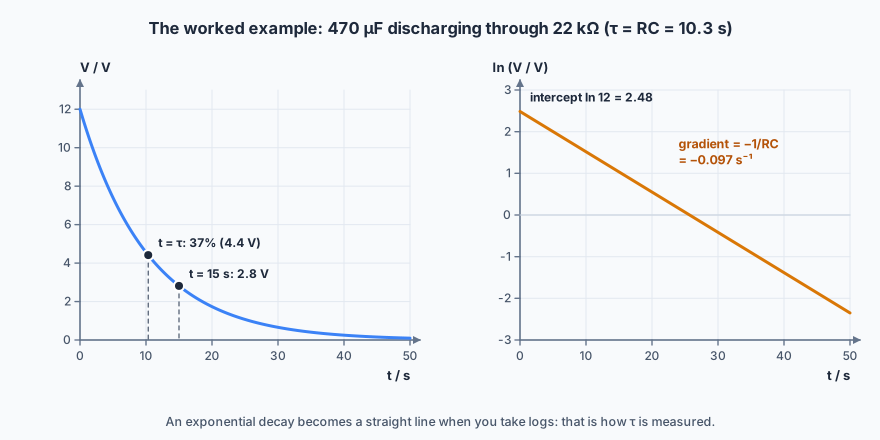
Discharge. Charge, current and p.d. all decay exponentially with the same time constant \( \tau = RC \), which is the time to fall to \( 1/e \approx 37\% \) of the initial value. After \( 5\tau \) the capacitor is more than 99% discharged. Plotting \( \ln V \) against \(t\) gives a straight line of gradient \( -1/RC \), which is how \(\tau\) is measured experimentally.
✏️Worked example
\( \tau = RC = 22 \times 10^{3} \times 470 \times 10^{-6} = 10.3 \) s.
\( W = \tfrac{1}{2}CV^{2} = 0.5 \times 470 \times 10^{-6} \times 12^{2} = 0.034 \) J.
🔭See it happen
Charge a large electrolytic capacitor and discharge it through a resistor with a voltmeter and a stopwatch: students can find \(\tau\) from the 37% point directly and then check it against \(RC\). For fields, a Van de Graaff and a few paper streamers show field lines leaving a conductor perpendicular to its surface, and a shaving-foam-and-oil dish with semolina grains gives the classic dipole pattern in about a minute.
🔗Go deeper — other people’s work
The links below are not mine. They are here because they are good, and they may move or disappear without warning.
- PhET, Charges and Fields and Capacitor Lab — the second shows the stored energy changing as you move the plates.
- The Physics Classroom, “Static Electricity”.
- Isaac Physics, “Electric Fields” and “Capacitors”.