Quantum physics
🎯What you need to be able to do
- Understand that electromagnetic radiation has a particulate nature, and that a photon is a quantum of energy with \( E = hf \).
- Use the electronvolt as a unit of energy, and convert between eV and J.
- Understand that a photon has momentum \( p = E/c \).
- Describe the photoelectric effect, and explain why it provides evidence for a particulate nature of electromagnetic radiation.
- Recall the existence of a threshold frequency, define work function, and recall and use \( hf = \Phi + \tfrac{1}{2}mv_{\max}^{2} \).
- Understand that electrons show wave–particle duality, and use the de Broglie relation \( \lambda = h/p \).
- Understand the existence of discrete electron energy levels in isolated atoms, and explain line emission and line absorption spectra.
- Recall and use \( hf = E_1 - E_2 \) for transitions between levels.
📚The physics
Why the photoelectric effect broke classical physics. Three observations, each impossible on a wave model. First, there is a threshold frequency below which no electrons are emitted however intense the light — a wave should eventually deliver enough energy. Second, emission is instantaneous even at very low intensity — a wave would need a measurable time to accumulate the energy. Third, the maximum kinetic energy depends on frequency but not on intensity; increasing the intensity increases the number of electrons, not their energy. All three follow at once if light arrives as discrete quanta, one photon being absorbed by one electron.
Einstein’s equation is just conservation of energy for that single absorption:
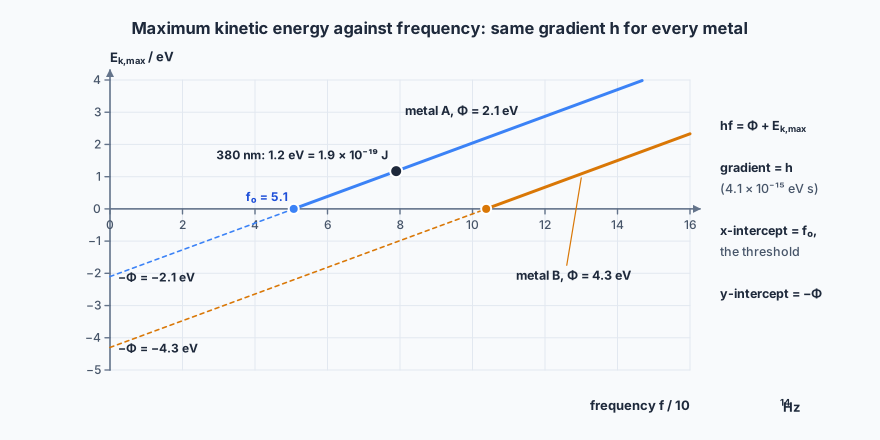
The work function \(\Phi\) is the minimum energy needed to remove an electron from the surface, so \( \tfrac{1}{2}mv_{\max}^{2} \) is the maximum kinetic energy — electrons from deeper in the metal emerge with less. Plotting \( E_{k,\max} \) against \(f\) gives a straight line of gradient \(h\) and intercept \( -\Phi \), and the gradient is the same for every metal.
Duality. \( \lambda = h/p \) applies to everything, but \(h\) is so small that the wavelength of anything macroscopic is unmeasurably tiny. An electron accelerated through 100 V has a wavelength of about 0.12 nm — comparable with atomic spacing, which is why electrons diffract through a graphite film and why electron microscopes resolve far more than optical ones.
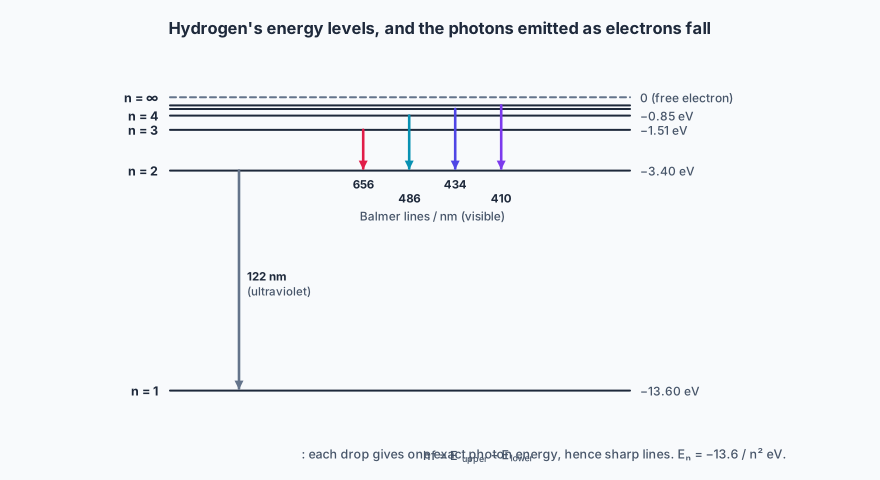
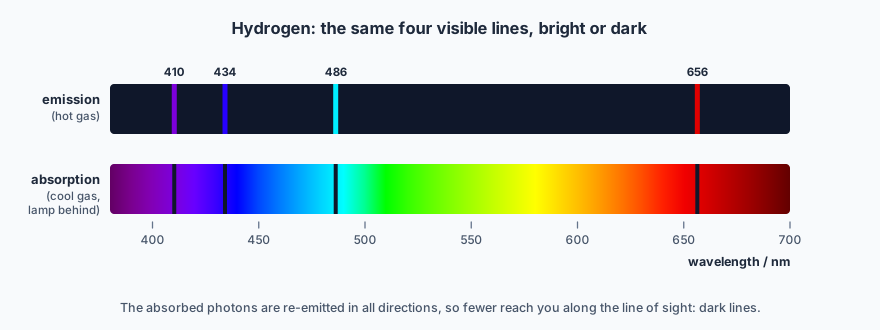
Energy levels. Electrons in an isolated atom can occupy only certain energies; the levels are negative because the zero is taken as a free electron at rest. A photon is emitted when an electron falls between levels, with \(hf\) equal to the difference, which is why emission spectra are sets of sharp lines rather than a continuum. Absorption spectra are the same set of lines, dark against a continuous background, because the atoms remove exactly those photons and then re-radiate them in all directions.
✏️Worked example
Photon energy \( E = hc/\lambda = (6.63 \times 10^{-34} \times 3.00 \times 10^{8})/380 \times 10^{-9} = 5.23 \times 10^{-19} \) J.
\( \Phi = 2.1 \times 1.60 \times 10^{-19} = 3.36 \times 10^{-19} \) J.
\( E_{k,\max} = 5.23 \times 10^{-19} - 3.36 \times 10^{-19} = 1.9 \times 10^{-19} \) J.
🔭See it happen
A clean zinc plate on a gold-leaf electroscope, charged negatively, discharges within seconds under an ultraviolet lamp and not at all under a bright filament lamp — intensity against frequency, decided in one demonstration. Charge the plate positively and the ultraviolet does nothing, because the emitted electrons cannot escape the attraction; that control is what makes the result convincing.
🔗Go deeper — other people’s work
The links below are not mine. They are here because they are good, and they may move or disappear without warning.
- PhET, Photoelectric Effect — vary frequency and intensity independently and watch which one changes the stopping voltage.
- PhET, Models of the Hydrogen Atom.
- Isaac Physics, “Quantum Physics” problem sets.