Physical quantities and units
🎯What you need to be able to do
- Recall the SI base quantities and their units, and express derived units in base units.
- Use prefixes, and check equations for homogeneity.
- Make reasonable estimates of physical quantities.
- Distinguish scalars from vectors; combine and resolve vectors.
- Distinguish systematic from random errors, and precision from accuracy.
- Calculate absolute, fractional and percentage uncertainties, and combine them.
📚The physics
The six base quantities you need: mass (kilogram), length (metre), time (second), electric current (ampere), thermodynamic temperature (kelvin), amount of substance (mole). Everything else is derived from these.
Expressing a derived unit in base units is a standard exam question and is done by substituting definitions. The newton: \( F = ma \), so N = kg m s\(^{-2}\). The joule: \( W = Fd \), so J = N m = kg m\(^{2}\) s\(^{-2}\). The watt: J s\(^{-1}\) = kg m\(^{2}\) s\(^{-3}\). Work them out rather than memorising them — the method never fails and your memory might.
Homogeneity. Every term in a physically valid equation must have the same base units. This gives you a free check on any equation you half-remember, and it can also earn marks directly. Note the limitation: a homogeneous equation is not necessarily correct, because dimensionless constants like ½ or \(2\pi\) do not show up in the check. Homogeneity can prove an equation wrong; it cannot prove it right.
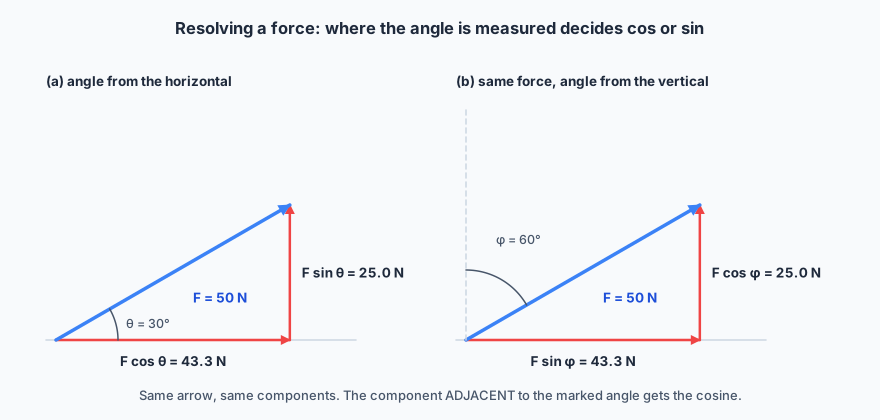
Scalars and vectors. Scalars: distance, speed, mass, energy, work, power, temperature, pressure, charge. Vectors: displacement, velocity, acceleration, force, weight, momentum, electric and magnetic field strength. To add two vectors at an angle, draw them tip to tail and find the resultant, or resolve into perpendicular components and add those. To resolve a vector \(F\) at angle \(\theta\) to the horizontal: \( F_x = F\cos\theta \), \( F_y = F\sin\theta \). Which gets cosine depends on where the angle is measured from, so label the diagram before writing anything.
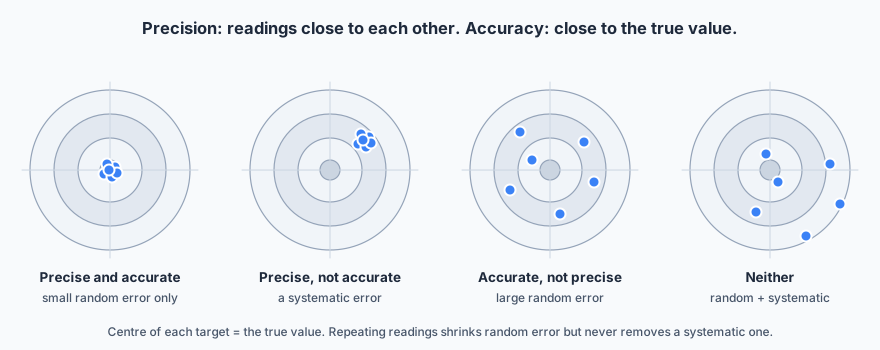
Systematic and random errors are different problems with different fixes. A systematic error shifts every reading the same way — a zero error on a micrometer, a mis-calibrated meter, a ruler read at an angle every time. Repeating does not help; you must find and correct the cause. A random error scatters readings either side of the true value, and is reduced by taking repeats and averaging.
Precision and accuracy are also different. Precise readings are close to each other. Accurate readings are close to the true value. A micrometer with a zero error gives precise, inaccurate readings all day. Examiners ask about this pairing constantly, and answers that treat the two words as synonyms score nothing.
Uncertainties. The absolute uncertainty on a single reading from an analogue scale is usually half the smallest division; from a digital instrument, the last digit. Percentage uncertainty = (absolute uncertainty / value) × 100.
Combining them follows two rules. When quantities are multiplied or divided, add the percentage uncertainties. When they are added or subtracted, add the absolute uncertainties. And if a quantity is raised to a power \(n\), multiply its percentage uncertainty by \(n\) — so a radius measured to 2% gives a volume uncertain to 6%.
✏️Worked example
Volume. \( V = \pi (d/2)^{2} L = \pi \times (6.20 \times 10^{-3})^{2} \times 0.085 = 1.027 \times 10^{-5} \) m\(^{3}\).
Density. \( \rho = m/V = 0.0740/1.027 \times 10^{-5} = 7.21 \times 10^{3} \) kg m\(^{-3}\).
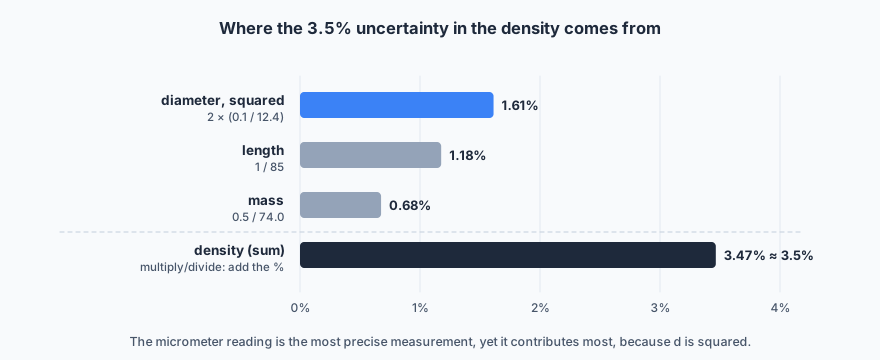
Percentage uncertainties, one at a time. In \(d\): \( (0.1/12.4) \times 100 = 0.81\% \), but \(d\) is squared in the volume, so it contributes \( 2 \times 0.81 = 1.61\% \). In \(L\): \( (1/85) \times 100 = 1.18\% \). In \(m\): \( (0.5/74.0) \times 100 = 0.68\% \).
Combine. Density is mass divided by a product, so add the percentages: \( 1.61 + 1.18 + 0.68 = 3.5\% \).
As an absolute uncertainty that is \( 0.035 \times 7.21 \times 10^{3} = 250 \) kg m\(^{-3}\), so the result is quoted as \( (7.2 \pm 0.3) \times 10^{3} \) kg m\(^{-3}\). Note that the uncertainty is given to one significant figure and the value is rounded to match — quoting \( 7.21 \pm 0.25 \) implies more precision than you have.
🔗Go deeper — other people’s work
These are external resources, not mine. If one stops working, tell me and everything above it on this page still stands.
- The Physics Hypertextbook — units and measurement
- HyperPhysics — units, dimensional analysis and error propagation