Particle physics
🎯What you need to be able to do
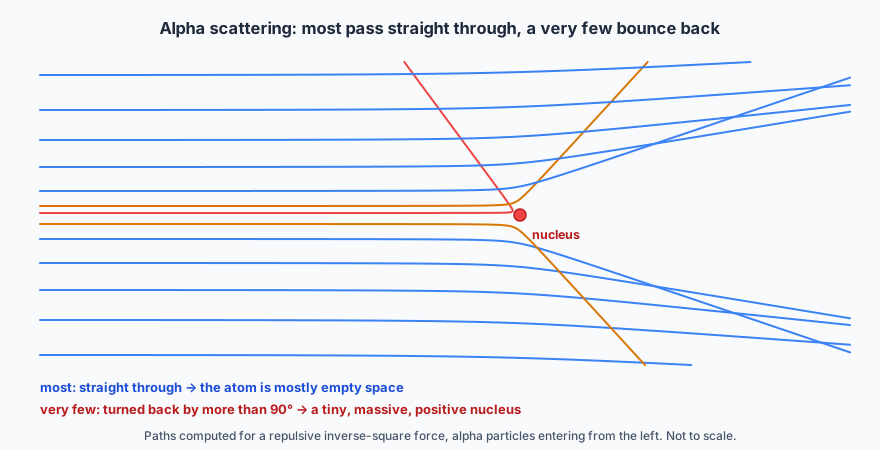
- Infer from the alpha-particle scattering experiment that most of the mass and all the positive charge of an atom is concentrated in a very small nucleus.
- Describe a simple model of the atom in terms of protons, neutrons and electrons, and use nuclide notation.
- Distinguish between nucleon number and proton number, and explain what isotopes are.
- Understand that a nucleon is not a fundamental particle, and that protons and neutrons are made of quarks.
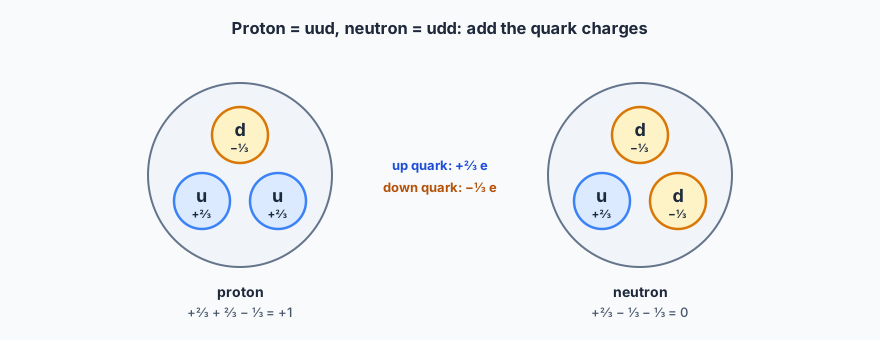
- Recall the quark composition of the proton and the neutron, and the charges of the up, down and strange quarks and their antiquarks.
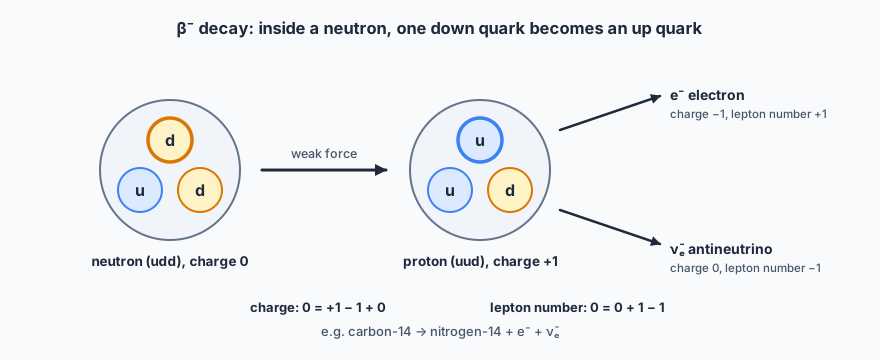
- Describe the changes to quark composition that take place during \( \beta^- \) and \( \beta^+ \) decay.
- Understand that electrons and neutrinos are leptons and are fundamental.
- State that there are four fundamental forces, and appreciate the weak interaction as the one responsible for beta decay.
- Apply conservation of charge and of nucleon number to nuclear equations.
📚The physics
Rutherford’s evidence. Almost all alpha particles passed through the gold foil undeflected, so the atom is mostly empty space. A very small fraction came back through more than 90°, so there is something small, massive and positively charged for them to bounce off. Those two observations, and the reasoning from each to its conclusion, are what the marks are for — not the historical narrative.
Nuclide notation. In \( ^{A}_{Z}\mathrm{X} \), \(A\) is the nucleon number and \(Z\) the proton number; the neutron number is \( A - Z \). Isotopes have the same \(Z\) and different \(A\): same chemistry, different nuclear behaviour.
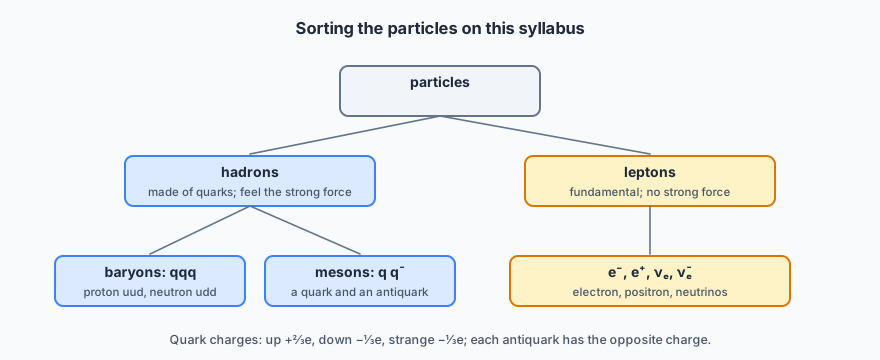
Quarks. The up quark has charge \( +\tfrac{2}{3}e \) and the down quark \( -\tfrac{1}{3}e \); the strange quark also has \( -\tfrac{1}{3}e \). A proton is uud, giving \( +\tfrac{2}{3} + \tfrac{2}{3} - \tfrac{1}{3} = +1 \). A neutron is udd, giving \( +\tfrac{2}{3} - \tfrac{1}{3} - \tfrac{1}{3} = 0 \). Antiquarks carry the opposite charge. Baryons are three quarks, mesons are a quark and an antiquark.
Beta decay as quark change. In \( \beta^- \) decay a neutron becomes a proton, so one down quark becomes an up quark, and an electron and an electron antineutrino are emitted. In \( \beta^+ \) decay a proton becomes a neutron, an up quark becomes a down quark, and a positron and an electron neutrino are emitted. The antineutrino in \( \beta^- \) is not decoration: without it, energy and lepton number are not conserved, which is exactly why Pauli proposed it.
Leptons — the electron, the positron and the neutrinos — are fundamental as far as anyone can tell; they are not made of quarks and they do not feel the strong force.
The four forces: gravitational, electromagnetic, strong nuclear and weak nuclear. The strong force binds quarks and holds nucleons together over about \( 10^{-15} \) m. The weak force is the only one that changes quark flavour, so it is the force behind every beta decay.
✏️Worked example
Check: nucleon number \( 14 = 14 + 0 \); charge \( +6 = +7 - 1 \). Inside the nucleus, one neutron (udd) has become a proton (uud), so a single down quark has changed into an up quark.
🔭See it happen
A cloud chamber with a small alpha source shows short, straight, thick tracks; a beta source shows long, thin, wandering ones. Seeing the difference in ionising power directly makes the penetration table something students remember rather than memorise. If no source is available, the background tracks from cosmic-ray muons in a dry-ice cloud chamber are visible within a minute and just as convincing.
🔗Go deeper — other people’s work
The links below are not mine. They are here because they are good, and they may move or disappear without warning.
- PhET, Rutherford Scattering — lets you vary the energy and see the deflection change.
- CERN’s public pages on the Standard Model.
- Isaac Physics, “Nuclear and Particle Physics” problem sets.