Kinematics and dynamics
🎯What you need to be able to do
- Define distance, displacement, speed, velocity and acceleration, and say which are vectors.
- Read motion graphs properly: the gradient of a displacement–time graph is velocity, the gradient of a velocity–time graph is acceleration, and the area under a velocity–time graph is displacement.
- Derive and use the equations for uniformly accelerated motion in a straight line, and know that they are only valid when \(a\) is constant.
- Describe an experiment to determine the acceleration of free fall, \(g\).
- Treat projectile motion as a uniform velocity in one direction and a uniform acceleration at right angles to it.
- Describe qualitatively how air resistance changes the motion of a falling body, and what terminal velocity means.
- State and apply Newton’s three laws of motion.
- Define linear momentum, and define resultant force as the rate of change of momentum; recognise \( F = ma \) as the special case for constant mass.
- Find the change in momentum from the area under a force–time graph.
- State and apply the principle of conservation of momentum to collisions in one and two dimensions.
- Distinguish elastic from inelastic collisions, and use the fact that in a perfectly elastic collision the relative speed of approach equals the relative speed of separation.
📚The physics
Vectors first. Displacement, velocity, acceleration, force and momentum are vectors; distance, speed, mass and energy are not. A body moving at constant speed round a circle has a changing velocity, so it is accelerating. Almost every “paradox” in this topic dissolves once you take the vector nature seriously.
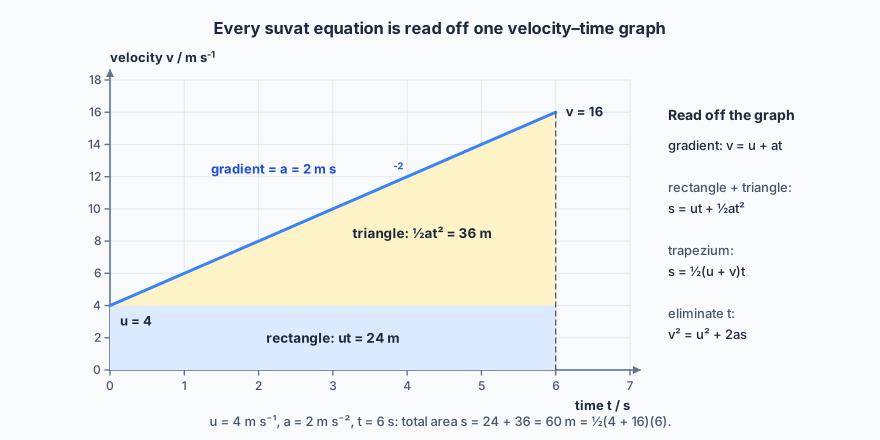
The four suvat equations follow from the definitions of velocity and acceleration when \(a\) is constant:
Each of these can be read off a velocity–time graph: the second is “area of rectangle plus area of triangle”, the third is “area of trapezium”. If you can draw the graph you never need to memorise the list.
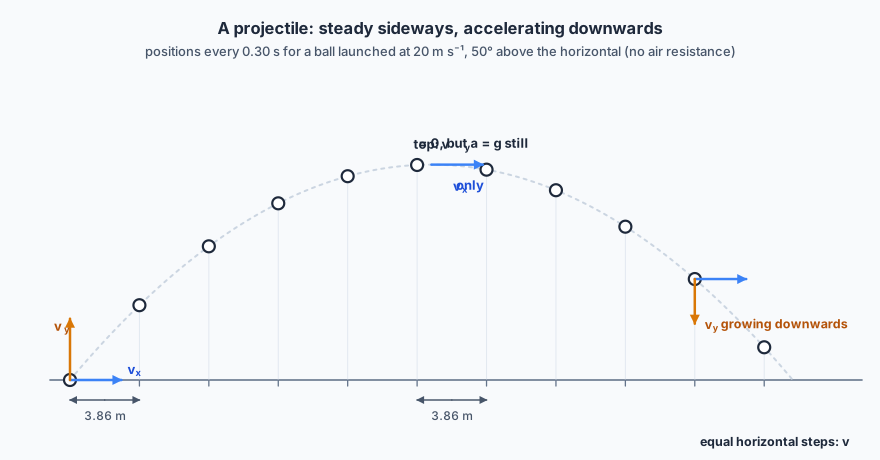
Projectiles. Horizontal and vertical motions are independent and share only the time. Horizontally there is no force (we ignore air resistance), so \( a_x = 0 \) and \( x = u_x t \). Vertically \( a_y = -g \) throughout, including at the top of the flight, where the vertical velocity — not the acceleration — is momentarily zero.
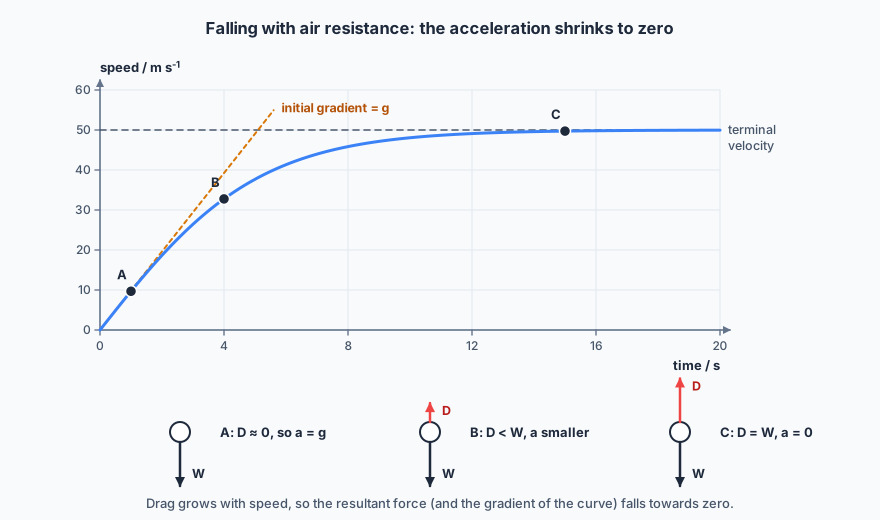
Air resistance grows with speed. A falling body therefore has a resultant force that shrinks as it speeds up, so the acceleration decreases; when the drag equals the weight the resultant is zero and the speed is constant — terminal velocity. The velocity–time graph is a curve of decreasing gradient approaching a horizontal asymptote, never a straight line that bends sharply.
Newton’s laws. The first law defines what a force is for: without a resultant force velocity does not change. The second law in its proper form is \( F = \Delta p/\Delta t \); \( F = ma \) is what it becomes when mass is constant. Cambridge likes questions where mass is not constant — rain collecting in a truck, sand falling on a belt, a rocket — and there only the momentum form works. The third law is about pairs: the two forces act on different bodies, are the same type of force, and are equal in size and opposite in direction. The weight of a book and the normal contact force from the table are not a third-law pair; they act on the same body.
Momentum. \( p = mv \). Rearranging the second law gives \( F\Delta t = \Delta p \); the quantity \( F\Delta t \) is called impulse, and on a force–time graph it is the area underneath. This is why crumple zones, airbags and bending your knees on landing work: the change in momentum is fixed, so lengthening the time reduces the force.
Conservation of momentum holds for any system with no external resultant force, elastic or not. Kinetic energy is not generally conserved. In a perfectly elastic collision both are conserved, and a useful shortcut follows: \( u_1 - u_2 = v_2 - v_1 \).
✏️Worked example
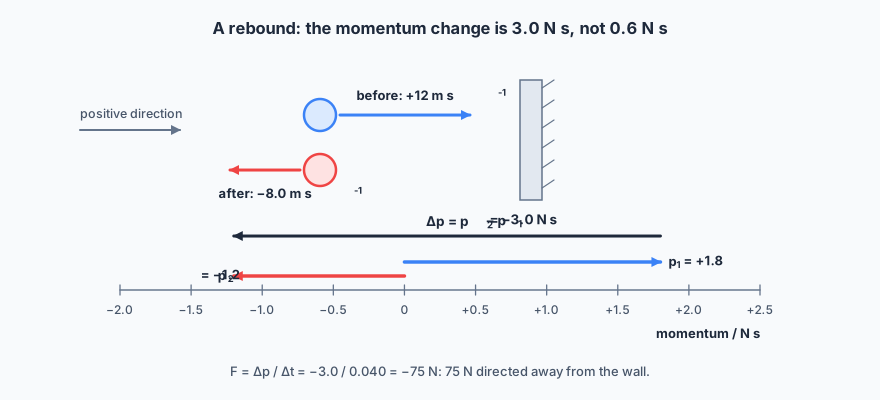
Take “towards the wall” as positive. Initial momentum \( = 0.15 \times 12 = +1.8 \) N s. Final momentum \( = 0.15 \times (-8.0) = -1.2 \) N s.
\( \Delta p = -1.2 - (+1.8) = -3.0 \) N s.
i.e. 75 N directed away from the wall.
🔭See it happen
Two trolleys on a track with a motion sensor will show you conservation of momentum in twenty minutes, and the mismatch in kinetic energy before and after tells you at once whether the collision was elastic. For projectiles, film a ball thrown across the room at 240 frames per second on a phone and step through it: the horizontal spacing between frames stays constant while the vertical spacing grows. That single observation is the whole of projectile theory.
🔗Go deeper — other people’s work
The links below are not mine. They are here because they are good, and they may move or disappear without warning.
- PhET, Projectile Motion and Collision Lab — both let you switch air resistance and elasticity on and off.
- The Physics Classroom, “Newton’s Laws” and “Momentum and Its Conservation” — unusually careful about third-law pairs.
- Isaac Physics — problem sets graded by difficulty, with hints rather than answers.