Forces, density and pressure
🎯What you need to be able to do
- Define and use density and pressure, and derive and use \( p = \rho gh \) for the pressure difference in a fluid.
- Explain the origin of upthrust acting on a body in a fluid, and use Archimedes’ principle, \( F = \rho gV \).
- Define and use the moment of a force, and the torque of a couple.
- State and apply the principle of moments.
- State and apply the two conditions for equilibrium: zero resultant force and zero resultant moment about any point.
- Use a vector triangle to represent coplanar forces in equilibrium, and resolve forces into perpendicular components.
- Understand and use centre of gravity.
📚The physics
Density and pressure. \( \rho = m/V \); \( p = F/A \), where the force must be perpendicular to the area. The pressure at depth \(h\) in a fluid of density \(\rho\) exceeds the pressure at the surface by \( \rho gh \). Notice what is missing from that expression: the shape of the container and the total weight of fluid. A narrow tube and a wide tank filled to the same depth have the same pressure at the bottom.
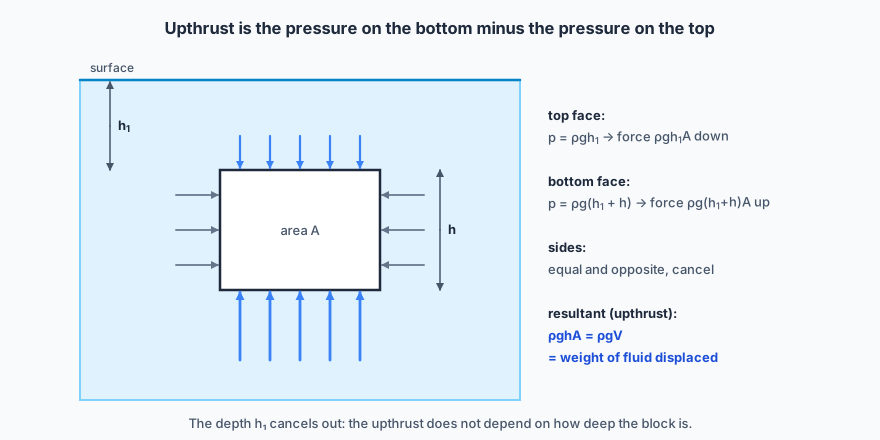
Upthrust is not a new kind of force. It is the resultant of the pressure forces on a submerged body, and it exists because the pressure on the bottom face is greater than on the top. For a rectangular block of cross-section \(A\) and height \(h\) the difference is \( \rho gh \times A = \rho gV \), which is the weight of fluid displaced — Archimedes’ principle, derived rather than remembered.
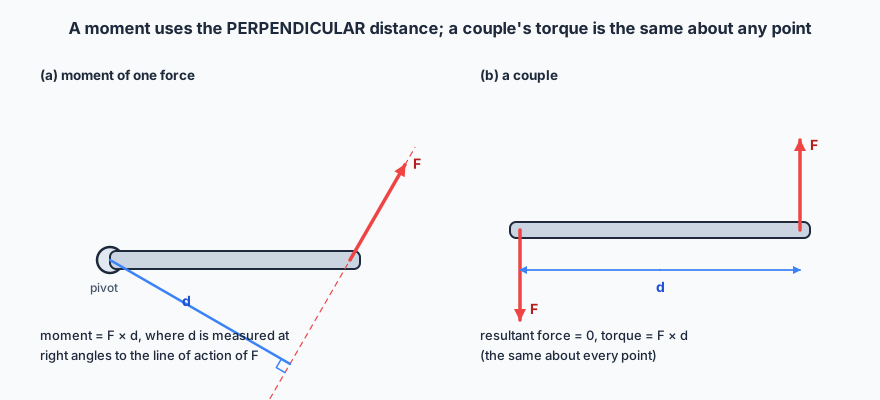
Moments. The moment of a force about a point is the force multiplied by the perpendicular distance from the point to the line of action of the force. A couple is a pair of equal, antiparallel forces whose lines of action do not coincide; its torque is one force times the perpendicular separation, and it is the same about every point.
Equilibrium requires two conditions together. First, the vector sum of the forces is zero — equivalently, the resolved components in any two perpendicular directions each sum to zero, or the force vectors form a closed polygon. Second, the sum of the moments about any point is zero. Because the second condition holds about any point, you may choose the point that eliminates the force you know least about; taking moments about the line of action of an unknown force removes it from the equation entirely.
Centre of gravity is the single point at which the whole weight of a body may be taken to act. For a uniform body in a uniform field it coincides with the centre of mass and lies at the geometrical centre.
✏️Worked example
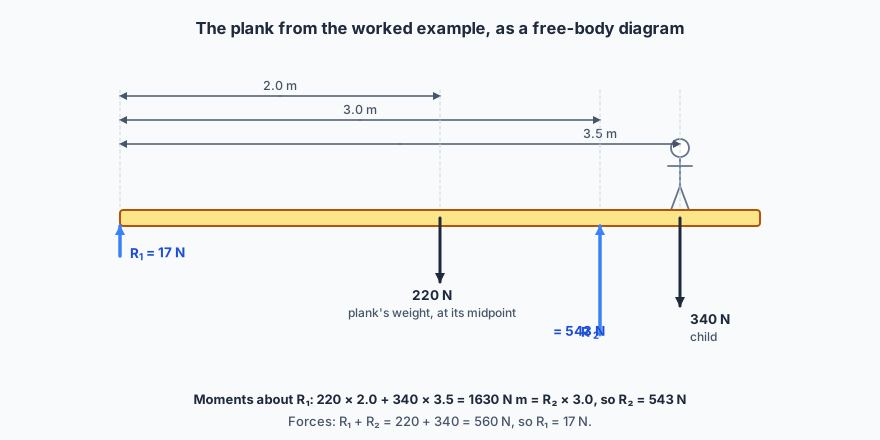
Take moments about the left-hand support, which removes the unknown force \( R_1 \) from the equation. The plank is uniform, so its weight acts at 2.0 m.
Clockwise moments \( = 220 \times 2.0 + 340 \times 3.5 = 440 + 1190 = 1630 \) N m. Anticlockwise moment \( = R_2 \times 3.0 \).
\( R_2 = 1630/3.0 = 543 \) N \( \approx 540 \) N.
Now use zero resultant force vertically: \( R_1 + R_2 = 220 + 340 = 560 \) N, so \( R_1 = 560 - 543 = 17 \) N.
🔭See it happen
A metre rule, a pivot and a set of masses will demonstrate the principle of moments in five minutes, but the more instructive version is to hang the rule off-centre and ask students to predict the reading on a newton-meter before they take it. For upthrust, weigh an object in air and then submerged: the loss in weight is the upthrust, and it equals the weight of water that overflows.
🔗Go deeper — other people’s work
The links below are not mine. They are here because they are good, and they may move or disappear without warning.
- PhET, Balancing Act and Buoyancy — both give immediate numerical feedback on predictions.
- The Physics Classroom, “Static Equilibrium” — strong on free-body diagrams.
- Isaac Physics, “Statics” problem set.