Waves and superposition
🎯What you need to be able to do
- Describe what a progressive wave is, and define displacement, amplitude, phase difference, period, frequency, wavelength and speed.
- Derive and use \( v = f\lambda \), and use \( f = 1/T \).
- Understand that energy is transferred by a progressive wave, and that intensity is proportional to the square of the amplitude.
- Compare transverse and longitudinal waves, and understand polarisation as a property only of transverse waves; use Malus’s law, \( I = I_0\cos^{2}\theta \).
- Recall the order of magnitude of the wavelengths of the principal regions of the electromagnetic spectrum.
- Explain the Doppler effect for a moving source and use \( f_o = f_s v/(v \pm v_s) \).
- State and use the principle of superposition.
- Explain the formation of stationary waves, and the meaning of node and antinode; use the fact that adjacent nodes are half a wavelength apart.
- Explain diffraction, and describe experiments demonstrating it with a ripple tank.
- Explain what is meant by coherence, and the conditions required for two-source interference fringes to be observed.
- Use \( \lambda = ax/D \) for double-slit interference and \( d\sin\theta = n\lambda \) for a diffraction grating.
📚The physics
The wave equation is a definition in disguise: in one period the wave advances one wavelength, so \( v = \lambda/T = f\lambda \). When a wave crosses into a new medium the frequency is fixed by the source and does not change; the speed changes, so the wavelength must change with it.
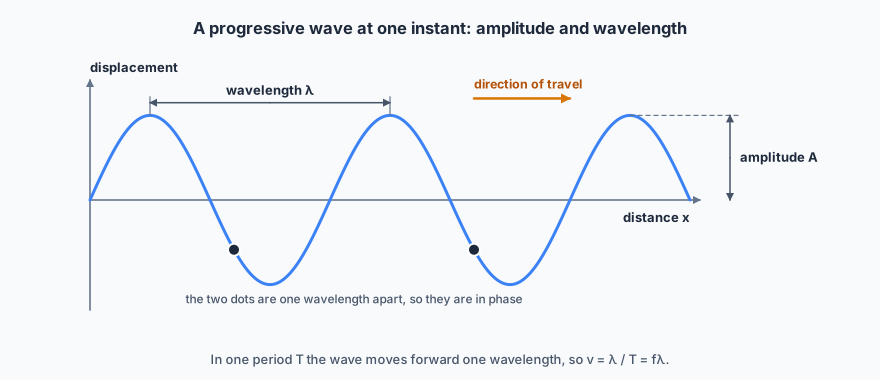
Intensity is power per unit area, and \( I \propto A^{2} \). Doubling the amplitude therefore quadruples the intensity. For a point source radiating uniformly, \( I \propto 1/r^{2} \), so the amplitude falls as \( 1/r \).
Polarisation only makes sense for transverse waves, because only they have a choice of oscillation direction perpendicular to the travel direction. Sound cannot be polarised, and that fact alone is enough to prove it is longitudinal. Through a second polariser at angle \(\theta\), the transmitted amplitude is \( A_0\cos\theta \), so the intensity is \( I_0\cos^{2}\theta \).
Superposition says that when two waves meet, the resultant displacement is the vector sum of the individual displacements. Everything in the rest of this topic follows from that one sentence. Stationary waves are superposition of two identical waves travelling in opposite directions; interference patterns are superposition of waves from two coherent sources; diffraction patterns are superposition of the infinitely many secondary wavelets across an aperture.
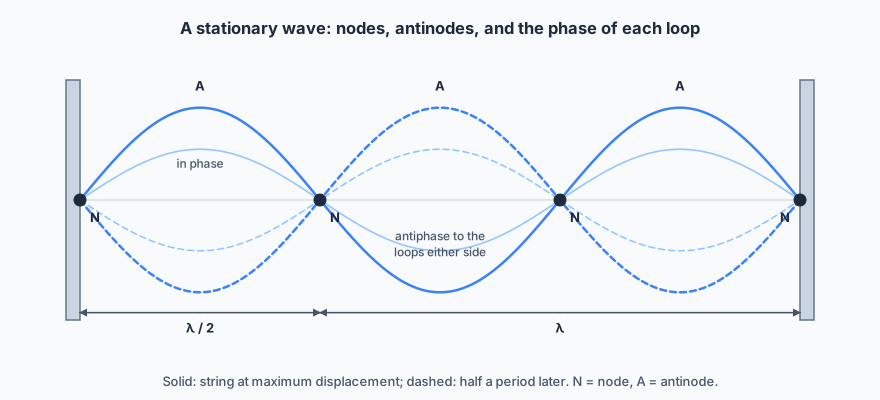
Stationary versus progressive. A stationary wave transfers no energy along its length, its amplitude varies with position from zero at nodes to a maximum at antinodes, and all particles between two adjacent nodes are in phase with each other while those in adjacent loops are exactly antiphase. A progressive wave transfers energy, has the same amplitude everywhere, and has a phase that varies continuously with position.
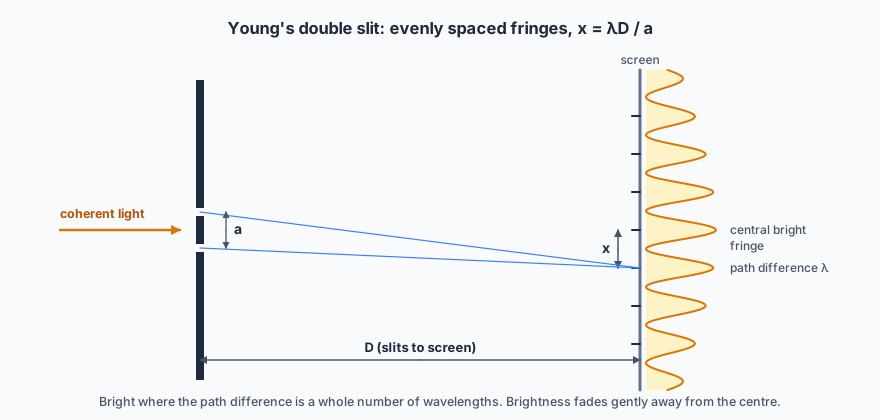
Coherence means a constant phase difference, which requires the same frequency. Two independent lamps are never coherent, which is why Young used one source and split it. Fringes are visible only if the two amplitudes are comparable as well.
Two slits versus a grating. The double slit gives evenly spaced fringes of gradually varying brightness, spacing \( x = \lambda D/a \). A grating with thousands of slits gives sharp, widely separated maxima at \( d\sin\theta = n\lambda \), which is why gratings, not double slits, are used to measure wavelengths accurately.
✏️Worked example
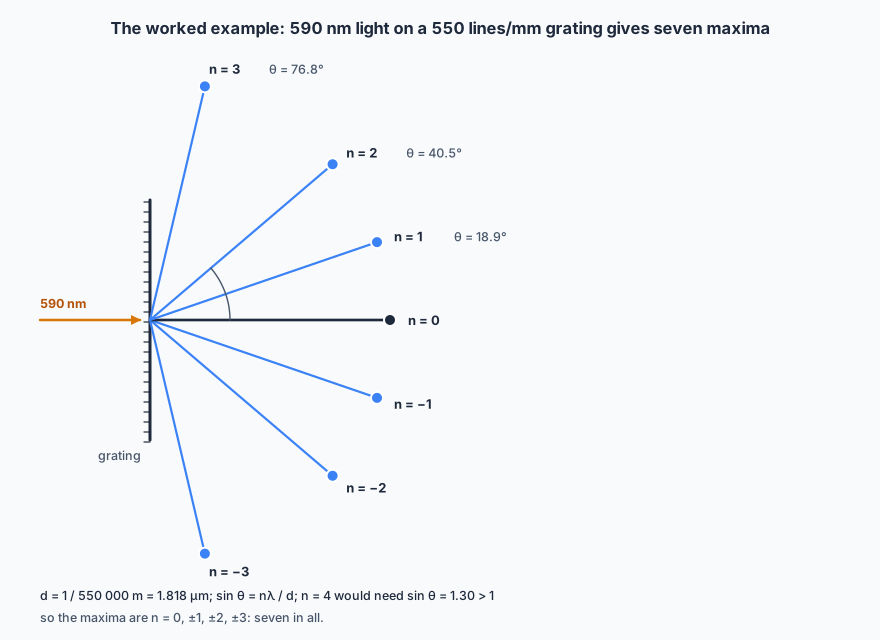
\( d = 1/(550 \times 10^{3}\ \text{m}^{-1}) = 1.818 \times 10^{-6} \) m.
\( \sin\theta = n\lambda/d = 2 \times 590 \times 10^{-9}/1.818 \times 10^{-6} = 0.649 \), so \( \theta = 40.5^\circ \).
For the highest order, \( \sin\theta \le 1 \) gives \( n \le d/\lambda = 3.08 \), so \( n_{\max} = 3 \). Counting both sides and the zero order, seven maxima can be seen.
🔭See it happen
A ripple tank shows diffraction through a variable gap better than any animation, because you can widen the gap continuously and watch the curvature of the wavefronts decrease until, at a gap much wider than the wavelength, it almost vanishes. For stationary waves, a signal generator, a stretched string and a strobe let students see nodes that genuinely do not move. Two polarising filters and a phone screen make Malus’s law a thirty-second demonstration.
🔗Go deeper — other people’s work
The links below are not mine. They are here because they are good, and they may move or disappear without warning.
- PhET, Wave Interference and Waves Intro — the two-source view makes coherence visible.
- The Physics Classroom, “Wave Basics” and “Light Waves and Colour”.
- Isaac Physics, “Waves” problem sets.