The Verb "To Be": am, is, are
🎯What you will be able to do
- Choose am, is or are for every subject.
- Use the short forms I'm, she's, they're in speech.
- Make negatives (isn't, aren't) and questions (Are you ...?).
- Give your name, age, nationality, job and feelings with be.
📚The grammar
1. Am, is, are
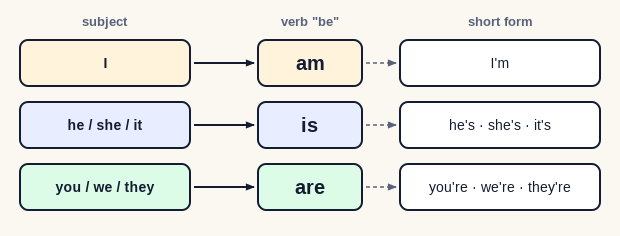
- I am a student. → I'm a student.
- You are my friend. → You're my friend.
- He is from Surabaya. → He's from Surabaya.
- She is twelve years old. → She's twelve.
- It is cold today. → It's cold today.
- We are in class 7B. → We're in class 7B.
- They are happy. → They're happy.
A name or a noun works like he, she, it or they: Rina is a doctor. My parents are at home.
2. What comes after be?
English sentences need a verb. When there is no action verb, be is the verb. After it you can put:
| After be | Example |
|---|---|
| a noun (job, thing) | My mother is a nurse. |
| an adjective (description, feeling) | The test is easy. I'm hungry. |
| a place | The keys are on the table. |
| an age | I'm fourteen. |
| a nationality / origin | We're Indonesian. We're from Bandung. |
3. Negatives: add not
Long I am not · you / we / they are not · he / she / it is not
Short I'm not · you aren't · he isn't (or you're not, he's not)
- I'm not tired.
- She isn't at school today.
- They aren't from Japan. They're from Korea.
- I amn't tired. — this form does not exist; say I'm not.
4. Questions: swap the subject and the verb
Statement You are ready.
Question Are you ready?
| Question | Short answer: yes | Short answer: no |
|---|---|---|
| Are you a student? | Yes, I am. | No, I'm not. |
| Is he your brother? | Yes, he is. | No, he isn't. |
| Is it expensive? | Yes, it is. | No, it isn't. |
| Are they ready? | Yes, they are. | No, they aren't. |
In a short yes answer, do not use a short form: say Yes, I am, never Yes, I'm.
With a question word, the word goes first: Where are you from? How old is she? What is your name?
5. Introductions with be
AyuHi, I'm Ayu. What's your name?
TomI'm Tom. Nice to meet you.
AyuWhere are you from, Tom?
TomI'm from Australia. I'm Australian. Are you from Bali?
AyuNo, I'm not. I'm from Lombok. This is my friend, Wayan. He's from Bali.
Countries and nationalities
| Country | Nationality | Country | Nationality |
|---|---|---|---|
| Indonesia | Indonesian | Japan | Japanese |
| Malaysia | Malaysian | China | Chinese |
| Australia | Australian | the UK | British |
| Korea | Korean | the USA | American |
| the Netherlands | Dutch | France | French |
Countries and nationalities always start with a capital letter: Indonesian, not indonesian.
🇮🇩 Catatan untuk penutur bahasa Indonesia
- Bahasa Indonesia sering tidak memakai kata kerja di kalimat seperti "Dia pintar". Bahasa Inggris wajib memakai be: She is smart, bukan She smart.
- Jangan menggabungkan be dengan kata kerja biasa: I am go ✘ → I go ✔ (atau I am going, lihat A2.1).
- "Saya berumur 15 tahun" = I am 15, bukan I have 15 years.
- Kata ganti dia dibedakan: he (laki-laki), she (perempuan), it (benda/hewan).
✎Worked example
Step 1, the subject. My brother and I is two people, so it works like we: the verb is are.
Step 2, the second clause. we not at home has no verb. Add are before not.
Step 3, punctuation. Two full sentences need a full stop (or and), not a comma.
My brother and I are very busy. We aren't at home.