The Present Continuous
🎯What you will be able to do
- Form the present continuous with am/is/are + -ing, with correct spelling.
- Use it for actions now, temporary situations and changes.
- Choose between present continuous and present simple.
- Recognise state verbs (know, like, want) that are not normally used in the continuous.
📚The grammar
1. Form
Positive I am / he is / they are + working.
Negative I'm not working. · She isn't working. · We aren't working.
Question Are you working? — Yes, I am. / No, I'm not. · What are you doing?
2. Spelling of -ing
| Rule | Examples |
|---|---|
| Most verbs: + ing | read → reading, eat → eating, play → playing |
| Silent -e: drop e + ing | make → making, write → writing, come → coming (but see → seeing) |
| One vowel + one consonant, stressed: double | sit → sitting, run → running, swim → swimming, begin → beginning |
| -ie → y + ing | lie → lying, die → dying |
3. Uses
- Now, at this moment: Be quiet! The baby is sleeping.
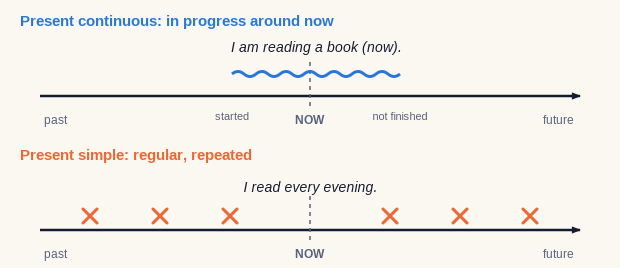
- Around now (this week, these days): I'm reading a book about volcanoes. — not at this second
- Temporary situations: My cousin is staying with us this month.
- Changes and trends: The weather is getting hotter. Your English is improving!
- Annoying habits, with always: He's always losing his keys!
- Future arrangements (see A2.3): We're flying to Jakarta on Friday.
4. Present continuous or present simple?
| Present simple | Present continuous |
|---|---|
| habits, routines: I usually walk to school. | now: Today I'm taking the bus. |
| permanent: She lives in Medan. | temporary: She's living in Bali this year. |
| signal words: always, usually, every day, on Mondays | signal words: now, right now, at the moment, today, this week, Look!, Listen! |
5. State verbs
Some verbs describe states (thoughts, feelings, possession, senses), not actions. They normally stay in the simple form even when we mean "now".
Common state verbs: know, understand, believe, think (= have an opinion), like, love, hate, want, need, prefer, belong, own, have (= possess), seem, mean, remember.
- I know the answer.
- I'm knowing the answer.
- I think it's a good idea. — opinion = state
- I'm thinking about my holiday. — the process of thinking = action
- She has two cats. / She's having lunch. — have = eat is an action
Listen: a phone call
MumHi, Dani. What are you doing?
DaniI'm studying for my maths test. Rina is helping me.
MumGood. Is your brother doing his homework too?
DaniNo, he isn't. He's playing games in his room, as usual!
MumHmm. I'm coming home now. I'm driving, so I can't talk long.
🇮🇩 Catatan untuk penutur bahasa Indonesia
- Bahasa Indonesia memakai "sedang" — tetapi bahasa Inggris memerlukan dua bagian: be + -ing. I studying ✘ → I am studying ✔.
- Sebaliknya jangan menambahkan be pada present simple: I am study every day ✘ → I study every day ✔.
- "Saya sedang tahu" tidak wajar dalam kedua bahasa — begitu juga I'm knowing.
✎Worked example
Usually → routine → drives. This month → temporary → is working. Need is a state verb → needs.
Usually Pak Made drives a taxi, but this month he is working on a building site because his taxi needs repairs.