Pronouns, Possessives and This/That
🎯What you will be able to do
- Use subject pronouns (I, he) and object pronouns (me, him) in the right place.
- Show who owns something with my/your/his, mine/yours/his and 's.
- Point to things near and far with this, that, these and those.
📚The grammar
1. The pronoun table
| Subject (before the verb) | Object (after the verb / preposition) | Possessive adjective (+ noun) | Possessive pronoun (alone) |
|---|---|---|---|
| I | me | my | mine |
| you | you | your | yours |
| he | him | his | his |
| she | her | her | hers |
| it | it | its | — |
| we | us | our | ours |
| they | them | their | theirs |
2. Subject or object?
The subject does the action and comes before the verb. The object receives the action, or comes after a preposition such as with, for, to.
- She helps me. — she = subject, me = object
- I help her.
- Come with us! — after the preposition with
- This present is for them.
- Me and him are friends. → He and I are friends.
It is for things, animals and weather/time: It's raining. It's nine o'clock.
3. Possessive adjectives: my, your, his ...
These go before a noun. They never take -s and do not change for plural nouns.
- This is my phone.
- Is that your bag?
- Ahmad loves his cat. — his = belongs to a man
- Dewi loves her cat. — her = belongs to a woman
- The school is proud of its students. — its, no apostrophe
- Our classroom is big. Their classroom is small.
4. Possessive pronouns: mine, yours, hers ...
These stand alone, with no noun after them.
- Is this pen yours? — Yes, it's mine.
- That isn't my umbrella. It's hers.
- It's mine pen. → It's my pen. / It's mine.
5. The possessive 's
One owner name/noun + 's: Rina's book · my brother's room
Plural -s noun + ': my parents' house · the students' books
Irregular + 's: the children's toys · the women's team
This is Budi's bike. Whose phone is this? — It's Maya's.
6. This, that, these, those
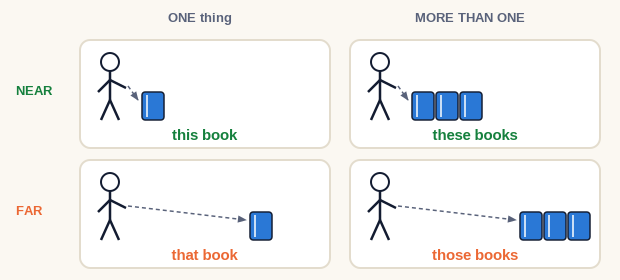
- This is my brother. — introducing someone next to you
- These shoes are new.
- What's that? — It's a lighthouse.
- Those people are tourists.
The verb follows the number: this is, these are, that is, those are.
🇮🇩 Catatan untuk penutur bahasa Indonesia
- "Dia" bisa he atau she — tentukan dari jenis kelamin orangnya. Kesalahan "my mother, he ..." sangat umum.
- "-nya" bisa berarti his, her, its, atau their. Pilih berdasarkan pemiliknya: Rina dan tasnya = Rina and her bag.
- Bahasa Indonesia meletakkan pemilik di belakang ("buku Rina"); bahasa Inggris di depan: Rina's book.
- "Ini" = this/these, "itu" = that/those; jangan lupa bentuk jamaknya.
✎Worked example
This — one person, near (and the verb is is). She — subject of is. my — before the noun cousin. Her — before the noun parents. them — object of visits.
This is Lisa. She is my cousin. Her parents live in Medan, and Lisa visits them every year.