Countable and Uncountable Nouns, Some and Any
🎯What you will be able to do
- Tell countable from uncountable nouns, including tricky ones like advice and money.
- Use some and any in positives, negatives, questions, offers and requests.
- Choose much, many, a lot of, a few and a little.
- Count uncountables with a bottle of, a piece of, a cup of, and order food politely.
📚The grammar
1. Countable and uncountable
| Countable (a/an, plural -s) | Uncountable (no a/an, no plural) |
|---|---|
| an apple, two apples · a chair · an egg · a job · a suitcase · a coin · a song | rice · water · bread · milk · sugar · money · information · advice · news · homework · furniture · luggage · music · work · weather |
Uncountable nouns take a singular verb: The news is good. This information is useful.
- Can you give me some advices? → some advice / a piece of advice
- I have many homeworks. → a lot of homework
- Our luggages are heavy. → Our luggage is heavy. / Our suitcases are heavy.
2. Containers and pieces
To count an uncountable noun, count the container or the unit:
- a bottle of water, two cups of coffee, a glass of juice
- a bowl of rice, a slice of bread, a piece of cake
- a kilo of sugar, a packet of noodles, a can of soda
- a piece of advice, a piece of information, a piece of furniture
3. Some and any
Positive some: There's some milk. I bought some eggs.
Negative any: There isn't any milk. I didn't buy any eggs.
Question any: Is there any milk? Did you buy any eggs?
Offer / request some: Would you like some tea? Can I have some water?
4. How much? How many?
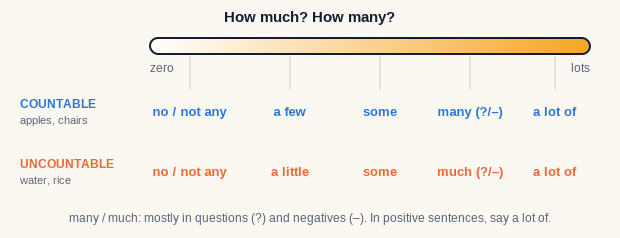
- How many people are coming? — Not many. Only a few.
- How much time do we have? — Not much. Only a little.
- There are a lot of tourists in August.
- Hurry! We don't have much time.
A few / a little = some, enough (positive). Few / little without a = not enough (negative): I have a few friends here, so I'm happy. vs Few people came, so the party was boring.
Too much / too many = more than you want: There's too much sugar in this tea. There are too many cars. Enough = the right amount: We have enough chairs.
Listen: ordering food
WaiterGood evening. Are you ready to order?
GuestYes, please. Could I have the chicken satay and a bowl of rice?
WaiterOf course. Would you like anything to drink?
GuestI'd like a glass of mango juice, please, with not too much ice.
WaiterAnything else?
GuestDo you have any vegetarian dishes? My friend doesn't eat meat.
WaiterYes, we have some. I'd recommend the gado-gado.
GuestPerfect. And could we have the bill at the end, please?
I'd like (= I would like) is a polite way to say I want when you order or ask.
🇮🇩 Catatan untuk penutur bahasa Indonesia
- Beberapa kata yang bisa dihitung dalam bahasa Indonesia tidak bisa dihitung dalam bahasa Inggris: advice, information, news, homework, furniture, luggage.
- "Banyak" = many (bisa dihitung) atau much (tidak bisa dihitung); dalam kalimat positif lebih wajar a lot of.
- "Saya mau ..." di restoran terdengar kurang sopan sebagai I want; pakai I'd like atau Could I have.
✎Worked example
rice is uncountable → a lot of rice (positive sentence). milk → a little milk. two breads → two loaves of bread (or two rolls). Question → any; eggs are plural → Are there any eggs?
We need a lot of rice, a little milk and two loaves of bread for sandwiches. Are there any eggs?