The Present Simple
🎯What you will be able to do
- Make positive sentences, including the -s/-es ending for he, she, it.
- Make negatives with don't / doesn't and questions with do / does.
- Say how often with always, usually, sometimes, never.
- Talk about your daily routine and what you like and don't like.
📚The grammar
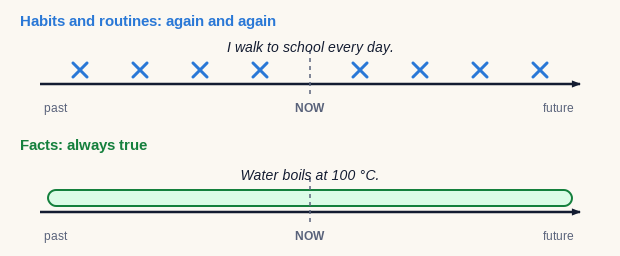
1. When do we use it?
2. Positive
I / you / we / they play football.
he / she / it plays football.
| Spelling of the -s ending | Examples |
|---|---|
| Most verbs: + s | work → works, eat → eats, read → reads |
| -s, -sh, -ch, -x, -o: + es | watch → watches, wash → washes, go → goes, do → does, fix → fixes |
| consonant + y: y → ies | study → studies, fly → flies (but play → plays) |
| Irregular | have → has |
- I get up at six o'clock.
- My father works in a hotel.
- She watches TV after dinner.
- My brother studies at university.
- Our cat has green eyes.
3. Negative: don't / doesn't + base verb
I / you / we / they don't (do not) like spicy food.
he / she / it doesn't (does not) like spicy food.
After doesn't the verb goes back to its base form — the -s has moved to does.
- He doesn't eat meat.
- He doesn't eats meat. — only one -s per sentence
- He not eat meat. — you need doesn't
4. Questions: Do / Does + subject + base verb
| Question | Yes | No |
|---|---|---|
| Do you like coffee? | Yes, I do. | No, I don't. |
| Does she speak Japanese? | Yes, she does. | No, she doesn't. |
| Do they live near here? | Yes, they do. | No, they don't. |
With a question word: Where do you live? What time does the bus leave? What does "pantai" mean in English?
5. How often? Adverbs of frequency
| always 100% | usually | often | sometimes | rarely | never 0% |
They go before the main verb but after be:
- I always have breakfast.
- She usually walks to school.
- We are never late. — after be
- Do you often go to the beach?
Longer expressions go at the end: I play badminton twice a week. We visit my grandmother every Sunday.
6. Likes and dislikes
like, love, hate, enjoy + noun or + verb-ing:
- I love music. I like listening to music.
- My sister doesn't like cooking.
- Do you enjoy swimming?
Listen: Rudi's day
1Rudi lives in Denpasar.
2He gets up at half past five every morning.
3He has rice and eggs for breakfast and takes the bus to school.
4School starts at seven and finishes at two.
5In the afternoon he usually plays football with his friends.
6He doesn't watch much TV, but he sometimes plays games on his phone.
7He goes to bed at ten.
🇮🇩 Catatan untuk penutur bahasa Indonesia
- Kata kerja bahasa Indonesia tidak berubah. Dalam bahasa Inggris, subjek he/she/it (atau satu nama) membuat kata kerja ber--s: Ani likes.
- Kalimat tanya tidak cukup dengan intonasi naik ("You like coffee?"). Gunakan Do/Does: Do you like coffee?
- "Tidak" sebelum kata kerja = don't/doesn't, bukan not saja.
✎Worked example
(a) Subject = my mother = she → doesn't. The -s moves to does, so teaches → teach: My mother doesn't teach English.
(b) Does goes first, then the subject, then the base verb: Does your mother teach English? — Yes, she does.