Modal Verbs: can, could, should, must, have to
🎯What you will be able to do
- Use the modal grammar rules: base verb after, no -s, no do.
- Talk about ability now and in the past (can, could, be able to).
- Ask for and give permission, and make polite requests.
- Give advice with should and talk about rules with must, have to, mustn't and don't have to.
📚The grammar
1. Modal rules
Positive subject + modal + base verb: She can swim. (not cans, not can to swim)
Negative + not: can't / cannot · couldn't · shouldn't · mustn't
Question modal + subject + verb: Can you swim? Should I go?
Have to is not a true modal: it changes (has to, had to) and uses do: Do you have to …? She doesn't have to …
2. Ability: can, could, be able to
- I can speak three languages.
- My grandmother can't use a smartphone.
- When I was six, I could ride a bike. — past ability
- I'll be able to drive next year. — future: will be able to
Pronunciation: in positive sentences can is weak ("kn"); can't is strong ("kahnt"/"kænt"). Listen: I can come. · I can't come.
3. Permission and requests
- Can I open the window? — friendly
- Could I use your pen, please? — more polite
- May I come in? — formal
- Can you help me? / Could you speak more slowly, please? — asking someone to do something
Answers: Sure. / Of course. / Go ahead. Sorry, you can't. / I'm afraid not.
4. Advice: should
- You should drink more water.
- You shouldn't stay up so late.
- What should I do? / Should I tell her?
- I think you should see a doctor. — softer
5. Obligation: must, have to, mustn't, don't have to
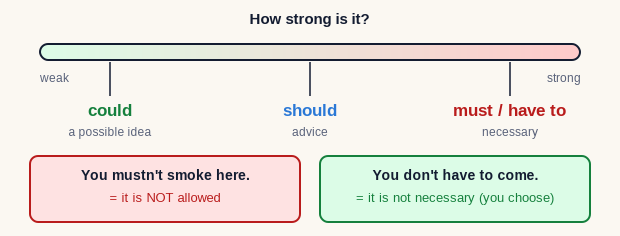
- You must wear a helmet. — a rule, or the speaker's strong opinion
- I have to wear a uniform at school. — an outside rule
- You mustn't use your phone in the exam. — forbidden
- We don't have to go to school on Sunday. — not necessary
- Yesterday I had to wait for an hour. — past: had to (must has no past form)
Listen: at the doctor's
DoctorYou have a bad cold. You should rest for two days.
PatientCan I go to school tomorrow?
DoctorI think you should stay at home. And you must take this medicine three times a day.
PatientDo I have to take it before meals?
DoctorNo, you don't have to. But you mustn't take it on an empty stomach.
🇮🇩 Catatan untuk penutur bahasa Indonesia
- mustn't = "tidak boleh / dilarang"; don't have to = "tidak perlu / tidak harus". Ini bukan sinonim!
- "Bisa" bisa berarti can (kemampuan) atau may/might (kemungkinan): "Besok bisa hujan" = It might rain tomorrow, bukan It can rain.
- Jangan menambahkan to: I can to swim ✘ → I can swim ✔.
✎Worked example
(a) obligation → Students must wear a uniform. / have to.
(b) forbidden → You mustn't smoke.
(c) not necessary → Students don't have to bring exercise books on Fridays.
(d) advice → You should arrive ten minutes early.