Numbers, Days, Months and Telling the Time
🎯What you will be able to do
- Say numbers from 0 to 1,000,000 and tell -teen from -ty.
- Use ordinal numbers (first, second, third) for dates and order.
- Name the days and months and say a full date.
- Ask and tell the time in two ways, with the right preposition (at, on, in).
📚Numbers
1. Cardinal numbers
| 0 zero | 1 one | 2 two | 3 three | 4 four | 5 five |
| 6 six | 7 seven | 8 eight | 9 nine | 10 ten | 11 eleven |
| 12 twelve | 13 thirteen | 14 fourteen | 15 fifteen | 16 sixteen | 17 seventeen |
| 18 eighteen | 19 nineteen | 20 twenty | 30 thirty | 40 forty | 50 fifty |
Note the spellings forty (no u) and fifteen, fifty. From 21 to 99, join with a hyphen: twenty-one, forty-five, ninety-nine.
-teen or -ty? Listen to the stress
- 13 thirTEEN · 30 THIRty
- 14 fourTEEN · 40 FORty
- 15 fifTEEN · 50 FIFty
Big numbers
- 105 — one hundred and five (British English adds "and")
- 2,500 — two thousand, five hundred
- 1,000,000 — one million
Hundred, thousand, million take no -s after a number: three hundred, not three hundreds. English uses a comma for thousands (1,500) and a point for decimals (2.5 = "two point five") — the opposite of Indonesian.
Phone numbers are said one digit at a time; 0 is often "oh": 0812 345 678.
2. Ordinal numbers
Ordinals show order: who is first, which floor, which day of the month.
| 1st first | 2nd second | 3rd third | 4th fourth | 5th fifth |
| 8th eighth | 9th ninth | 12th twelfth | 20th twentieth | 21st twenty-first |
Most ordinals just add -th. The irregular ones are first, second, third (and the spelling of fifth, eighth, ninth, twelfth).
📅Days, months and dates
Days: Monday, Tuesday, Wednesday, Thursday, Friday, Saturday, Sunday.
Months: January, February, March, April, May, June, July, August, September, October, November, December.
Days and months always begin with a capital letter. Wednesday is said "WENZ-day".
Saying the date
Write 17 August 2026 (UK) · August 17, 2026 (US)
Say the seventeenth of August / August the seventeenth
Year 2026 = twenty twenty-six · 1998 = nineteen ninety-eight
- My birthday is on the third of May.
- Independence Day is on the seventeenth of August.
- What's the date today? — It's the twenty-first of October.
At, on, in for time
| at | on | in |
|---|---|---|
| clock times: at 7:00, at noon at night, at the weekend (UK) | days and dates: on Monday, on 5 June, on my birthday | months, years, seasons: in July, in 2026, in the morning |
🕐Telling the time
Ask: What time is it? or What's the time? Answer with It's ...
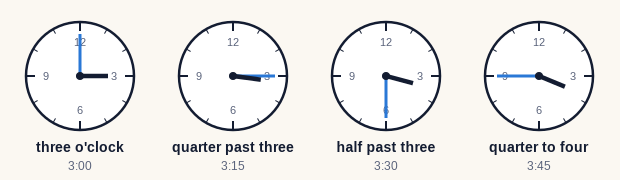
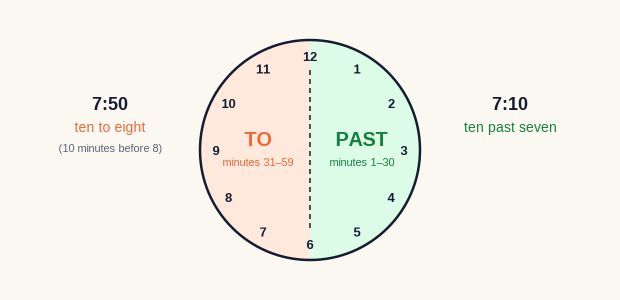
The simple way, very common and always correct, is to read the digits: 7:50 — It's seven fifty. 3:15 — It's three fifteen. For minutes 1–9 say "oh": 6:05 — six oh five.
a.m. = morning (midnight to noon), p.m. = afternoon and evening. Spoken English rarely uses the 24-hour clock: 19:00 is seven p.m. or seven in the evening.
🇮🇩 Catatan untuk penutur bahasa Indonesia
- "Setengah delapan" artinya 7:30, tetapi dalam bahasa Inggris 7:30 adalah half past seven (setengah lewat tujuh). Jangan katakan "half eight" untuk 7:30.
- Pemisah angka terbalik: Rp 1.500,50 ditulis dalam bahasa Inggris sebagai 1,500.50.
- Urutan tanggal Inggris (UK) sama: hari–bulan–tahun; tetapi Amerika: bulan–hari–tahun. 03/05 bisa 3 Mei atau 5 Maret!
- Pakai bilangan bertingkat untuk tanggal: the first of May, bukan the one of May.
✎Worked example
A day → on; a clock time → at. 14/9 is the date, so use an ordinal: the fourteenth of September. 7:45 is 15 minutes before 8, so quarter to eight (or seven forty-five).
The concert is on Saturday, the fourteenth of September, at a quarter to eight in the evening.