Adjectives, Adverbs and Describing
🎯What you will be able to do
- Describe appearance, personality, places and weather.
- Put two or three adjectives in the natural order.
- Form adverbs of manner (-ly, irregular well, fast, hard).
- Choose between -ed and -ing adjectives (bored / boring).
📚The grammar
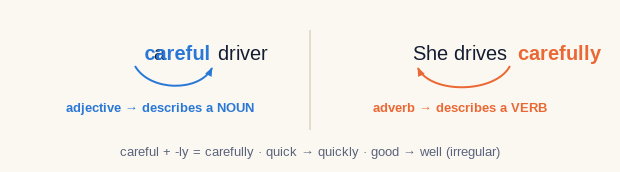
1. Adjective or adverb?
| Rule | Examples |
|---|---|
| adjective + ly | slow → slowly, quiet → quietly, careful → carefully |
| -y → -ily | easy → easily, happy → happily |
| -le → -ly | terrible → terribly, gentle → gently |
| irregular | good → well, fast → fast, hard → hard, late → late, early → early |
- She's a good singer. She sings well.
- He works hard. — hardly means "almost not": I hardly slept.
- He speaks English very good. → very well
After be, look, seem, feel, taste, smell, sound use an adjective, because it describes the subject: You look tired. This soup tastes delicious.
2. Describing people
| Appearance | Personality |
|---|---|
| tall, short, medium height · slim, well-built · long / short / curly / straight hair · young, middle-aged, elderly | friendly, kind, funny, shy, confident, lazy, hard-working, honest, patient, generous, rude, polite |
Two questions, two meanings: What does she look like? (appearance) — She's tall, with long black hair. What is she like? (personality) — She's really friendly and funny.
3. Describing places and weather
- It's a quiet, peaceful village with narrow streets.
- The city is crowded and noisy, but exciting.
- What's the weather like? — It's hot and humid. / It's cloudy. / It's windy. / It's raining.
Weather nouns become adjectives with -y: sun → sunny, cloud → cloudy, wind → windy, rain → rainy, fog → foggy.
4. The order of adjectives
When you use several adjectives, opinion comes first and the most "fixed" facts come last:
opinion → size → age → shape → colour → origin → material → purpose + NOUN
- a lovely little old house
- a big black wooden box
- a beautiful Balinese silk scarf
In practice, use two or three adjectives at most.
5. -ed or -ing?
-ed = how a person feels. -ing = the thing that causes the feeling.
- The lesson was boring, so I was bored.
- I'm interested in history. History is interesting.
- I am boring in this class. — this means YOU make people bored!
More pairs: excited / exciting, tired / tiring, surprised / surprising, worried / worrying, confused / confusing.
🇮🇩 Catatan untuk penutur bahasa Indonesia
- "Bosan" = bored; "membosankan" = boring. Kesalahan I'm boring sangat umum dan lucu bagi penutur asli.
- "Dengan baik" = well, bukan good.
- Rupa vs. sifat: "Dia seperti apa?" bisa dua makna — gunakan look like (penampilan) atau be like (sifat).
✎Worked example
- a man nice → a nice man (adjective before noun).
- drives very slow → very slowly (adverb describes drives).
- is very patiently → very patient (after be → adjective).
- a old car red → an old red car (an before a vowel sound; age before colour).
My uncle is a nice man. He drives very slowly and he is very patient. His car is an old red car.