The Future: Will and Going To
🎯What you will be able to do
- Form will / won't and be going to in all three sentence types.
- Use going to for plans and intentions, and will for decisions made while speaking.
- Make predictions with both forms and offers and promises with will.
- Talk about arrangements with the present continuous.
📚The grammar
1. Forms
will I / she / they will ('ll) help. · won't (will not) help. · Will you help?
going to I'm / she's / they're going to study. · isn't going to study. · Are you going to study?
Will is the same for every person and is followed by the base verb (no to): She will come, not She will comes or will to come.
2. Plan or instant decision?
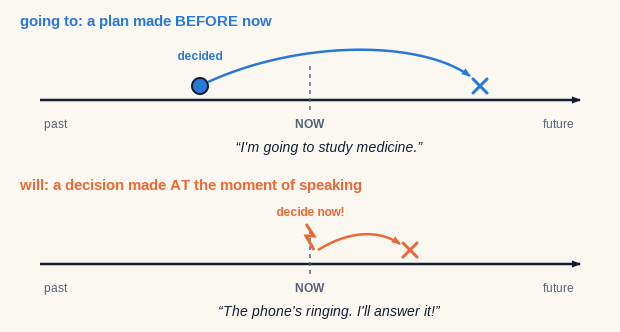
- going to — plan / intention: I'm going to visit my grandma this weekend. I bought the ticket yesterday.
- will — decision now: It's cold in here. I'll close the window.
- will — offer: That bag looks heavy. I'll carry it for you.
- will — promise: I won't tell anyone. I promise.
- will — request: Will you help me with this, please?
3. Predictions
- going to — evidence you can see now: Look at those black clouds. It's going to rain. Watch out! You're going to fall!
- will — opinion or belief: I think Indonesia will win. Don't worry, the test won't be difficult.
Will predictions often follow I think, I'm sure, probably, maybe: It will probably be sunny tomorrow. (Note the position: will probably, but probably won't.)
4. Arrangements: present continuous
For fixed plans with a time and place, especially with other people, English often uses the present continuous:
- I'm meeting Andi at the café at four.
- We're flying to Singapore on Friday.
- What are you doing tonight? — a very common question about plans
5. Future time expressions
tomorrow, the day after tomorrow, tonight, next week, next year, in two days, soon, later, this weekend
Listen: making plans
LiaWhat are you doing on Saturday?
BimaI'm going to clean my room in the morning. Why?
LiaWe're having a barbecue in the afternoon. Do you want to come?
BimaSounds great! I'll bring some drinks.
LiaThanks! I think it'll be really fun.
🇮🇩 Catatan untuk penutur bahasa Indonesia
- "Akan" tidak selalu = will. Rencana yang sudah diputuskan lebih wajar dengan going to: "Saya akan kuliah di Bandung (sudah daftar)" = I'm going to study in Bandung.
- Jangan lupa be: I going to ✘ → I'm going to ✔.
- Dalam percakapan, going to sering terdengar "gonna". Boleh dipahami, tetapi jangan ditulis di tulisan resmi.
✎Worked example
(a) Decided before speaking → are going to. (b) Decided at the moment → 'll. (c) Prediction from evidence you can see → is going to.