The Past Simple
🎯What you will be able to do
- Form regular past verbs and pronounce -ed as /t/, /d/ or /ɪd/.
- Use the most common irregular verbs.
- Make negatives with didn't and questions with did.
- Use was/were and past time expressions (yesterday, last week, ago).
- Tell a short story in order with first, then, after that, finally.
📚The grammar
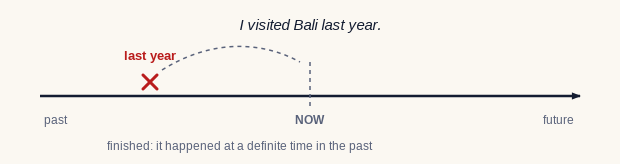
1. Regular verbs: + ed
| Rule | Examples |
|---|---|
| Most verbs: + ed | work → worked, play → played, watch → watched |
| Ending in -e: + d | live → lived, dance → danced |
| consonant + y: → ied | study → studied, try → tried (but play → played) |
| One vowel + one consonant, stressed: double | stop → stopped, plan → planned (but visit → visited) |
2. Three sounds of -ed
| /t/ after p, k, s, sh, ch, f | /d/ after voiced sounds and vowels | /ɪd/ after t and d (extra syllable) |
|---|---|---|
| walked | played | wanted |
| stopped | lived | needed |
| watched | cleaned | visited |
| laughed | opened | decided |
Only verbs ending in a t or d sound get the extra syllable. Walked is one syllable: "wokt", never "wok-ed".
3. Irregular verbs you need first
| be — was / were | go — went | have — had | do — did |
| get — got | make — made | see — saw | come — came |
| eat — ate | drink — drank | buy — bought | take — took |
| say — said | tell — told | give — gave | find — found |
| know — knew | think — thought | leave — left | meet — met |
| write — wrote | read — read | sleep — slept | swim — swam |
Read keeps its spelling but changes sound: present "reed", past "red".
4. Negatives and questions with did
Negative I / she / they didn't + base verb: She didn't go.
Question Did + subject + base verb: Did you see it? — Yes, I did. / No, I didn't.
Wh- Where did you go? · What did she buy?
- We didn't watch TV last night.
- We didn't watched TV. — the past is already in didn't
- What did you eat for breakfast?
5. Was and were
Be does not use did: I was tired. They were at the beach. Was it fun? — Yes, it was. We weren't late.
I / he / she / it → was; you / we / they → were.
6. Time expressions
- yesterday, yesterday morning
- last night, last week, last year — no "the", no "in"
- two days ago, a long time ago — ago goes after the time
- in 2019, on Monday, at nine o'clock
7. Telling a story
Sequence words help the listener: First, … Then, … After that, … Finally, …
1Last Saturday, my family went to Bedugul.
2First, we visited the temple on the lake. It was very beautiful.
3Then we had lunch at a small restaurant. I ate grilled fish.
4After that, it started to rain, so we bought hot drinks and waited.
5Finally, we drove home. We didn't arrive until eight, but we were happy.
🇮🇩 Catatan untuk penutur bahasa Indonesia
- Bahasa Indonesia memakai keterangan waktu ("kemarin saya pergi") tanpa mengubah kata kerja. Bahasa Inggris wajib mengubahnya: Yesterday I went, bukan Yesterday I go.
- Jangan memakai was/were dengan kata kerja lain: I was go ✘ → I went ✔.
- "Dua hari yang lalu" = two days ago (ago di belakang), bukan ago two days.
✎Worked example
The answer is a thing → What. Past simple with a normal verb → did. After did, the verb returns to the base form: bought → buy.
What did Ketut buy last week? — A new guitar.
Yes/no version: Did Ketut buy a new guitar? — Yes, he did.